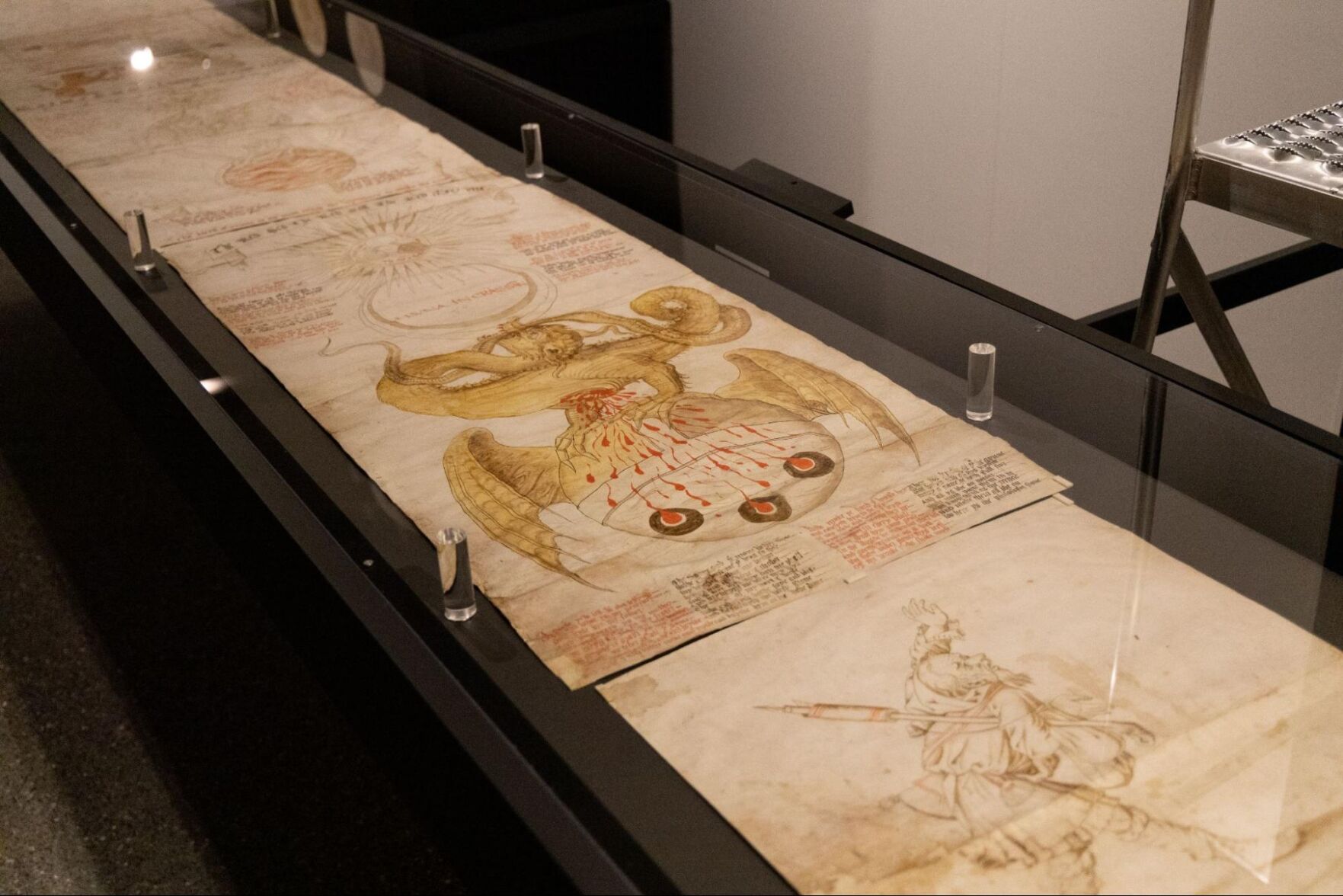
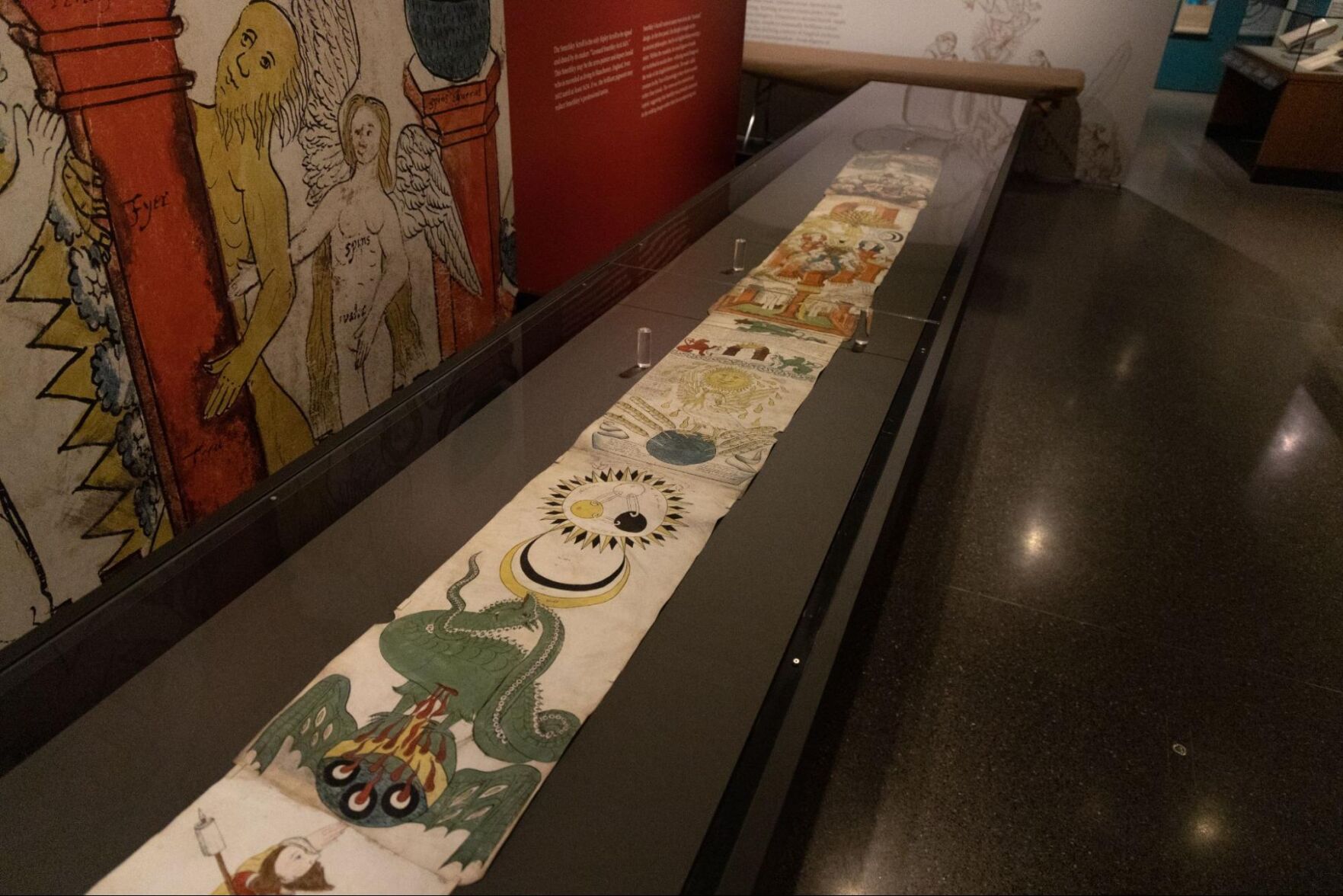
Unrolled and read from top to bottom, the Ripley Scrolls are messages, copied over centuries, from philosophers practicing the “science of change” known as alchemy. Rather than being painted as fools for pursuing early theories like the ability to transmute base metals into gold and silver, or creating the life elixir for immortality known as the Philosophers’ Stone, early practitioners produced imaginative works dating back to the 15th century.
Two of these Ripley Scrolls are at the center of the Princeton University Library exhibition “Through a Glass Darkly: Alchemy and the Ripley Scrolls, 1400–1700,” which is on view through July 17 at the Ellen and Leonard Milberg Gallery in the Firestone Library.
The exhibition curator and associate professor of history Jennifer M. Rampling has a Ph.D in history and philosophy of science from University of Cambridge. Her studies there were focused on the history of alchemy, and English alchemist George Ripley, whom the scrolls are named for.
Rampling’s interdisciplinary background, as she prefaced, is “quite suitable” in approaching alchemy because of not only the history, but the law and literature subject matter that helps inform the practice. What compelled her to learn more about alchemy was coming across one of Ripley’s poems, the “Compound of Alchemy,” in 1999.
The famous piece, written in 1471, is noted by Rampling as being “largely allegorical,” talking about alchemy as if it’s a castle with 12 gates. To go onto the next stage and reach the center, each gate needs to be opened, using that imagery to discuss twelve chemical processes including calcination, sublimation, and dissolution.
“What really fascinated me about this poem was that Ripley seemed to know what he was talking about. It seemed to be internally coherent, but at the same time, I had no idea what he was talking about,” she said. Seven years later, she started her Ph.D on the topic.
Now, Rampling said that she feels she has a handle of Ripley’s view of alchemy, “specifically the kind of practices that he was trying to bring to life.”
She also added that Ripley “may, or may not, even had anything to do with the Ripley Scrolls named after him, because there’s no evidence Ripley actually made them himself.”
“By the 16th century, Ripley was so famous that almost anything that’s English and alchemical tends to get associated with him. But the fact is, and this is something I’ve discovered during my research, is the alchemy of the Ripley Scroll is really close to the alchemy of George Ripley in his attested works. There’s a clear overlap in practice,” she explained of the provenance, but the approach was also “popular in the late 15th century, so it doesn’t have to be the same person.”
“If you’ve really come a hundred years later to associate that with a particular guy, you’re going to assume he was the author. It’s a tricky historical conundrum. I’d love to know who really made them,” Rampling said.
The exhibit is available to the public every day from noon to 6 p.m. until July 17. Guests must sign in and self-attest to their vaccination status. Information on the exhibit, as well as when guided tours will be held, can be found at library.princeton.edu/alchemy.
As quoted on a wall in the exhibit, the name “Through a Glass Darkly” is a reference to the New Testament, 1 Corinthians 13:12, where apostle Saint Paul said the following: “For now we see through a glass, darkly; but then face to face: now I know in part; but then shall I know even as also I am known.”
Besides serving as a literal parallel to the alchemists’ use of glass apparatuses, the title is a reference to how alchemical works are more than their surface appearances, requiring a lifetime of studying to gain a proper grasp on the symbolism, as Rampling explained.
“The Ripley Scroll design itself is this fusion of alchemical imagery and religious imagery. There were so many allusions to scripture in the design. You’ve got that Garden of Eden with the alchemical serpent, you’ve got the book of the seven seals,” Rampling said. “Think about Genesis and revelation—they bookend the entire Bible, at least in the form we have now, so it seemed very appropriate to use that biblical quotation,” she said.
Alchemy was always meant to be somewhat inaccessible, Rampling added, as only those with the most extensive knowledge of practices, gained through years of experience, were intended to interpret allegorical imagery like the Ripley Scrolls.
“The idea that when you’re young, you don’t understand what you see, but then you get older and wiser and then you understand—that’s the essence of alchemical philosophy, really, the idea that most people don’t understand. They just see the pretty images and they think it’s weird, or they think it’s fraudulent, but they don’t really understand the secret. Only the ‘true Alchemist,’ ‘a true philosopher,’ will be able to understand that,” she said.
This is where the exhibit, which was supposed to open two years ago in April 2020, helps bridge that divide. During that same year the pandemic postponed her curated work, the professor released a book, “The Experimental Fire: Inventing English Alchemy, 1300-1700” that expands on the background of English alchemy.
“Ripley Scrolls aren’t meant to be read. We’re not meant to understand them. You’re supposed to spend years and years studying alchemical books before you know what it means, so I wanted people to understand the Ripley Scrolls a bit better. But that’s really hard. So the challenge was to build the exhibition around those two scrolls in such a way that people can get a bit of insight into what they [mean] and why,” she said.
During her research, Rampling has examined all 23 of the known Ripley Scrolls, two of which she identified herself. By December of 2017, the only one she had not seen was the 1624 Ripley Scroll copied by Leonard Smethley.
The scroll was in private hands before it came up for auction at Christie’s of London. When Christie’s approached her about the sale, Rampling suggested to Princeton University Library (PUL) that they should purchase the last scroll on the market. The library had already owned a 16th century scroll for almost a century at the time, but, Rampling said, “no other North American institution had two.”
PUL won the bid for the 17th-century parchment scroll, securing it for the collection. Rampling began putting together the exhibit, seeking to aid both academics and the general public in comprehending the pieces.
“At first glance, it’s not obvious what they’re all about, and certainly not obvious that they allude to anything practical,” she said. “I wanted to use the exhibition to explain what these objects are, what they were doing in their own time, why they were important, why people thought they were worth copying, but also, what the underlying practices are.”
Prior to the 18th century, “alchemy encompassed a host of chemical operations — it was essentially the chemistry of its day,” Rampling continued.
“For a long time, it was viewed as a valid subject of academic inquiry. It never actually got on to the medieval university curriculum, but you have medieval scholars — philosophers — arguing about how transmutation works, and what’s the theory of metals that would make that possible. That alchemical theory of metals became the mathematical theory of the 16th, and part of the 17th century.”
Then, Rampling said, during the 18th century, alchemy was no longer deemed academic because of the philosophers’ belief in transmutation.
“The most common approach, at least in transmutation, is to use metals. Gold and silver often get used as ingredients, which means it’s quite expensive to do alchemy,” she explained. But those were, and still are, expensive materials, meaning philosophers either had to have some level of wealth, or seek patronage, which was the issuing of licenses or sponsoring of alchemical projects by English royals.
“People at every level of society were interested in alchemy. We have craftsmen, artisans, who are using techniques they might have learned in their own trade to try and manipulate metals,” Rampling said.
“You have university-educated physicians who have the independent income to study alchemy, but who also find it useful for their own work, for instance, using distillation to make remedies. Among princes and nobles, it’s quite common in 16th century Europe, for instance, in England, in the German states, or in Italy, to hire alchemists to do projects. You can actually be hired to do alchemy and nothing but, or you can do it on the side — but your day job is paying for it, whether it’s your craft or medicine,” she pointed out, comparing it to how venture capital investments function in the modern era.
“The way it works in alchemy is you approach your potential patron, you pitch your project to them, you have to convince them that you’re good at what you do, that alchemy really works, that it really is a legit enterprise and not just some kind of nonsense,” Rampling said. These common misconceptions might have led to why philosophers are often illustrated as wise sages in the scrolls, giving visual credence to their work.
The two Ripley Scrolls are “stars” of the exhibit. Rampling suggested for people to go to the middle of the room where they are set up side by side, then take in how the “two objects, which ostensibly have the same design, actually differ from each other in so many ways.”
The changes in copy are seen through contrasting colors, imagery, text, and other features definitive of the times; all details that Rampling confirmed are not random — they represent a later reader “trying to interpret an alchemical tradition” through their own lens.
“I love comparing the Ripley Scrolls,” Rampling said, adding that the more you survey them, the more details you can discover. Even her students point out new aspects, enriching the experience and informing everyone about the science of the past.
“One of my favorite pieces of the design [is that] towards the bottom, there’s a dragon. It’s called the serpent of Arabia,” she said of the 1624 scroll. “It’s biting, sinking its jaws into this crescent moon, and above it is the sun. It’s another way of talking about gold and silver, sun and moon being dissolved by the solvent. But if you just tried to represent a solvent naturalistically, it would just look like anything—it could just be liquid, it could be water, it could be blood. You can’t tell from a manuscript image what it’s meant to be. But if you show a ferocious serpent, it’s pretty obvious it’s a solvent. It’s devouring and dissolving the metals.”
Elements are also shown through twists on biblical scenery, with two figures, in a scene evocative of Adam and Eve in the Garden of Eden, representing the “chemical wedding” of sulfur and mercury.
“I love the way that sometimes alchemical imagery, it’s not naturalistic, but it cuts to the chase and tells you this is what these substances do, and that’s what you need to know,” she said.
“The rest of the exhibition serves to help you, the visitor, also understand how to interpret this strange, abstruse tradition — so that instead of just looking at it like an outsider, as someone who thinks alchemists are all clowns wearing a jester’s hat, will see that while alchemy may have been ultimately misguided in its aims — in that its aims mostly are not physically possible to achieve — these were serious people. They were doing science by the standards of their day. They were investigating the structure of matter. They were interested in the past and trying to recover what they thought was a lost history of English alchemy, and they’re trying to use that history to make their own way in their own times.”
Rampling’s next book, “The Hidden Stone,” is specifically about the Ripley Scrolls. Rampling, who is from the northwest of England, spent time as a research fellow at Cambridge before arriving at Princeton in 2014. She gained tenure in 2020.
As long as the Ripley Scrolls are available for viewing, Rampling can communicate how to learn from the alchemists, despite their speculative beliefs.
“I hope that by cracking open some of the secret language of the Ripley Scrolls, visitors to the exhibition will just get that little bit of extra insight into the past, because past people aren’t a lot different from us. They want to make a living. They want to be rich. They want to have good health, and we all want to have good health at the moment. Having an amazing cure or remedy is quite a useful thing to have right now. Alchemy is an aspirational science.”
She reflected that the philosophers’ attempts at securing funding for their alchemical practices are relatable, especially when medieval England lacked trained doctors.
“You can see how in that environment, people might want to turn to alchemical medicine as a cheaper option and make it at home,” Rampling said, noting how similar nonprofessional remedies grew popular during the COVID-19 health crisis.
Even with no philosophers’ stone in sight, Rampling keeps that tradition of keeping information, and encouraging interpretation, ongoing.
“Historians of alchemy like myself, we’ve become the next rungs in this ladder. The only difference is that I don’t believe in transmutation. I don’t believe it’s going to work. But I do believe that attempting to follow the instructions of these earlier writers can give me special insight into what they were doing. It’s clear from my own experiments that these people weren’t totally misguided. The early steps are often quite convincing. The problem is when you try to go all the way, the instructions just become a little bit too opaque.”
What is an enduring, crystalline fact is that the alchemical objects in the exhibit, particularly the two Ripley Scrolls, are historical artifacts that the Princeton University Library can now prominently feature in their collection — in part because of Rampling’s expertise.
Through a Glass Darkly: Alchemy and the Ripley Scrolls 1400-1700, Ellen and Leonard Milberg Gallery, Firestone Library, Princeton University Library. Through July 17. Guided tours on Tuesdays, June 14 and 28, at 12:30 p.m.; Saturday, June 4, at 1 p.m.; and Sunday, June 5, at 1 p.m. library.princeton.edu/alchemy
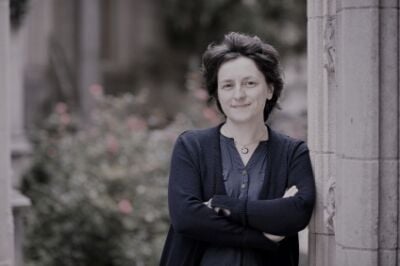
Professor Jennifer Rampling is the curator of ‘Through a Glass Darkly,’ on view through July 17 in the Milberg Gallery. Photo by Sameer Khan, Fotobuddy.,