Mary Street is one of those quaint streets in Bordentown where colorful row houses are attached like the pearls on a necklace. Each pearl in the neighborhood is individually unique with appearances in all shapes and sizes.
This is the case with one home that happens to be the narrowest in the state. Built in 1890, the home measures just 11 and a half feet wide. More than likely, it was built to fill the space between two homes, rather than creating an alley.
Another interesting home is a simple cottage with flanking wings. The property maintains a postage-stamp sized yard where its neighbors are devoid of such luxury. Built in 1854, it was the long-time residence of William and Susan Waters.
Born in Binghamton, New York, in 1823, Susan and her younger sister Amelia grew up in a loving Quaker environment with their parents, Lark and Sally Moore. A cooper by trade, the Moores were firm believers in a good education but couldn’t afford to pay for their daughters’ tuition when they moved to Friendsville, Pennsylvania to attend the prestigious Friendsville Boarding School for Females.
As a result, young Susan, demonstrating a natural ability for the pen and paintbrush, paid the tuitions through art created for her natural history class. This is the only known documented artistic instruction that she received during her life.
In 1841, she married a local boy from Friendsville named William Waters. Like her family, William encouraged her to develop her talent to its fullest extent as a portrait painter. However, it wasn’t long before William’s physical well being deteriorated to the point that he had no choice but to quit the mercantile business where he worked. Any income for the couple’s livelihood squarely rested on Susan’s shoulders. The situation proved to be both a blessing and a burden.
From 1843-45, Susan traveled by carriage with art supplies and paint to nearby towns along the border of New York State and Pennsylvania, in the hope that potential customers would sit for her portraits. After knocking on doors in towns like Cannonsville, Kelloggsville, Oxford, Berkshire and Richford, she quickly gained recognition as a very fine artist.
Painting on fabric, using cotton or linen, she would draw the outline of her subject directly on a light-colored background to resemble skin tone. Then she inserted the facial features. Her particular attention to detail meant applying white accents to the eyes, nose, cheeks, and mouth followed by thinly veiled contours of dark shadowing to give the oil portrait texture and balance.
Finally, later portraits were set against outdoor landscapes instead of a column or interior drapery. This theme would be prevalent as her art style changed.
In 1852, Susan and her husband moved to Bordentown. Although they didn’t know much about the town, they did know that it had a strong faith-based affiliation with the Religious Society of Friends.
In 1854, they bought land on Mary Street for $150 and built a simple cottage. However, they only stayed a year before deciding to move to Iowa where a relative resided. In turn, the relative bought the home as a formality in the event that Susan and her husband ever decided to return.
After settling in the Midwest Quaker community for several years, they did not return to Bordentown, but chose to move back to Friendsville. It wasn’t until after the turbulence of the Civil War ended that they finally returned and bought back their cottage.
The war had changed the mood of the country and shifted the national economy from an agricultural society to an industrial society. In essence, this also changed Susan’s perspective about art. Her career as a portrait artist now focused on sophisticated images of animals and still life.
As she watched noisy factories grow and plumes of constant smoke from brick stacks rise above the Bordentown skyline, she brought sheep into her back yard, constructed a deer pen, and began to paint them on canvas in a naturalist style that was never attempted by artists before. Other subjects like dogs, cows, fowl, chipmunks, and squirrels were often drawn in playful scenes thus becoming part of her artistic portfolio.
The greatest triumph of Susan’s career came in 1876, when she was honored with an invitation to showcase some of her artwork in both the Women’s Pavilion and the Art Pavilion at the Centennial Exhibition in Philadelphia. Known as “Pets of the Studio,” this series of animal paintings were fondly admired by the public.
Although she managed to collect several hundred dollars for her reasonably priced creations, she reserved the right to paint one copy each of her blue ribbon winners. She was not attracted to the desire of wealth but rather to the desire of achievement in knowing that her paintings graced the fireplaces of many homes.
Since she did not have any children of her own, she considered her creations as substitutes that were lovingly nurtured and maintained by those willing to display them. It is no wonder then that she became an early proponent of animal rights as well as the women’s suffrage movement. In 1871, she was elected as recording secretary of the New Jersey Women’s Suffrage Association.
In 1893, her husband passed away, leaving the cottage on Mary Street in his will to her. She resided in the home until 1899 when she moved to a care facility for Quakers in Trenton. The following year, she died and was buried in the Bordentown Cemetery alongside her husband and parents.
She left the majority of her estate and personal effects to her niece, the only child of her sister. Her paintbrush never rested against a canvas again.
It’s unclear as to how many paintings she accomplished during her life time. Only 80 or so survive and can be found in many art museums and private collections, including the Bordentown area. Her legacy to the world exceeded more than her impact on art. It’s fighting for what’s right and being accepted as an equal.
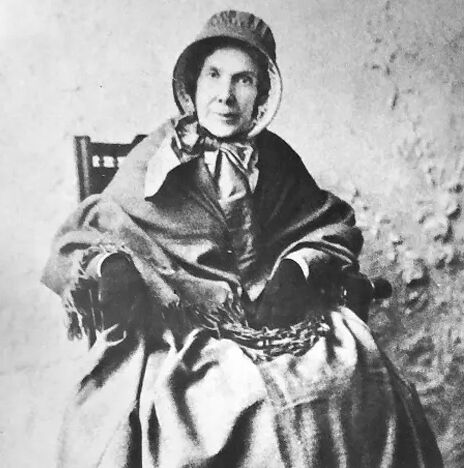
Photo of Susan Waters. (Courtesy of the Bordentown Historical Society.),

