There is nothing more basic and important than safe drinking water. That is why the State of New Jersey needs to take over Trenton Water Works to ensure that the ongoing problems there find a permanent solution.
The mayors of Hamilton, Lawrence, Ewing and I made this clear to the Department of Environmental Protection in October. In response, DEP issued a unilateral order instituting direct oversight and monitoring of the system, including embedding a third-party adviser to monitor and assess all system operations and maintenance.
Shortly after the unilateral order was announced, the NJ Department of Health notified the public that multiple sites in the TWW service area have tested positive for legionella bacteria. Following up on cases of Legionnaires’ Disease in areas of Hamilton Township served by TWW, NJDOH had proactively sampled the water from a wide swath of territory served by TWW from volunteer homeowners, including three sites in Hopewell Township.
These new test results emphasize that more needs to be done at Trenton Water Works. While DEP’s actions last month are a good first step to fix immediate operational problems, longer term financial issues remain a concern, and the Trenton City Council in the past has voted down important investments in the utility. Legislative action needs to ensure that the safe drinking water of 225,000 people is not held hostage by how the political winds blow in Trenton.
To this end, I testified at a hearing of the New Jersey Assembly Telecommunications and Utilities Committee on Oct. 17. I urged the Committee members to put in place concrete and sustainable solutions that ensure operational and financial stability at the utility. Importantly, the legislation needs to ensure that Trenton City Council can’t vote down the financial needs of TWW.
I look forward to working with our legislative representatives and surrounding cities and towns to ensure that these changes become reality. We will not rest until this is accomplished.
To read more about the Assembly hearing, go to hopewelltwp.org/CivicAlerts.aspx?AID=1099.
To read more about what DEP is doing to address the problems at TWW, including the text of the unilateral administrative order, go to dep.nj.gov/trentonwater.
Information on legionella
Getting sick from legionella bacteria is rare, but is possible when water is aspirated into the lungs, which is the only way to get Legionnaire’s Disease from legionella. When small water droplets are aerosolized – for example, during showers, using hot tubs or decorative fountains – legionella bacteria could be inhaled. In nature, legionella bacteria live in freshwater and rarely cause illness. Most healthy people do not get Legionnaires’ disease after being exposed to legionella. Current or former smokers, those who suffer from a lung disease such as COPD, or have a weakened immune system have greater susceptibility.
People cannot get Legionnaires’ disease from drinking their water or from being around someone else with the disease.
Conditions that promote the growth of Legionella include water temperature, stagnant water, and sediment. Hopewell Township Health Officer Dawn Marling strongly recommends all TWW customers set their hot water heaters to a minimum of 120⁰ F, which will reduce Legionella growth and minimize the potential for scalding.
Setting the heater to a higher temperature, such as 140⁰ F, may better control bacterial growth, but extra precautions are needed to avoid scalding. A mixing valve can be installed to reduce the risk of hot water burns.
Residents should also flush any faucets or showers that do not get used at least weekly (run the water for 3 minutes), and flush your water after any disruption to your home, for example low pressure or discoloration resulting from a water main break or nearby hydrant flushing.
It is also important to clean or replace household water filters per manufacturer’s instructions and to clean showerheads and faucet aerators (screens) whenever buildup is visible. Residents at high risk for illness should consider avoiding hot tubs, decorative fountains, power washing or similar activities which may generate increased amounts of aerosols or mists.
Residents with specific concerns can call the Hopewell Township Health Office at (609) 737-0120.
A complete list of public health recommendations, as outlined by the NJDOH, can be found at nj.gov/health/news/2022/approved/20221015a.shtml.
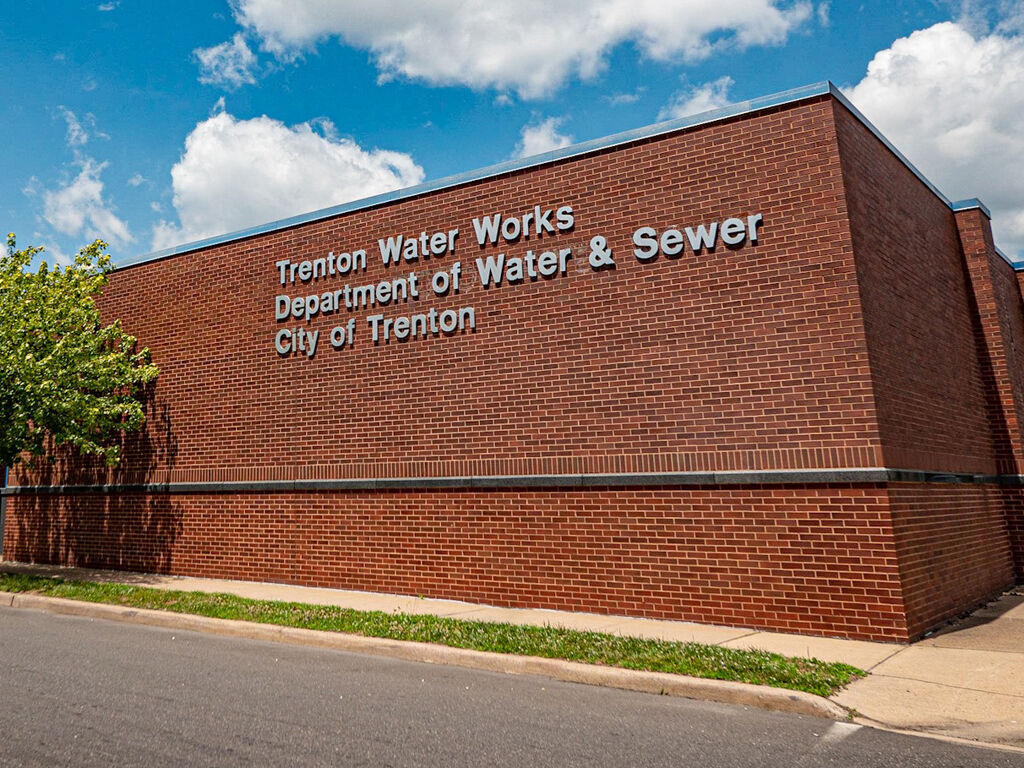
Trenton Water Works administrative building at 333 Cortland St., Trenton.,

