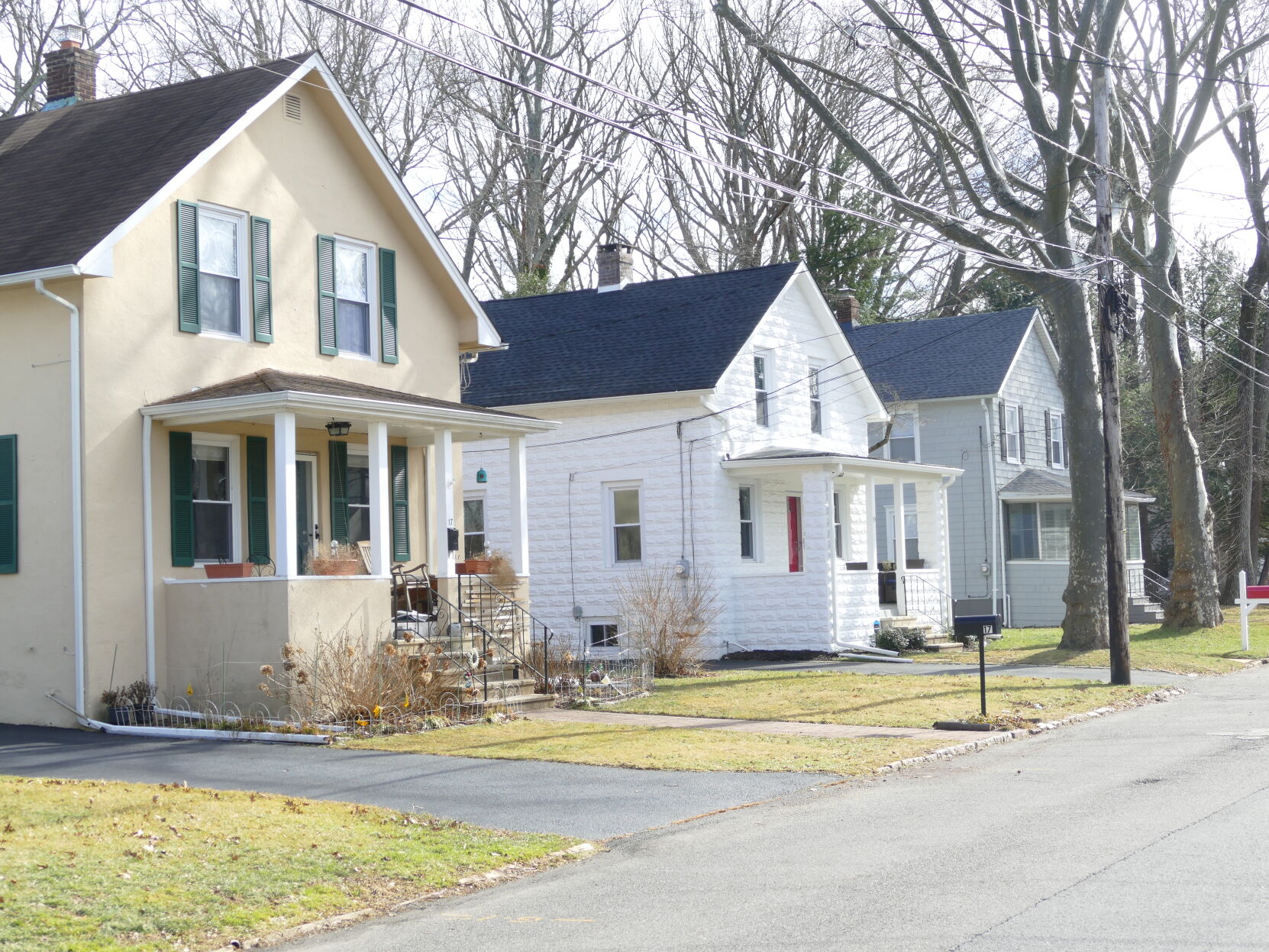
Today, the Historical Society of West Windsor—a 100% volunteer nonprofit that preserves and promotes local history—explores the history of West Windsor’s first suburban development, which many residents call home: Berrien City.
Also—2022 is West Windsor’s 225th birthday! The Historical Society is leading dozens of commemorative community projects and free-to-the-public events throughout the year. Visit westwindsorhistory.com/year-225 to learn more.
A city amid farmlands
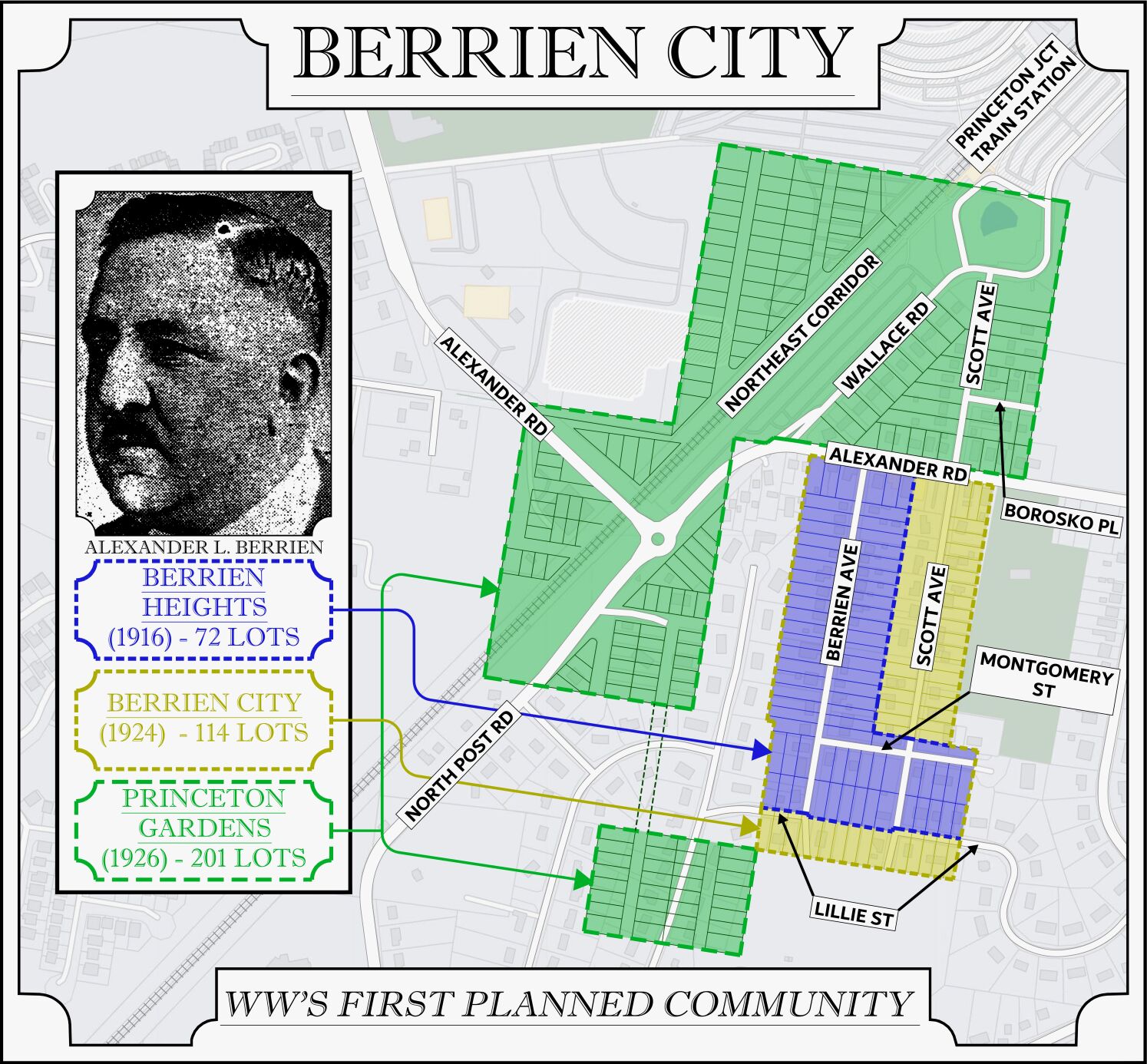
The idea for West Windsor’s first planned development—in what was then a town that had been dominated by a farming landscape since the mid-1700s, with farmland stretching as far as the eye could see – originated with a man named Montgomery Scott Berrien. In 1916, Montgomery presented plans to the Town Committee for a development he called “Berrien Heights” next to the former Elliot Nurseries—a plant distribution center straddling either side of the railroad tracks that operated from 1912-1919.
This development was designed to take advantage of its proximity to the Princeton Junction train station (itself built in the 1860s) and featured 72 properties with uniform lots, surrounding two new roads: Berrien Avenue and Montgomery Street, named after the Berrien family and Montgomery himself, respectively. According to township tax records, about sixteen homes date to the time of Berrien Heights, and about half a dozen predate the development.
Montgomery died in 1922, but by 1924, his son, Alexander, had purchased enough property to expand Berrien Heights from 72 to 114 lots, renaming it “Berrien City.” Like his father, he sold only the land itself to buyers, who built their own houses. Berrien City included three new roads — Lillie Street, Scott Avenue, and Emil Street—named after his sister, father, and brother-in-law, respectively. Alexander died in 1926 but his son, Alexander Jr., appears to have actually lived in Berrien City and, with the Princeton Bank & Trust Company, carried on his father’s business for several years.
Also in 1926, a real estate developer named Michael McLaughlin proposed a third community, called “Princeton Gardens.” The original plans featured 201 lots on both side of the railroad tracks. However, only part of the community—all east of the tracks – was actually developed, around the newly-constructed Wallace Road and the northern extension of Scott Avenue, as well as Emil Street and the railroad bridge.
Borosko place was also built, albeit named after a local family of Hungarian immigrants. Eventually, all three communities—Berrien Heights, Berrien City, and Princeton Gardens—became collectively known as “Berrien City.”
The Berrien City Fire Company
The West Windsor Fire Company formed in Dutch Neck in 1921 as our town’s first emergency service. However, only five years later, it was evident that more was needed to provide for the township, especially with the construction of Berrien City. So, in 1926, a group of locals formed the Berrien City Fire Company, which soon reorganized as the present-day Princeton Junction Volunteer Fire Company.
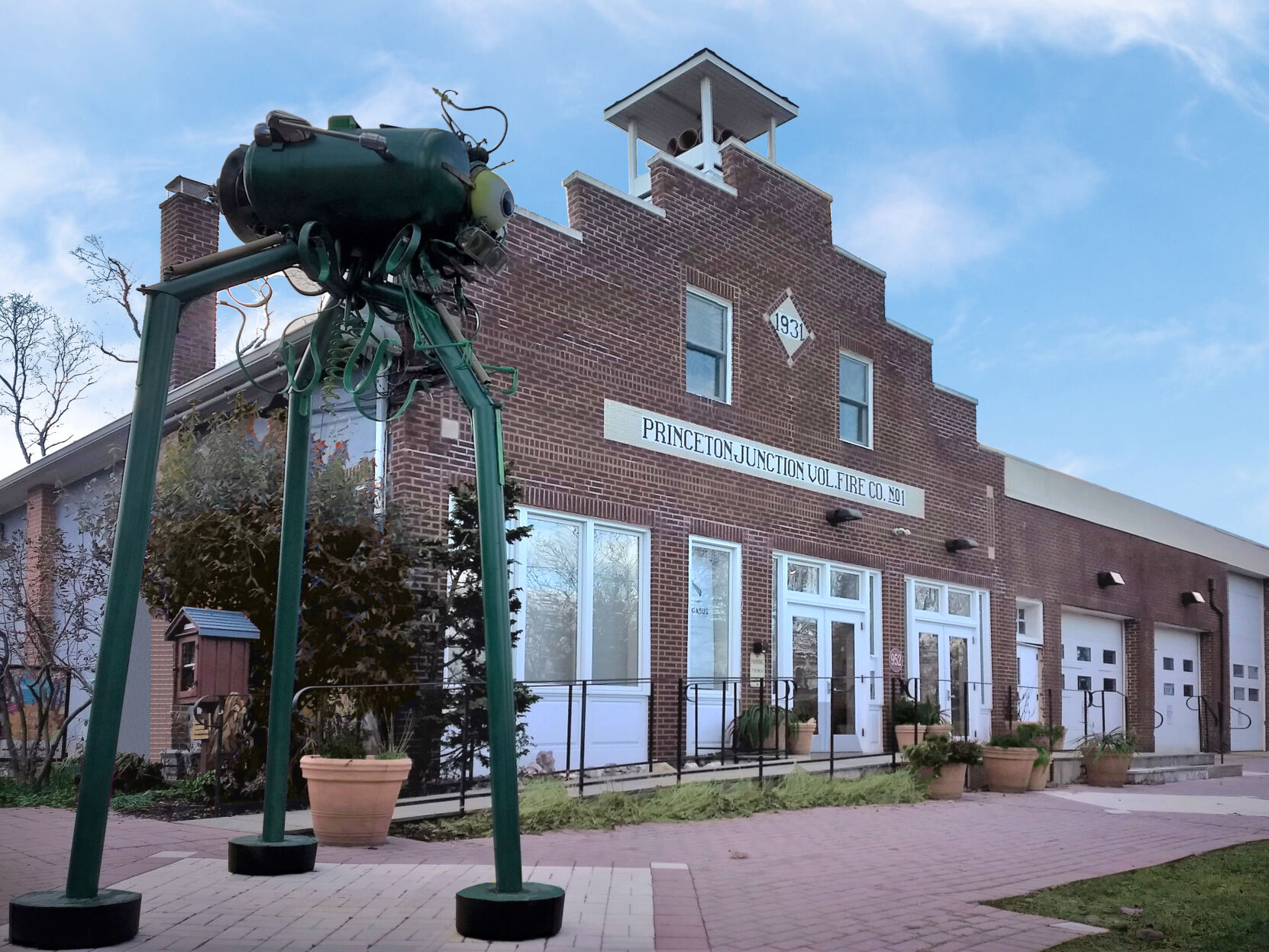
They erected a firehouse at 950-52 Alexander Road—in the heart of Berrien City—in 1931. Over the decades, the building was enlarged to accommodate ever-expanding equipment and personnel. At one point, this even required the relocation of a house from the intersection of Scott Avenue and Alexander Road to North Post Road.
Mid-1900s Growth
Berrien City itself also grew significantly over the decades as dozens of new families built dozens of new homes. Many of the brick houses were constructed by Charles Aversano, and many of the stucco houses were built by the Hall family. Locals talk of finding leftover materials from the Pennsylvania Railroad in their homes.
Several houses were built from modular kits purchased from Sears, Roebuck, Weyerhauser, and other companies. Family, friends, and neighbors occasionally helped with construction. Today, Berrien City features a cornucopia of architectural designs, demonstrating a level of individuality unique among West Windsor’s planned developments.
Berrien City also had its own water company. Around the intersection of Scott Avenue and Wallace Road, there was a fresh water spring. Residents filled jugs there for drinking, until it was capped in the 1970s.
Another water tower, with an electric pump, was located at the corner of Scott Avenue and Montgomery Streets at least as far back as the 1940s, if not earlier. During the winter, the tower often overflowed, forming ice sculptures. It was demolished many decades ago.
Berrien City’s sense of community has been evident throughout its existence. During the Great Depression, Bingo games at the Berrien City firehouse were popular. During World War II, the building also served as a Civil Defense station. In 1943, the local post office moved very briefly to the firehouse, then to the building directly next door, now occupied by Brother’s Pizza.
In the 1970s and 1980s, this same building housed an Italian restaurant called “Galleta’s Galley,” and before that “Howard’s Luncheonette.” Sal’s Shoe Repair Shop, directly adjacent, is another longtime business. A variety of local efforts – including, of course, the Berrien City Neighborhood Association – also helped to define the community’s identity.
John Forbes Nash, Jr.
Until recently, Berrien City was also home to one of West Windsor’s most famous residents—John Forbes Nash, Jr. Born in 1928, Nash was a mathematical genius who made fundamental contributions to humanity’s understanding on non-cooperative games, singularity theory, geometry, and much more, and even predicted many contemporary cryptographic concepts.
In 1994, Nash received the Nobel Prize in Economic Sciences based on his contributions to game theory. The next year, he became a Senior Research Mathematician at Princeton University. He won myriad other distinctions over the years.
Nash is also well known for his decades-long struggles with schizophrenia. These struggles, and Nash’s eventual (majority) recovery after many long years, were the subject of Sylvia Nasar’s 1998 book “A Beautiful Mind” and the film of the same name.
From around the 1970s onward, Nash and his family lived in Berrien City. He took the Dinky Line to work in Princeton and was a familiar local face. Nash Park nearby on Alexander Road is named after him. Sadly, he and his wife, Alicia, passed away in a car crash in 2015. However, their legacies, and Nash’s immense contributions to the world, persist.
Arts in the city
In 2002, the Princeton Junction Fire Company moved most of its operations from Berrien City to new and larger facilities on Clarksville Road. That same year, after being petitioned by local residents, Mayor Shing-Fu Hsueh convened the Mayor’s Art Center Formation Task Force, with the goal of turning the historic Berrien City firehouse into an arts center.
The West Windsor Arts Council formed in 2002, after months of work by enthusiastic and visionary community members. In 2010, the West Windsor Arts Center opened in the old Berrien City firehouse. The building – once the site of emergency calls, bingo nights, dances, and receptions – now hosts exhibitions, performances, classes, camps, and more for the community.
Berrien City today
Today, Berrien City, while part of West Windsor, retains a unique identity and sense of place. Its tree-lined avenues evoke the Elliot Nurseries of over a century past. Its proximity to the train station is a constant reminder of Princeton Junction’s 1800s-era roots. And most importantly, the neighborhood retains a strong sense of “community” that makes its history all the more worth memorializing.
To contact, support, or volunteer for the Historical Society, or to check out our new full-length West Windsor history book, visit westwindsorhistory.com. We are also on social media—search “@SchenckFarmstead” on Facebook and Instagram. Email us at westwindsorhistory@gmail.com.
Old houses in Berrien City, a community that is now over a century old.,