The caliber of the player is critical in several ways to “The Gin Game,” the neat, entertaining two-hander playing at the Bristol Riverside Theatre’s makeshift “pop-up” digs at Bristol’s Regency Room.
First, there’s the sense of competition when two sit down to a game of cards. Weller Martin (Keith Baker) takes refuge on the porch of the minimally appointed nursing home that is his unwelcome lot in later life, to escape from fellow denizens he finds vapid or dead behind the eyes. He occupies himself playing solitaire, cheating with reckless abandon to make the hand he’s dealt conform to a winning pattern.
Circumstances turn in his favor when a new resident, Fonsia Dorsey (Zuhairah), also retreats to the porch, ostensibly to water plants and take walks in the garden, and is invited — inveigled? — by Weller to join him in a friendly game of gin.
He fancies himself a master of both the etiquette and strategy of gin and figures the less experienced Fonsia will be an easy mark he can belittle or educate as hands dictate.
The rub is Fonsia never loses, prevailing even when Weller is nonplussed she violated cardinal rules of gin.
Now he has a challenge on his hands. So does Fonsia. Part of the fun and drama of D.L. Coburn’s comedy with serious overtones is how they meet and react to it.
Competition engenders company. Weller finds in Fonsia, and Fonsia in Weller, a combination of conversation and conflict that both foments and threatens their friendship, thereby providing the framework of Coburn’s play.
The give-and-take and the flares of personality, and pique, keep us engaged and make us wonder about the sustainability of the pair’s relationship, part of which is fueled by each being among the few residents of the nursing home either can stand.
Weller and Fonsia both prove to be in prime caliber as hard-nosed card players and as flinty individuals whose quirks and occasions of temper imperil Weller dealing out the hands, counting “one, one, two, two,” etc. as he distributes the first 21 cards of each game, 10 to him and 11 to Fonsia, who must begin the game by discarding one unnecessary card from her hand.
They also prove to be compatible, although each has a knack for disturbing the other’s peace, often doing so with purposeful relish.
The most important of any caliber, of course, is that of the actors taking on the roles of these reluctant retirees consigned to social work-conceived living, i.e. unimaginative, conventional, rule-bound, and potentially punitive, questionable food, less than stimulating company aside from the other, and the looming threat of terminal boredom, not to mention tenuous medical conditions.
“The Gin Game,” first performed in 1977 by the august couple, Hume Cronyn and Jessica Tandy — I saw them in it three times — depends on performers who can make the exchange of dealt and discarded cards interesting while rising to the moments when their character’s personality shows, perhaps unattractively, and creating more important moments when the actor fleshed out an idea Coburn plants or uses an expression or inflection that makes what seems like an ordinary conversational line into a comic or revealing gem.
Take joy on that account.
Bristol’s “The Gin Game” is richly blessed with the canny, inventive, and exquisitely timed turns of Keith Baker and Zuhairah as Weller and Fonsia. These two are not experienced hands at taking characters beyond the written page but accomplished in keeping an audience rapt to see what they’ll do next.
D.L. Coburn provides excellent fuel, and Jon Marans’ direction is smart and different in tone and pace from the dozen or so “Gin Games” I’ve seen over the past decades, but it is the absolute assurance and natural characterizations provided by Baker and Zuhairah that elevate Bristol’s production from a fine rendition of a reliable chestnut into a riveting display that is so realistic and honest that between Jason Simm’s flawless set, Linda B. Stockton’s perfect clothing, and Keith Baker and Zuhairah’s seamless performances, you might forget you’re in a theater but rather, visiting a nursing home observing two of the more interesting inmates in their daily routines and occasional outbursts.
It was Keith Baker, who in a random conversation that took place in an earlier century when we bumped into each other on Bristol’s Mill Street, explained to me the importance of letting a play breathe and letting sequences live in their own time.
It was a lesson that stayed with me and one I saw vividly realized as Baker and Zuhairah went through their scenes.
I often say “there’s no pro like an old pro,” and the wealth of the actors’ mutual experience radiated from the intimate Regency Room stage.
I mentioned Jon Marans’ production varied from other I’d seen.
It was softer. Both Weller and Fonsia have their moments of temper, both erupt at what today would be called triggers that harken back to their adult lives before the nursing home.
The difference is Baker and Zuhariah moved into their emotional, guarded, or revelatory selves from a place that seemed real, that was part of their behavioral pattern but one they preferred to suppress.
Baker was crotchety and cynical, as called for by Coburn’s script, but he conveyed those traits by staying in some control. He didn’t overdo, overstate, or exaggerate Weller’s flintiness. It sprang from similar moments, such as losing for the fourth hand in a row to the novice Fonsia, to having his accountability for segments of his family and professional life brought up, and from having to put up with conditions he finds intolerable because he can’t afford to avoid them.
Baker showed more of Weller’s breeding, more of his gentlemanly nature that nonetheless was riddled with impatience, frustration, and discontent with the general circumstances of his life.
Although Coburn constantly tells us Fonsia is hard, set in her ways, stubborn, and vindictive, all of which is true, Zuhairah only shows these traits when necessary. They are part of her character, the part that often defeats her best intentions, but they are not the totality of it.
Both Baker and Zuhairah play a range. Rather than retreat into quirks and foibles that are dramatic and flashy to play, they withhold the worst parts of their characters until they ugly heads can’t stay hidden.
It makes these lapses in their usual steadiness more poignant.
It also sets up some interesting reactions. I found myself laughing a lot at lines that were intrinsically funny — Coburn wrote them as humor — but had more than a tinge of seriousness in them. I call it laughing with a lump in the throat.
Of course, these lines would not have landed so successfully if Baker and Zuhairah weren’t masters at reading them.
Baker demonstrated Weller’s humor — witty, sarcastic, and observational — making every line count. Zuhairah can make you think butter had nothing on Fonsia for being sweet, practical, and enhancing, but that only make her zingers and her outburst when Weller makes her own up to her brittle, judgmental, unyielding side all the more frightening and pitiable.
Without stressing much, Coburn covers a lot of ground in showing the existence of elderly people who no longer have the freedom to live as they please because they don’t have the money to do it. In that, he taps into some of the biggest fears of the aging. “The Gin Game” is more about Weller and Fonsia than is about what the old face, but the specter of dependency and coping with the power of doctors, administrators, and a government that thinks it’s doing a favor is present and strikes home if subtly.
Coburn does pull a punch by saving his most incendiary fireworks for the last of four extended scenes. It is only then you learn things you’ve been curious about all along.
No matter. Baker, Zuhairah, and Marans rise to the occasion.
Coburn also likes irony. Fonsia claims she fears Weller will become violent when he launched into one of his poor loser tantrums that includes tossing over tables and throwing cards in the air. Yet the two times one character assaults the other, Fonsia is the perpetrator who slaps a face or pushes Weller to the ground.
Caliber of playing matters, and with this “The Gin Game,” Bristol has set a bar that is hard to equal.
The Gin Game, Bristol Riverside Theatre in the Regency Room, 190 Mifflin Street, Bristol, Pennsylvania. (The site is temporary while BRT renovates its regular house. The important thing left out of any directions is the Regency Room is in a fire house that takes up its entire block of Mifflin Street.) Through Sunday, September 29. Showtimes are Wednesday and Thursday, 7:30 p.m.; Friday and Saturday, 8 p.m.; Wednesday and Saturday, 2 p.m.; and Sunday, 3 p.m. $45. www.brtstage.org or 215-785-0100.
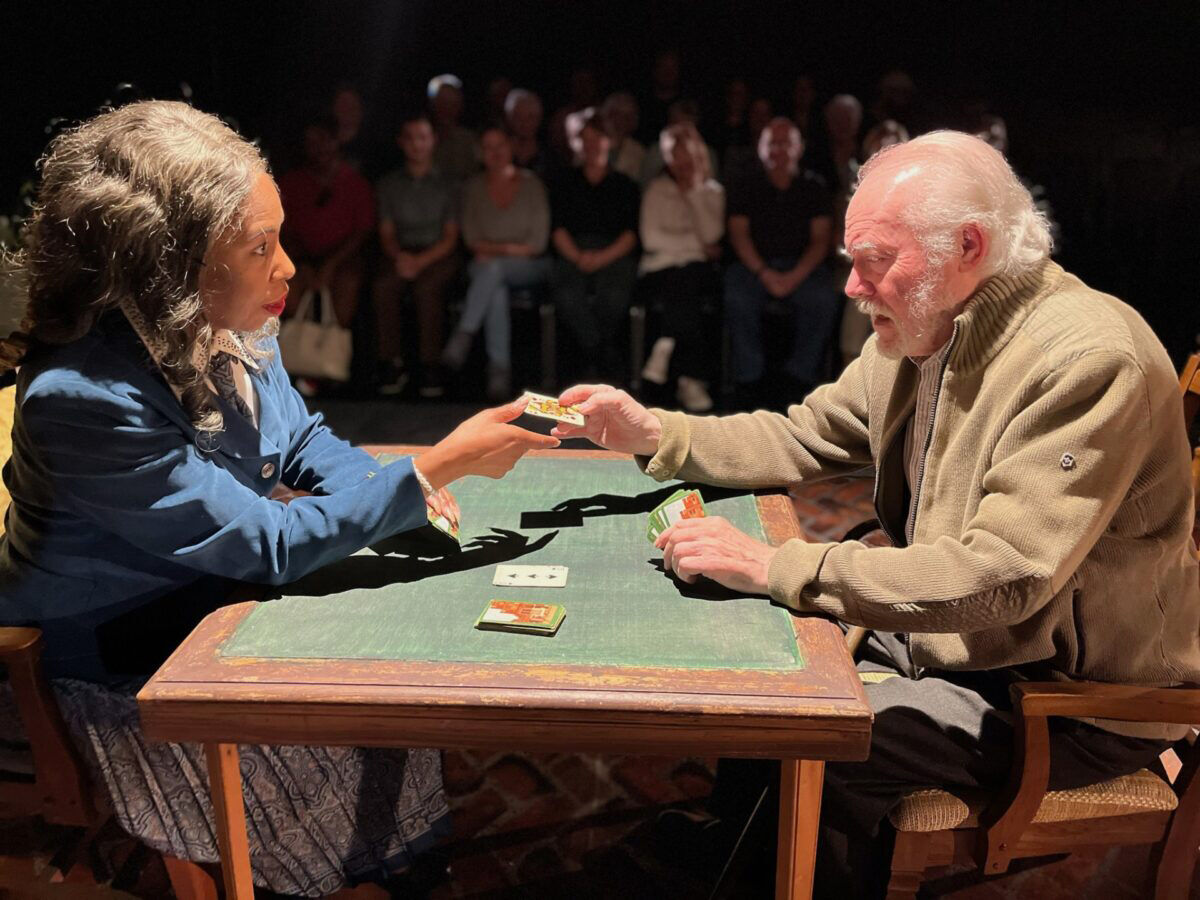
Zuhairah, left, as Fonsia and Keith Baker as Weller in ‘The Gin Game’ presented by Bristol Riverside Theater through Sunday, September 29.,

