The Princeton Symphony Orchestra’s 2024-25 season opened Saturday, September 14, with works by Tchaikovsky, Brahms, and contemporary composer Gemma Peacocke, and also featured an array of guest musicians from the Youth Orchestra of Central New Jersey.
2025 will mark conductor/music director Rossen Milanov’s 60th birthday, and he is programming some of his favorites all season to celebrate.
The evening of music began with “Manta” (2023) by Peacocke, a native of Aotearoa/New Zealand, who was inspired by Maori mythology about stingrays to create the composition.
As the piece launched, we heard the fluidity of the oboes, flutes, and clarinets, evoking ocean waves and currents, while the grandeur of the lower brass painted a sonic picture of the powerful and mysterious manta ray. Peacocke uses repetition to sustain the oceanic sensation of this work, and I wondered if she had been influenced by Philip Glass.
The piece rose to a rich crescendo with the full orchestra, sonorous and cinematic. A foray into a minor key was brief, as “Manta” came to its lovely conclusion, sweetened by a variety of winds, then solo violin.
Then came the virtuosic talents of violinist Aubree Oliverson, who absolutely aced Tchaikovsky’s familiar Violin Concerto in D Major, Opus 35 (1878). The soloist took the stage in a beautiful royal blue gown, adorned with yellow and pink flowers and a tiny bit of sparkle.
The work is familiar but never disappoints. Its unassuming intro quickly builds in emotion, volume, and intensity. You can understand why the concerto was once deemed “unplayable,” with its rapid-fire runs, venturing all over, into the very highest range of the instrument.
The solo cadenza, which employed both bowing and plucking, was rife with Eastern European tonalities. Oliverson played with such precision and joy, spot-on intonation and attention to the rising and falling volume of the piece. She made it look easy.
The audience was so moved by her playing — and the splendid PSO, which was in total sync with her — that we broke the cardinal rule and clapped after this stirring first movement. In fact, Oliverson got a standing ovation. She was just getting started, though.
The second movement provides a respite from the furor of the first, with its song-like melody. The flutes and clarinets provided a balance with the solo violin, as Oliverson explored the melancholy strain with feeling and control. The third movement arrived with a literal bang on the timpani, and exploded into a dynamic romp, full of energy.
The soloist, who had mentioned how much ballet she hears in the Tchaikovsky concerto, danced up and down the violin, summoning the spirit of Russian folk music. I also enjoyed watching Milanov command the PSO with grace and delight, as well as concertmaster Basia Danilova really get into the passion of the piece.
For the second half of the evening, in contrast to the impassioned Tchaikovsky, we heard the more grounded Brahms Symphony Number 4 in E Minor, Opus 98 (1884-85), considered to be a cornerstone of the symphonic repertoire.
The work opens with a four-note theme, which becomes significantly varied and developed throughout the first movement. I was especially drawn to the vivid use of the French horns, and one particular repeated horn motif, like a call to the hunt. The soaring strings were balanced with the more discreet woodwinds, as well as a fine interchange between the hushed tones of the solo flute, oboe, and bassoon.
The French horns shone again in the second movement, as a somber solo horn line was picked up by the clarinet, and traded back and forth between the two instruments. The melody then wandered through the cellos, then back to the woodwinds, all with the warm, noble harmonies that signify Brahms.
As the third movement began, I thought, “Yes!” Indeed, the progressive rock group Yes (their keyboardist Rick Wakeman) arranged and recorded excerpts from this passage of the fourth symphony. They titled it “Cans and Brahms,” which appeared on the 1971 album “Fragile.”
This was much brighter and more energetic than the previous movement, and had the spirit of Beethoven to it. As this powerful and likable passage grew in intensity, the sound merged a Classical-era essence with a more Romantic-era feeling.
The fourth and final movement embodied the perfect balance of heart and mind, tradition and emotion, which might describe Brahms himself.
Powerful chords in the combined brass stated the opening theme, which travelled throughout the orchestra, unfolding through more than 30 variations.
An exquisite flute solo by Sooyun Kim floated above the fray, and more superb solo French horn by Steven Harmon introduced the final strains of the symphony. The sound rose and rose in strength, with the full PSO exploring the brilliance of this singular Brahms composition.
The Princeton Symphony Orchestra will return Saturday and Sunday, October 19 and 20, with music by Beethoven, Prokofiev, and Abels. Rossen Milanov’s 60th Birthday Celebration will be the weekend of January 11-12, 2025, and features works by Stravinsky and Tchaikovsky. 609-497-0020 or www.princetonsymphony.org.
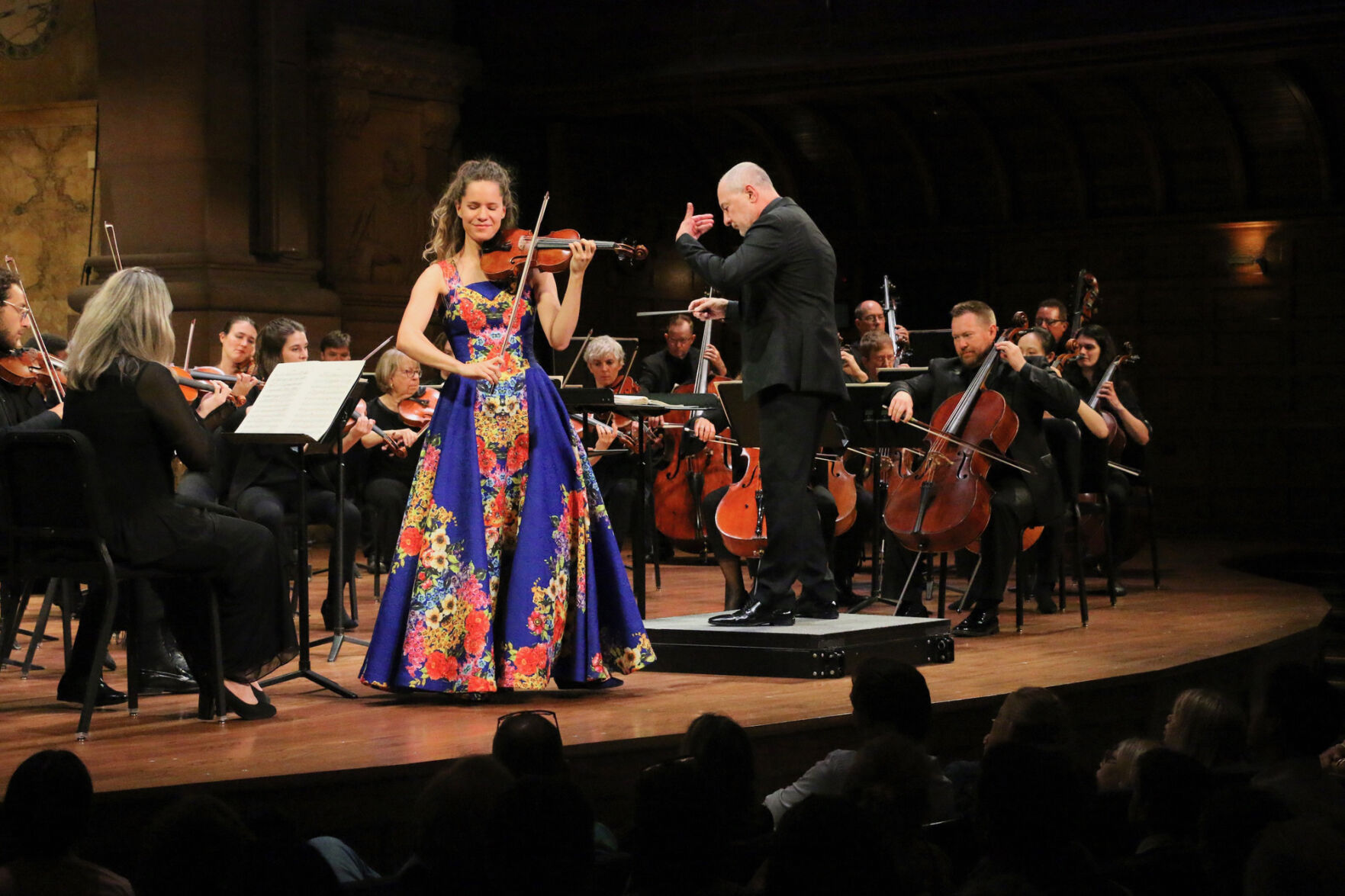
Violin soloist Aubree Oliverson, left, and conductor Rossen Milanov during PSO's performance of Tchaikovsky’s Concerto in D.,

