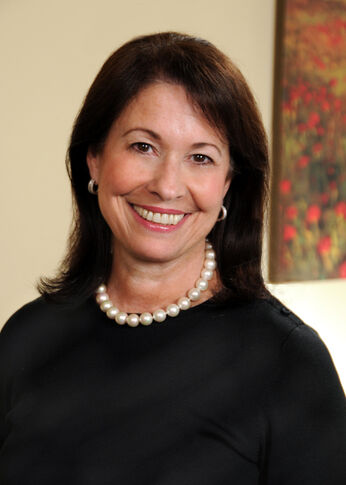
Judith Persichilli of Pennington in May 2013 was named the interim president and CEO of the new hospital group created by the merger of Catholic Health East and Trinity Health.
Pennington’s Judith Persichilli was named CEO of the Catholic Health East and Trinity Health merger.
Judith Persichilli always wanted to be a nurse.
She achieved her dream in 1968 when she got her nursing degree and went to work at St. Francis Hospital in Trenton. Back then, she never guessed that her career path would lead to her taking charge of a network of 82 hospitals with some $14 billion in annual revenue.
Even so, Persichilli has been named the interim president and chief executive officer of the chain of hospitals that was created when Catholic Health East merged with Trinity Health in May. The accomplishment hasn’t changed the way she sees herself, however.
“When I get up in the morning and look in the mirror, I see a nurse,” the Pennington resident said. “I don’t see an executive.”
However, an executive she is. After spending five years as a nurse at St. Francis, Persichilli went into nursing administration, earning a master’s degree in the subject. With education, she rose through the ranks to become executive vice president of St. Peter’s hospital in New Brunswick, where she was born.
She later became the CEO of St. Francis, and was promoted to CEO of Catholic Health East in 2009. CHE’s merger with Trinity means that she is now at the helm of the second largest nonprofit health system in the United States.
Persichilli grew up in New Brunswick and went to St. Peter’s High School. Her mother was a legal secretary and her father worked in a local factory. When it came time for Persichilli to find work, she ended up at St. Francis. Although Persichilli is a Catholic, she didn’t choose to work there based on her religion.
As she advanced in her career, however, she chose to stay at Catholic hospitals by design. She said she came to love Catholic hospitals’ mission to serve the poor, as well as the unique way they make decisions.
What separates Catholic hospitals from other hospitals, she said, is what she calls their values-based decision making process.
“For example, if we’re changing a benefit that in the broader scheme might save money, but would have a direct impact on employees, we’ll have employees at the table with us while we discuss it.
“We always ask the question first, who are the stakeholders? Who is this decision really going to affect? Is this going to inappropriately affect people at lower wage scale than higher wage scale? How we can mitigate that type of effect?” she said.
For example, Persichilli says, one of their hospitals was struggling with the cost of health benefits and a proposal was made that would have lowered the cost of health benefits but increase the employee contribution. The eventual solution was for people at higher salary levels to pay more than the people at the lower salary levels.
In her new role, Persichilli will be called upon to make many such decisions, weighing the social costs of her actions. She is used to making tough decisions like that, and trying to solve problems in a creative way.
In 2008, Sisters of Mercy Hospital in Pittsburgh was struggling financially. The Catholic hospital was in the shadow of University of Pittsburgh Medical Center and wasn’t getting enough reimbursement from major insurers.
However, the hospital operated a successful street medicine program that served Pittsburgh’s homeless. So, Persichilli and others made a decision that preserved the outreach work: they sold the hospital to UPMC, and used the profits to create a foundation that allowed the nuns that ran the hospital to create even more community services.
Another way Catholic hospitals differ from other hospitals is that they are tied to the Vatican. Each Catholic hospital was founded by congregations of sisters who are part of the Catholic Church. That gives the church some sway over the operations of the hospitals.
“Ethical and religious directives that are present in the U.S.A., we follow, which come from bishops, who are directly responsible to the Vatican,” she said. “Certain decision making has to go to the Vatican for approval. For example, we went to the Vatican for acknowledgement and approval of this merger because it affects the sisters. All of the bishops in all the 21 states that CHE and Trinity are in have already approved.”
Persichilli says she has a good relationship with the Vatican and in 2011 received a Benemerenti Medal, an honor bestowed upon her by Pope Benedict XVI for her service to the church.
Persichilli said one of her main goals as CEO of the hospital ministry is to reduce the cost of health care. She said she hopes to do this by transforming the way hospitals offer services, as is mandated by the Patient Protection and Affordable Care Act, the bulk of which goes into effect in January 2014.
In her personal life, Persichilli enjoys exercising and reading. Most recently, she finished David Shef’s book, A Beautiful Boy. She said she enjoys living in Penningon, where her husband Tony is the mayor.
“We used to live in Yardville and travel through Pennington. I always said, ‘If we save enough money, I’d like to live in Pennington.’”
“We love Pennington,” she said. “It’s our home.”
Persichilli said she feels privileged to do what she does for a living. “I’m pretty lucky to be able to bring my clinical knowledge and what I think is important in health care to a larger stage, and hopefully make things better,” she said.
,