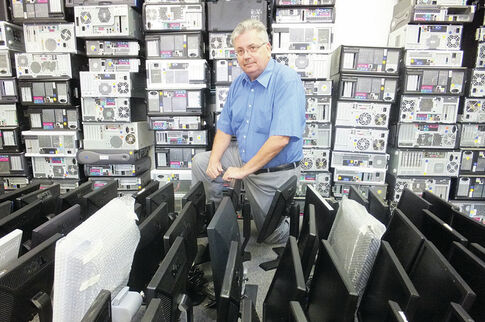
Dave Zboray keeps tabs of the 200 refurbished computers ready to link the Trenton community with the World Wide Web.
By Dan Aubrey
It looks like a dead end, but this storage room with walls covered by stacks of computers and floors covered with dark monitor screens is all about new starts.
“I didn’t know what it was going to be like,” says Dave Zboray about the Trenton Digital Initiative — a project developed in 2012 to give Trenton residents a high-tech opportunity. “But this whole thing is making a difference.”
Zboray is in his small nearly empty office — a stark contrast to other side of his door: a veritable computer dispensary in the Mercer Street Friends space off Parkway Avenue. And as befits his IT job for the Trenton anti-poverty nonprofit and his self-initiated label as “cheerleader” for the digital initiative, he sits in front of a computer and regularly consults it as he recounts the genesis of a project that’s all about new beginnings.
Opening up the TDI website on the computer screen, he gestures to the page that notes “the Trenton Digital Initiative is a nonprofit initiative to distribute free computers and low-cost, high-speed Internet to economically challenged Trenton families.”
“It was in December, 2012. I got three names from the mayor’s office and we began delivering computers. That’s when it began to move,” says Zboray.
“We” includes Glenn Paul, an area businessman with an expertise in computers and the man Zboray credits with pushing the start button on the project linking poor city residents to the digital world.
“The idea started in his kitchen (in Titusville),” says Zboray, eyes bright with wonder. “He asked what we could do to help Trenton. Glenn initially called the project 100 Computers for 100 Families.”
Paul — originally from Georgia and whose father was a sales manager and mother a nurse — came to the region in the mid-1970s to study English at Princeton University. His early work in computer stores appealed to him — after graduating he partnered with investor Bob Clancy to start Clancy Paul Computers, a well-known company that sold and serviced personal computers in central New Jersey. It also became a prominent presence at the then-new Roebling Center in Trenton.
Although the Clancy Paul store in Trenton was unsuccessful and closed before the Clancy Paul Company was sold, Paul — who has been called a “serial entrepreneur” and now runs the medical-retrieving software company Textler — got interested in the city and the state of cities in general. “It’s getting to the point that there are a lot of cities where we are warehousing people,” he says in a 2013 interview. “We’re warehousing people when we wall off a city and say it’s alright to keep everybody alive, but we don’t have anything for these people to do.”
Knowing firsthand how computers are continuing to change American society, he adds, “Digital technology is concentrating power and wealth, which is a problem not just for the children of Trenton, but for all Americans.”
Yet there is another side: education and opportunity. “We may be in the golden age of education. Instead of education becoming prohibitively expensive, it is going to be free,” he says, referring to courses offered by major universities and instructors just a webpage away on online courses such as Coursera or EdX. Opportunities exist in two ways: using the Internet to find jobs or for young entrepreneurs to launch online business.
“Glenn and I were business partners way back in the 1980s. I’ve known him for 30 years, all though the computer business,” says Zboray, a Hamilton resident who joined the Mercer Street Friends staff 15 years ago (he also taught science for a few years after graduating from Glassboro State College in 1972). I immediately saw that it was fantastic idea and wanted to implement it the best that I could. That’s how we started out.”
Yet between Paul’s kitchen meeting in 2010 and the day Zboray and Paul hand delivered the first three computers, several business-related “hows” needed to be addressed: how to get the computers, how to pay for Internet service, and how to pay for software.
Zboray says solutions were waiting with the friends. “All the thinking was done by volunteers. It’s a grass roots movement.”
First, as Paul and others knew, there was no computer scarcity: consumers were purchasing new machines and looking for ways to dispose of old computers. And over the past few years computers and monitors have been donated by Mercer County Community College, Rider University, Comcast, Law School Admission Council (in Newtown), and individuals. Second, a network of computer professionals shared the know-how to upgrade and prepare used computers, and the Trenton Rotary adopted the project and helped obtain funding for parts and other costs.
A third obstacle was trickier: affordable Internet access. “If you don’t have access, a computer is useless,” says Zboray. “But that’s where we got Comcast to help us. They have a program called Internet Essentials. They base it on (the same qualifications as) the federal lunch program, and cities like Trenton qualify for that program. So if you’re a Trenton student, you’re qualified. And in some cases Comcast — and some donors — even give scholarships for a year, just to get people on the internet. The going cost is $10 a month and no other service is required. With the current version, they even put a wireless router in the house.”
That left the organizers now to tackle software. “How do we supply all the software to people?” asked Zboray. “If they had to go out and buy $300 office software, it would be self defeating. But some of the computer nerds said, ‘There’s a lot of good free software out there.’”
Zboray turns back to the computer and shows-and-tells as he pulls up a website and says, “We’re using a version of Linux called Ubuntu. It’s an African word that means human kindness. It’s a free computer operating system. It solved two problems: a cost problem and a unified operating system. We’re able to load Ubuntu on every computer we have and don’t have the problem that Microsoft has with various versions. Every computer gets the same stuff, including Firefox and LibreOffice, which is Microsoft Office compatible and can do word processing and create spread sheets like Excel and Power Point presentations. And it’s free. We didn’t know how good free software could be.” Holding up a mini-memory stick, Zboray says, “I have a whole operating system here.”
With computers upgraded and ready, the question then moved to distribution. “We could go out on the corner and give them away, but that wouldn’t help. It’s not a handout. It’s a tool that can be used for good,” says Zboray as the topic moves to partnering with an existing nonprofit dealing with populations in Trenton.
After a trial run with HomeFront, Mercer Street Friends emerged as the logical partner, something Zboray is pleased about and says, “I wanted to get Mercer Street Friends in on it. We have the clients. It sounded so good.”
He then describes how the computers are distributed. “We have a family program and invite people to a free computer training program. We do six classes in a row. After the classes they can take the computer home. So instead of forgetting, they can use what they learn. It’s theirs.”
Other distribution points include MSF school-programs, preschool, and the Youth Service Program where young people are taught “about the inside of the computers: taking them apart and rebuilding, so each one gets a computer to rebuild and take home. We also have coding each day where they work on (computer coding) and built their own website.”
The last point of distribution is MSF’s Community Work Experience Program (CWEP), a 16-week session to help community members — including referrals from Mercer County Board of Social Services — improve job readiness and self-sufficiency. After learning how to reassemble and operate a computer, participants can take a computer home.
To illustrate the project’s success Zboray mentions a young African American client named Kareem. “When I met him he was the custodial parent of a two year old and six month old. He was unemployed and had dropped out of high school. Now he’s trying to take responsibility for the children but has no skills. He was in our CWEP program to get work experience. (We) got him a computer. He said he looked for a job on it, applied for a one on it, and got an interview. Next time I saw him he got the job at Cheesecake Factory. He said, ‘I really love cooking, and I’ll be starting from the bottom, but I am going to work in the kitchen.’ Having a computer turned around his life and family.”
Another story involves a woman who received a computer through the family program. “She was happy because she said, ‘I have the library in my house.’ She was going to the library to use a computer. She is using it for information gathering,” says Zboray who adds that others use it for social security and to look up information about drug prescriptions.
Critics of social programs and supports may say “well and good” before pointing to the reality that computers are getting cheaper and easier to get.
Zboray says that while some of this is true the goal to teach and empower can require an investment some people just do not have. And while the price of computers in the form of tablets is cheaper, larger and more powerful computers are more costly yet more beneficial to the project’s goal: self-sufficiency and knowledge. “You can’t create things on a tablet. If you want to create a Power Point and learn how to do it, or create a resume or program you have to do it on a computer. Computers are required to create stuff. That’s the opportunity, not just getting information. Computers are more helpful than hand-held devices. The computer is a helping hand in the right direction.”
While the program attempts to connect the computer with a responsible person who uses it as hoped, there is no guarantee. “Once they’re out there, people can do whatever they want with the computer. If a guy sells a computer for money, these are depreciated products already. I just hope he needs the money that he sold it for.”
Looking at the both short and long term needs, Zboray says “We’re trying to create a N2N — a nonprofit to nonprofit distribution model. We’re looking at the Mercer Street Friends’ food distribution network. Mercer Street runs a food bank that has 60 members. That includes soup kitchens and food pantries. All members are nonprofits. So this would be a great model for technology. These member agencies pull from the bank at no cost. But sometimes member agencies will chip in certain amounts to help defray distribution costs. That’s in the planning.”
Zboray says two other considerations need to be addressed in planning. One is a budget. The project is run mainly by volunteers and Mercer Street Friends absorption of costs, including the time that Zboray contributes to it while addressing IT needs at six other MSF locations. He says that a budget needs to be created to determine how the project can move to any determined future steps. “We solved computers, software, and distribution. It’s (a question) of scale now. If we could digitize the city and give a computer to everyone who wants one, we can become a model for other cities,” he says.
Data collection is the other. “What we have to ‘benchmark.’ We are tracking each computer and have follow up work. That’s the next level is to have volunteers contact users to see if all is all right and collect data. We have to develop our matrixes. (But) I think that someone connecting and looking for a job is a success.”
Then there is the ongoing need for computers and volunteers. From three computers, “We have delivered over 200 and have about 200 ready to go now.”
Thinking about the project, Zboray says, as he looks over the room with old computers, “This is the easiest thing in the world to sell. When I tell people I can take an old computer, clean it up, and give it to someone who needs it, people ask ‘How can I help?’”
Among those answering the question are — in addition to the Rotary Club of Trenton — Mercer Street Friends, the Hamilton Area YMCA, and the MIDJersey Chamber of Commerce, all official sponsors and computer drop-off locations. AR&C Self-Storage serves as the official transportation partner.
Other ways to help include donating an old Windows PCs — which will be wiped cleaned and restored with a new operating system — or giving some financial support — both are tax-deductible.
There are also two events that support the program:
Mercer Street Friends’ “A Taste-Full Evening” fundraising event on Friday, October 16, 6 to 9 p.m. at the Mercer Street Friends Food Bank Warehouse, 824 Silvia Street, Ewing. The event includes food prepared by chefs from Agricola, JM Group (Blue Point Grill, Nassau Street Seafood, and Witherspoon Grill), Marsilio’s, McCaffrey’s, Pennington Quality Market, ShopRite, and Wegmans. Beer and wine and live music are also featured. Tickets are $85.
“Something’s Brewing,” a TDI awareness and involvement event organized by members of the Trenton Rotary and the MIDJersey Chamber of Commerce, Wednesday, October 21, River Horse Brewing Company, 2 Graphics Drive, Ewing, from 5 to 7, $25 to $30, includes beer tasting, light fare, and brewery tour. app.etapestry.com/onlineforms/MercerStreetFriends/tdi-event.html.
TDI/Parenting classes that include a free computer are held on Wednesday evenings. For more information, call Elizabeth Hoffman at (609) 278-6907.
For more information on the Trenton Digital Initiative and information on computer drop-off or pick-up and volunteer opportunities, and a to view a video overview, go to www.tdi-trenton.info, call (609) 278-5520, or E-mail TDI@MercerStreetFriends.org.
,

