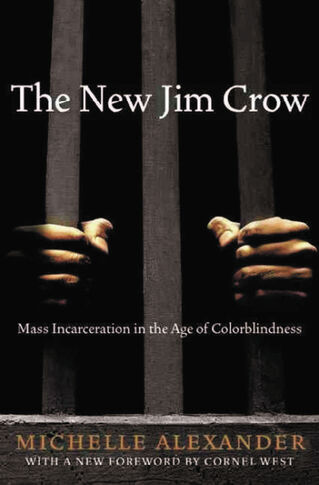
The book “The New Jim Crow,” by Michelle Alexander was the impetus for the creation of the Campaign to End the New Jim Crow – Princeton.
By Michele Alperin
Passion for social justice often grows out of a lifetime of influences and experiences, but the commitment to a particular cause may arise suddenly, from a confrontation with truths that cannot be denied.
For Jean Ross, Princeton resident and attorney, it was the combination of a labor union family, work in drug counseling and later prisons, then a law degree at Columbia to help her fight injustice. In the case of Princeton resident Rosemary Cilenti, it was reading Michelle Alexander’s The New Jim Crow: Mass Incarceration in the Age of Colorblindness two years ago.
For Cilenti, co-founder and chair of the Campaign to End the New Jim Crow, Princeton Chapter, the picture Alexander painted of the criminal justice system was “a complete and total surprise.”
“I had no idea that we incarcerated at the rate we do and that the whole system is replacing the old post-Reconstuction Jim Crow system and is creating a permanent, largely black and Hispanic underclass,” Cilenti said.
“People don’t understand there is a cradle to prison pipeline, and school to prison,” she said. “Children in poor communities where public school is less than adequate become acculturated to a system of prisonlike conditions.”
Not only do they walk through medical detectors and get frisked, but the quality of education is very low, which constrains children’s futures in many ways. For example, research has found a high correlation between children not being able to read by the time they are in third grade and imprisonment as a young person, Cilenti said.
With another woman from Trinity Church, Cilenti got people involved, first by simply raising consciousness through meetings at different congregations. The next step was activism, partnering with organizations already working for change, like Ban the Box, which asks employers to choose their best candidates based on job skills and qualifications, not past convictions. The Campaign to End Jim Crow has also been organizing volunteers to staff prison law libraries in the face of the state’s cutbacks on library monitors.
Congregations and organizations involved in the NJC Princeton effort include Nassau Presbyterian Church, Witherspoon Street Presbyterian Church, Trinity Church Princeton, Princeton United Methodist Church, Princeton Friends Meeting, Unitarian Universalist Church, Episcopal Diocesan Committee on Racism, Labyrinth Books, Not in Our Town Princeton, Princeton University, Princeton Theological Seminary, Princeton Public Library, the Children’s Defense Fund, the Arts Council of Princeton, and the Bernstein Gallery at the Woodrow Wilson School.
NJC Princeton holds events throughout the year, most recently a panel discussion event titled, “Race, Justice, and Mass Incarceration in America” at the Jewish Center of Princeton on Dec. 8. It also held a seven-night “Read-Out” last April in Hinds Plaza, during which attendees heard stories of people who had been imprisoned, had loved ones have been imprisoned, or who have worked with the imprisoned. Excerpts of from Alexander’s book were also read.
Ross, co-chair of NJC Princeton, as well as consultant and chair of the group’s legislative committee, grew up in the Bronx in an activist union family.
“I grew up with a sense of responsibility for fighting for social justice,” she said.
After a long time studying graduate mathematics at the Courant Institute of Mathematical Sciences at New York University, Ross was lured away to work for four years at a storefront in the Village in the 1960s in an effort to stop young people from using drugs and go back to school, to their parents’ homes, or to jobs.
Later working as a paraprofessional drug abuse counselor in an adolescent drug program on Rikers Island, she noticed a serious difference in outcomes from the largely white young people in the Village.
“The people who I met at Rikers Island uniformly failed,” Ross said. “I concluded that prison is not good for young people, with and without drug problems, so I went to law school.” She graduated from her “neighborhood law school,” at Columbia University.
Ross highlights one of the points Alexander makes in her book — that the phenomenon of mass incarceration was intentional, using the drug laws to imprison large numbers of people. They were, she said, “gathering up people for whom they don’t have enough jobs in the economy and gathering people from the black community, which in the 60s had been restless.”
Cilenti adds, “It was push back on the civil rights gains in the 60s.”
The result is that 2.4 million Americans are under corrections custody, with the number, already the largest in the world, rising steadily, Ross said.
The huge numbers of Americans under the custody of the criminal justice system, slightly less than 50 percent of whom are serving time for nonviolent crimes, said Ross, create a complicated array of problems and injustices, which the two women describe.
One is the near absence of opportunities for training and education, which sent a prison warden to a recent New Jim Crow program to sign up volunteer tutors.
Another is the way the criminal justice system undermines democracy. “In New Jersey you can’t vote until you’ve served your sentence and finished with parole or probation,” Ross said. As a result, with 67 percent of prisoners black or Hispanic, a part of our population is not fully represented.
Another antidemocratic practice connected with the criminal justice system is “prison-based gerrymandering.” Because the census considers people in prisons as living where the prisons are located, areas in South Jersey with sparse populations end up with higher representation in the New Jersey legislature.
The physical conditions in New Jersey prisons are another problem. While the state closed one of its newest prisons, Riverfront, to develop the city of Camden, the “West Compound” of the New Jersey State Prison (which a blue ribbon government commission 50 years ago recommended tearing down), is still standing and houses about a 1,000 people.
The compound, finally undergoing some renovation, features, said Ross, rats and mice, dust in the winter from never-cleaned, 150-year-old air ducts, summertime temperatures in the metal building that can go up to 110 degrees, and 5 by 7 foot cells where people live for decades.
To make matters worse, Cilenti said, the state no longer provides long underwear to prisoners, who must buy them through a for-profit commissary.
Another issue involves revolving doors between prisons and psychiatric hospitals. Ross, who has been legal advisor to New Jersey’s Division of Mental Health and Hospitals and has represented patients who are involuntarily committed to psychiatric hospitals, notes that when mental hospitals were depopulated, many people became homeless.
“People who had been in hospitals and returned to the community without sufficient community mental health services would do something dangerous because of their mental illness and go to prison,” said Ross, for example, taking something from a video store, urinating on the sidewalk, or assaulting someone because of delusions.
Ross added that hospitals receive prisoners who are difficult to handle, who are then sent back to “the cages.”
Our government also gives undo deference to prison wardens and the prison system, suggests Ross, with the courts decreasingly available to challenge conditions of confinement and federal and state laws make it more difficult to bring judicial scrutiny of the prison system.
Ross is also concerned with the absence of law and order in prisons, where guards have abused and beaten her clients, including people with mental illness, and they enforce retaliation against prisoners who attempt to complain about anything.
When a prison system is entirely punitive, with little rehabilitation, like the one in the United States, the consequences for the society are disastrous, said Cilenti, both financially and in human terms.
The costs of incarcerating people are extraordinarily high, and particularly so for solitary confinement. Ross adds that New Jersey spends $1.4 billion a year in the prison system, and “it leaches money from human services and education.”
These economic effects on the wider society combined with the social damage to inmates and their communities as well as recidivism at levels of 60 percent points to a simple fact. “It is a system in desperate need of reform,” said Cilenti.
At yet the world of prisons and its effects are at the back of most people’s minds. “Nobody wants to talk about prisons. Some people need to be incarcerated; it is true,” said Cilenti. “What we have done is incarcerated people in a big, blanket way and are treating people in ways that have terrible consequences for all of us.”
There has been some pushback toward reform in recent years, with hearings that result in recommendations and “a little bit of easy legislation,” said Ross. She is heartened, though, by the recent success of a coalition of faith communities and secular organizations who made New Jersey the first state to legislatively abolish the death penalty.
Cilenti compares the criminal justice system in the United States to the prison in Abu Ghraib: “The things that occurred in Abu Ghraib — that set-up came from the prison system in this country that goes on all the time. This is a system done in our name, without our knowledge. It doesn’t work, doesn’t make us safer, and we don’t know what is being done, and that is the road to perdition.”
Quoting Dostoevsky, who wrote, “The degree of civilization in a society can be judged by entering its prisons,” Cilenti concludes with a plea to activism: “In Princeton, a community of many riches, we should be able to really change things, or at least try. We have been endowed with such plenty, it’s time to really use that in the way a community like this can really do.”
,

