When visionary architect Michael Graves died last March at the age of 80, he left a lot behind. His Portland Building in Portland, Oregon helped usher in postmodernist architecture, and his line of household products for Target broke new ground in making good design affordable. He created the whimsical Swan and Dolphin resort at Walt Disney World and the illuminated scaffolding used in the restoration of the Washington Monument. Closer to home is the Paul Robeson Center for the Arts on Witherspoon Street in Princeton and the distinctive Miele Headquarters on Route 1.
He also left a firm bearing his name, Michael Graves Architecture and Design, located in Princeton, in a historic yellow house on the corner of Nassau and Harrison streets. Today, the company is continuing on without him.
Graves’ bold approach to architecture and design propelled him to exceptional architectural prominence, and his distinctive design characterized his products and buildings. But leaving behind buildings is one thing. What happens to the practice and to the successors charged with continuing his legacy and expanding a style so uniquely associated with the designer himself?
Graves arrived in Princeton in 1962, after having studied architecture at Harvard and then at the American Academy in Rome. He began teaching at Princeton University, and in 1964, he set up his architecture practice. Over the course of his 50 year career, Graves became one of the most well-recognized names in architecture. He was awarded the National Medal of Arts from President Clinton in 1999 and two years later the American Institute of Architects Gold Medal, the highest honor the organization grants individual architects.
His firm, which offers services in architecture, planning, branding and interior and product design, has fluctuated in size over the years. When he started the practice, he had only a handful of employees, but as his stature as a designer grew in the 1980s, the firm grew as well. By the early 2000s, there were almost 125 employees on staff. While the practice shrank during the recent financial crisis, it is now back up to 60 employees, who are currently deciding what it means to continue Michael Graves’ legendary work without him.
Alan Chimacoff, a founding principal of the architecture firm ikon.5 and the former director of design at Hillier Architecture in Princeton, taught alongside Graves at Princeton University. He suggests that firms founded by iconic leaders face challenges in moving forward without them, but it can be done. “The ones that have succeeded and continued in their importance were ones that were led by strong, gifted people, who continued in the spirit of the founder, but without emulating or trying to continue the work literally,” he says. “They reinterpreted the principles of the founder’s values, but developed their own voices.”
The partners at MGA&D see their history developing the firm alongside Graves and his insistence on the firm’s longevity as proof that they can do just that as they move the firm into the future.
“[Michael Graves] never felt the firm would die with him,” says Karen Nichols, FAIA. Nichols, who is one of the firm’s three architecture principals, began working with Graves in 1977. With a Master of Architecture from MIT, she was hired to write a monograph on Graves’ work and to lead the design of the Fargo-Moorhead Cultural Bridge, which, despite funding issues preventing its completion, received numerous accolades, including a Progressive Architecture Award from Architect Magazine. Nichols has since written or edited eight books on architecture and Graves’ work and has led countless design projects for the firm. In 2003, she became a Fellow in the American Institute of Architects for her role in developing the model that integrates architecture, interior and product design, planning, and branding for which the firm is known.
“Michael always had the idea that the firm would continue, and … we would bring in more people and continue the legacy,” Nichols says. In the ’90s, to ensure that legacy, Graves put in place a company succession plan and named six partners who could continue to grow the firm after he was gone. Several years later, in 2003, he contracted a serious infection which left him paralyzed from the waist down. The experience, which saw him in and out of eight hospitals and four rehabilitation facilities, encouraged Graves and the company to think deeply about the future and refine the succession plan.
“He was forced to decide, ‘Do I just want to say I want the practice to continue, or do I really want it to?’ And he did want it to,” says Ben Wintner, a marketing and business development principal. Wintner joined the firm in 2002, shortly before Graves’ paralysis. He’s worked as the director of business development and has helped shape the company’s major healthcare design strategy in recent years.
The partners worked with Graves to ensure a structure that could continue seamlessly without him. After his death, the only leadership issue to address was who would replace Graves as the firm’s president. While Graves, as the practice’s founder, held the position prior to his death, the role of president at MGA&D is an administrative one, rather than a design role. The president oversees the financial, legal, and human resources side of business management, while the design principals jointly lead the company’s diverse design work.
Rob Van Varick, a product design principal, says, “From a design perspective, we believe the group is stronger than any single person. We want to continue to develop a collaborative [design] environment and never considered elevating one principal designer to the position of president.”
Instead, the principals elected Joe Furey, the company’s chief financial officer. Furey joined the firm in 2008 with nearly 20 years of experience in the IT, hospitality, and finance industries. His expertise helped steer the company’s business decisions during the 2008 financial crisis, which allowed the design leadership to continue focusing on working with clients and leading projects. The experience suggested that keeping the position of president as a business role would allow similar latitude for the design partners to concentrate on leading the firm’s design work.
Patrick Burke, an architecture principal, says, “Unlike the ’80s, when Michael was truly the singular design voice of the firm, today we have many talented, experienced lead designers. And we want all of our designers to continue to develop their voices, passions, and perspectives. So for us, the decision to make our CFO our new president was obvious.”
Today, Furey and seven other partners, five of whom have been with the firm for more than 25 years, own MGA&D. The architectural partners consist of Nichols, along with Tom Rowe and Burke, who both hold Master of Architecture degrees from Princeton, where they studied under Graves. All three were among the partners named in the original succession plan, and together they have over one hundred years of experience building the company alongside Graves.
Donald Strum, who holds a BFA from Parsons School of Design and has been with the firm since 1984, and Van Varick, who has a BFA from Rhode Island School of Design and joined MGA&D in 2003, complete the design leadership as Product Design principals. Linda Kinsey, who has been with the company since 1987, and Wintner are marketing and business development principals.
The smooth adjustment in leadership has allowed the firm to focus on managing the overall transition and moving forward. Since Graves’ death, the company has hired 15 new employees, which represents almost a quarter of the firm’s total staff. And they haven’t lost a single client. In fact, only one small detail went wrong in the transition. The company American Express card turned out not to be the company’s card at all. It was Graves’ personal card, though he had been using it for business for so long that everybody assumed it was the firm’s. “If that’s the only thing that went wrong, we’re pretty proud of that,” says Nichols with a smile.
But cementing the identity of MGA&D beyond Michael Graves himself is new territory for the firm. Nichols and Wintner say the company is committed to passing on Graves’ legacy, even as it hires staff who never knew him. At the annual company picnic, new employees are given tours of Graves’ Princeton home, a former storage building known as The Warehouse, which Graves renovated into an elegant residence. New hires are also given a Graves watch and are encouraged to read his books. Graves-designed furniture and products decorate the firm’s work space, where the recent office guacamole contest was a hit and a couple of friendly dogs wander the worn wood floors. The office culture reflects Graves’ design philosophy of humanism, which emphasizes the importance of the human experience in the larger built world.
When dealing with clients, the firm is similarly committed to ensuring the Graves legacy—while simultaneously asserting an identity independent of Graves himself. Wintner says the market response after Graves’ death has been better than the company expected, and that clients seem to understand that the firm is more than capable of delivering the thorough planning and high quality design that characterized Graves’ projects. Past clients have given the firm more work, and it has picked up new ones. The company is currently designing its fourth public school in New York City and it recently unveiled a thirtieth anniversary edition of its signature tea kettle for Alessi. It is also working with a major financial services company to build a new corporate headquarters. The company is transforming its workplace culture, and the designers are expanding Graves’ emphasis on the human experience, demonstrating how good design can help create a better work environment.
The firm also continues to develop Graves’ post-paralysis interest in bringing humanism to healthcare and handicap design. After experiencing firsthand the practical problems often endemic in healthcare delivery and in navigating the world from a wheelchair, Graves worked to position his firm as a leader in innovative healthcare design. The company is currently designing the Madonna Rehabilitation Hospital’s Omaha, Nebraska campus. It has recently had two major projects at the Yale-New Haven Hospital, designing an emergency department and a center for elder care, which explored the way that geriatric patients engage with their surroundings. The firm is likewise developing new products for elder care for Kimberley-Clark and is expanding its line with Stryker, which produces products for hospital mobility.
It was the way that Graves’ paralysis interacted with his leadership style that in part allowed the firm to transition so seamlessly after Graves’ death. Prior to falling ill, Graves was frequently on the road, traveling internationally, meeting with clients, and acting as the public face of the company. That left the principals back in Princeton with much of the responsibility for running the day-to-day details of the firm as well as for the bulk of the design work.
“Michael was not someone who was interested in the detail of a lot of the projects. He was interested in the high level, the character,” Wintner says. “It gave real creative opportunity for the design teams.” Architecture principal Tom Rowe’s collaboration with Graves on an addition to the E. Barrett Prettyman U.S. Courthouse in Washington was typical. Rowe took responsibility for developing the overall building design as well as managing design details. The two worked together to refine the overall character of the building, ensuring its façades and rotunda expressed the building’s judicial purpose and echoed the classical architecture of the neighboring structures along the National Mall. That type of teamwork helped the firm develop its style. Although the practice bore Graves’ name and its work was consistent with his image, its designers were leading projects that reflected their own work, which allowed for a collaborative approach to defining the Michael Graves brand.
When Graves became paralyzed, he continued to work throughout his rehabilitation, but his ability to act as the public face of the company was limited. As a result, other leaders within the practice took over many of his events, which introduced them to another side of running the office. With a lighter travel schedule, Graves spent more time in the Princeton office, and his partners were responsible for an increased share of managing projects onsite, traveling to meet clients, and beginning to develop the company’s broader public identity.
When a developer needed an architecture firm to increase its prospects of competing successfully for a 3.5 million square foot resort project in Singapore, it turned to MGA&D not necessarily because of Graves, but more because of Patrick Burke, who had recently forged relationships and demonstrated his resort planning credentials in leading the design of the Azulera Resort in Costa Rica.
So when Graves passed away, nearly 13 years after he became paralyzed, the company’s principals had already had their crash course in firm management. They were well-versed in every aspect of running the practice, from representing the Graves brand and interfacing with the public to design work and internal operations. The experiences before and after Graves’ paralysis allowed the firm’s leadership, already strong after decades of working closely with Graves to build the practice, to further expand their ability to guide the company. While Graves’ death was unexpected, the partners had a clear transition plan in place and a wealth of experience to help move the firm into the future.
Despite their preparation, however, the principals say there is a difference without Graves. “The buck always stopped with Michael,” says Wintner. “I think there’s just an added level of pressure.” Often, when a client advocated for an idea that the project budget or architectural considerations couldn’t accommodate, Graves took responsibility for delivering the news that it wasn’t doable. His standing as a luminary within the field afforded him an authority that resonated with most clients. Today, that responsibility lies with the project principal, and Wintner and Nichols agree that this and other natural shifts in leadership following Graves’ death have helped them mature as a firm.
The world outside the company is responding. People who previously would have insisted on working with Graves are recognizing that the firm is more than the eponymous architect. Graves had two speaking engagements lined up at the time of his death, and Burke gave both, one at the Stahl Memorial Lecture in Bioethics at Rutgers Robert Wood Johnson Medical School and one at the Cleveland Clinic’s Patient Experience: Empathy + Innovation Summit. He paid tribute to Graves’ commitment to humanistic healthcare design and emphasized the way that design will continue to improve patient and caregiver experiences.
And when Yale University decided to use the Michael Graves College—a new architecture program at Kean University rooted in Graves’ architectural philosophy—as a design problem for a graduate architecture studio this fall, all three MGA&D architecture principals were involved. Yale students were challenged to design a fictitious building to house the program on Kean’s Union, New Jersey campus, and Nichols discussed Graves’ design outlook with students during the studio’s orientation session. Nichols, along with Burke and Rowe, will travel to Yale in December to review the studio’s final designs—an opportunity that in the past would likely have been given to Graves. While the principals have had previous experience as the firm’s public face, there’s now an added responsibility. “It’s really forcing us not to say what we think Michael would say, but to develop our own messages which are still consistent with the vision of the firm,” Nichols says.
MGA&D’s vision is far-reaching and includes continuing design work around the world. But the practice itself remains rooted in Princeton. After Graves’ death, the company became the full owners of the firm’s offices and Wintner says, “MGA&D has deep roots in Princeton at the corner of Nassau and Harrison streets, and that won’t change.”
Similarly, Graves’ “Warehouse” residence on Patton Avenue will continue on as an inspiration for future generations of designers. MGA&D and Graves’ estate are working together to fulfill his vision of making his home a center for the study of design, architecture, and the humanities. After 40 years of Graves’ renovations, the house itself is a record of his evolving thoughts on architecture, and it showcases the development of a design legacy that is both local and global.
In October, Nichols and Strum went to New York, to accept the Cooper Hewitt National Design Award for Lifetime Achievement on Graves’ behalf. The award, which counts among its winners architectural luminaries like Frank Gehry and I.M. Pei, was announced in early May, just over a month after Graves’ death. The timing, while tragic, was perhaps a fitting analogy for the practice Graves built and left to continue without him. In accepting the award, Strum noted Graves’ longstanding interest in this particular honor. “Michael always wanted to receive this award and predicted that this would finally be his year,” Strum said. “He was right, it was his year.” But his partners were there to accept the award instead, and in her remarks, Nichols pointed to the way that the firm’s past has built its future. “We think that this practice of ours is really just a prologue to Michael’s legacy.”
It is Graves’ legacy that inspires the company to continue growing. The architect’s commitment to supporting big ideas with small details that take human experience into account paved the way for his exemplary career, but it also created a practice that has the ambition and the experience to continue without him. The firm plans to expand the idea of what an architect can do in society and how creative design thinking can address problems beyond the typical realm of architecture. And having celebrated its 50th anniversary last year, just before Graves died, does the firm want to be around in another fifty years?
“Definitely,” Nichols says.
Sonner Kehrt is a freelance writer and a former Coast Guard officer who worked in the Arctic before returning to her New Jersey roots.
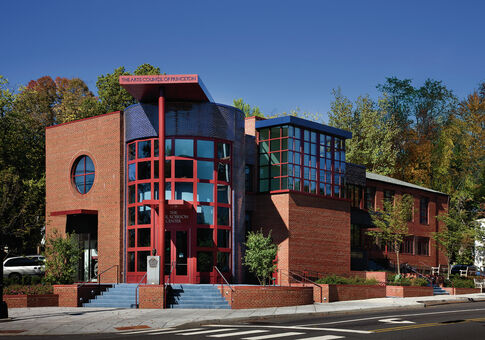
Arts Council of Princeton courtesy of Michael Graves Architecture & Design.,

