In McCarter Theatre’s annual holiday adaptation of Charles Dickens’ classic
A Christmas Carol,
the Ghost of Christmas Present is typically played by a tall, slim actor. But three years ago, Cynthia Abel Thom remembers, a petite woman was tabbed for the role.
The audience, the actors and even the show’s long-time director, Michael Unger, scarcely need to care about such a detail. But in McCarter’s costuming department, the casting choice raised a lot of questions, like: will her dress fit?
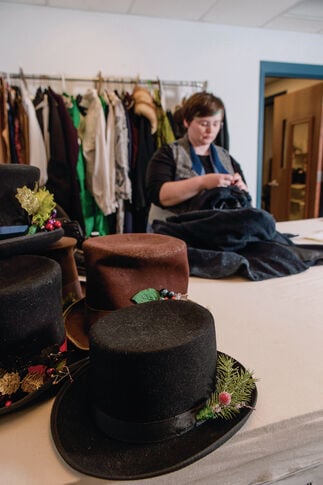
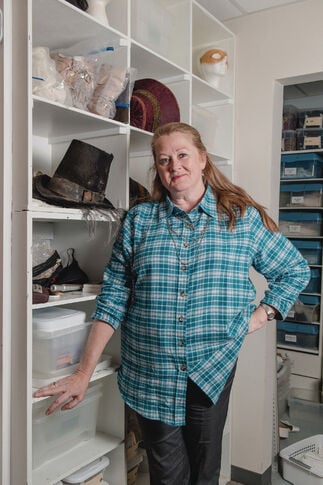
Such is life in the costume shop, which is managed by Thom and housed in a nondescript building on Alexander Road on the other side of Route 1, a short drive from the theater building. She and her staff share space with the prop shop, the scene shop, and hundreds of costumes that have been worn in past McCarter productions, including some that have been worn so often and altered so many times that they are falling to pieces.
There are 12 featured players and 25 ensemble members in this year’s production of A Christmas Carol, including 14 children. All told there are 96 costumes for the 37 members of the cast, every one stored away at the end of December and trundled back out come October, when fittings start. Every actor is fitted for every costume every year—even actors who are reprising their roles, like Graeme Malcolm, who has portrayed Ebenezer Scrooge since 2010.
Since Jess Goldstein became the production designer for A Christmas Carol in 2000, the Ghost of Christmas Present has worn a long dress made of velvet. When the petite actor was cast, Thom worried that she would be weighed down by the heavy fabric. Rather than drastically alter the dress that year, she decided to have a new one made.
So Goldstein was consulted, a fitting was done and one of McCarter’s talented seamstresses assembled a new, more lightweight dress. But shortly before the show began, the actor who had been cast as the Ghost of Christmas Present dropped out and was replaced by someone who had played the role previously.
The replacement actor was quickly fitted for the old dress and the new one was put on a rack, never worn in front of an audience—until last season, when a petite woman was again cast in the role.
“We put the old dress away and the new dress finally got to be worn,” Thom said. “That’s the way it goes.”
On Thom’s staff are two drapers, who create the garments, two first hands (the drapers’ assistants), wardrobe supervisor Carissa Thorlakson (who also handles wigs) and a full-time intern. The costume shop is responsible for every McCarter production, not including those in the “Presented By” series, which usually feature traveling companies with their own costume departments.
So even as Thom was knee deep in A Christmas Carol, she was working on three other shows: The Piano Lesson by August Wilson, which is up next in McCarter’s season; The Mousetrap, which comes after that; and Ken Ludwig’s Baskerville, which played at McCarter in March and which is currently being staged by the Philadelphia Theatre Company in Philly, using McCarter’s costumes.
Every show presents unique challenges, but some are more straightforward than others. For McCarter’s recent adaptation of Tennessee Williams’ 1950’s screenplay Baby Doll, which featured just five actors and few costume changes, Thom looked to buy vintage clothes from specialty shops or contemporary clothes that they can distress to make them look old. The more costumes that have to be fabricated by hand in house, the more costly a production becomes.
The Rachel Bonds play Five-Mile Lake, which made its East Coast premiere at McCarter in May, was set in present day Scranton and featured mostly casual outfits, allowing Thom to outfit the cast mostly with clothes off the rack, doing alterations as needed.
For A Christmas Carol, Thom keeps “bibles” — thick binders with specifications for every costume in the production: who they’re worn by, what scenes they’re worn in, and what accessories go with which costumes. Each season’s bible is used to make the next.
That all could change next year. 2015 will be the last season for the current production of A Christmas Carol. Next year’s show will continue to use David Thompson’s familiar adaptation, but will probably feature new costumes, new sets, and a variety of other twists and tweaks. “Each designer has their own vision for the show,” Thom said. “We will have to allow the design process to take place and see how many of these costumes will fit into the new design.”
The more a costume or accessory is tied to the current production, the less likely it is that it will be carried forward into the new one. “Pieces like Mrs. Fezziwig’s dress and the undertaker’s (false) teeth probably won’t be used again because they are so specific and memorable,” she said.
One reason to change the production has everything to do with the wardrobe. After 16 seasons, many of the garments were falling apart. A few years ago, all the dresses worn in the Fezziwigs’ Christmas Eve party had to be replaced. “They have to be altered every year, and the seams can only take so much ripping out and taking in,” Thom said.
Thom, a native of Maine, graduated from Grinnell College with a degree in sociology. She married a local and settled in Iowa, raising her family and working part-time as a seamstress. One day a local theater company asked her to help out and she “got the bug.” She went to the University of Iowa and got a MFA degree in costume design.
After she was divorced and her children grown, she moved to Washington, where she spent six years as costume director for the Shakespeare Theater Company. Nine years ago, she came to McCarter. Today she lives in Hopewell Borough.
“The job I have only exists in regional theater,” she said of moving around. “To find a job like this at this level, you have to be willing to move.”
A Christmas Carol, McCarter Theatre, 91 University Place, Princeton. Dec. 4-27. Showtimes and tickets at mccarter.org.
,