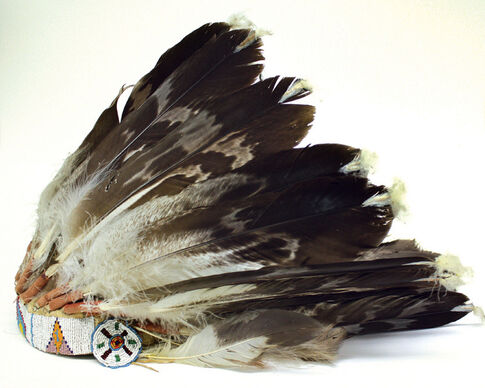
‘Silver Shell and Glass” — the New Jersey State Museum’s shimmering showcase of Native American clothing, jewelry, and ceremonial garb -— aims to take visitors on a visual tour of nearly 60 rarely seen objects from the museum’s collection. On view through September 4, the exhibition exploring the crafting of beads in North America was something sparkling in the curator’s mind for some time.
“The planning has been going on for about a year, and my idea was originally ‘the beaded universe,’” says New Jersey State Museum curator Karen Flinn. “We have an extensive ethnographic collection, including beads from Africa, Asia, etc. But because of space, I had to pull back a little, and focus just on beaded (works from) North America.”
“They’re arranged according to geography, so we go from the east coast and woodlands, to the Plains Indians, to the southwest and California, and then to the northwest coast and up into Alaska and the Arctic,” Flinn says. “It’s like a geographic trip through the Americas.”
Flinn reflects that humans began making art very early on in our cultural evolution, and the use of beads for a variety of purposes has been documented in cultures around the world, dating back to ancient times. In fact, examples have been found in archaeological excavations dating as early as 100,000 years ago.
“In the ‘Old World,’ beads can go back 80,000 to 100,000 years; but in the New World, things are not as (ancient), maybe more like 13,000 years old, which is still pretty old,” Flinn says.
As much as she enjoys delving into bead making and crafting from the past, Flinn says bead making is not a lost art, and she has seen modern bead work that is just as meticulously done as in long ago times.
“Modern bead making and beadwork by Native American descendants continue to follow traditions, even as they experiment with modern, non-traditional forms, such as beading high-heeled shoes and sneakers,” she says. Flinn adds that archaeologists and anthropologists also find it possible to learn the history of native peoples by studying the changes in their bead making over time.
“Before contact with Europeans, native people used local materials, and they also traded among themselves, so we find shell (beads) from coastal areas at sites that were well inland, meaning they were traded or carried inland,” Flinn says. “Even turquoise (associated with native people in the southwest) might have been traded for shell beads. There was much trade going on in the New World before the Europeans came.”
Once Europeans arrived in the New World — as well as northern people like Scandinavians and Russians — they especially hankered for the pelts of North American fur-bearing animals, such as beavers and otters.
“So we see pelts (and other Native American materials) being traded for European things like cloth, iron axes, and especially glass beads,” Flinn says. “For any trader from the Old World, glass beads would have been prominent in their trade items.”
“Native Americans, who had been using things like porcupine quills to decorate leather and whatnot, were fascinated with glass beads,” she continues. “They would acquire them readily.”
From her office in the basement of the NJSM, Flinn produces a small container of porcupine quills and explains that these sharp-as-a-knife quills (about the size of a large domestic cat’s whiskers) had to be chewed on and softened up before they could be utilized for crafting.
“Using glass beads was much easier than catching the beavers and porcupines, then working these materials for beading and decoration,” she says. “That’s one example of how we start to see the changes (in bead making) in an archaeological context.”
A major change in native bead craft and jewelry making came when the Spanish arrived, after which the native people learned the art of making silver.
“Many people think the Native American silver (particularly in the Southwest) is self-taught, but the craft was brought to them by the Europeans, especially the Spanish,” Flinn says.
When asked about some of the more unusual Native American items on view in “Silver Shell and Glass,” Flinn immediately thinks of an Alaskan piece, something akin to a modern yo-yo.
“It’s not just a museum piece; it’s more functional than most, a game that kids would have played,” she says. “And since it’s Alaskan, it’s covered with fur and glass beads.”
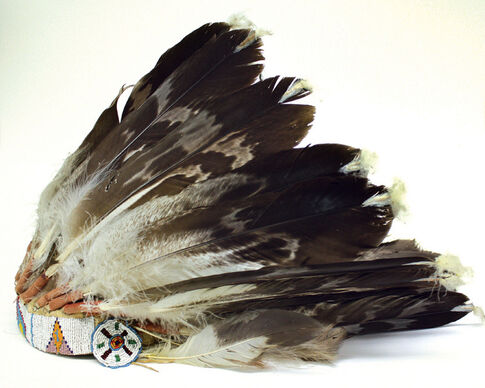
“Then there is a Plains Indian headdress, which was ceremonial, as the Native American special events like powwows were discouraged or forbidden once they were moved into the reservations,” Flinn says. “But they celebrated events like the Fourth of July, and this was an occasion when they would wear such headdresses in parades and whatnot.”
Born in New York City and raised in the South Bronx, Flinn and her family later moved to what was then rural Warren Township, New Jersey. She still lives there and commutes to Trenton.
While her father was an electrical engineer, developing sensing devices for various companies, and mother had been a bank teller when the family lived in the city, the longtime NJSM staff member seems to have fallen in love with Native American history, craftsmanship, and artwork while studying art history as an undergraduate at New York University, where she received a bachelor’s in fine arts. Flinn stayed at NYU, completing the master’s program in anthropology with a focus on Northeastern (American) archaeology.
“My initial interest came through art history,” she says. “I studied all eras of art history but came to love the very early art forms, such as pre-historic (works). For example, when I was an undergrad in art history, I did field work in Turkey for a couple of summers. But graduate school was where the ethnography came in.”
Prior to being promoted to assistant curator at the NJSM in 2000, she served as the registrar from 1978 to 2000. Flinn has more than 36 years of experience working with archaeological and ethnographic collections, as well as background in all aspects of museum management, including collections care and exhibition planning.
She was a curator and developed programming for a number of exhibitions at the museum, including “A Much Moved People: Preserving Traditions of the Delaware Indians” and “Cultures in Competition: Indians and Europeans in Colonial New Jersey” in 2012.
“We don’t have a huge budget to go out and buy stuff, but we do have the generosity of New Jersey residents who care about educating our school children and their fellow New Jersey residents,” Flinn says. Silver Shell, and Glass: A History of Native American Beadwork, New Jersey State Museum, 205 West State Street, Trenton, through Sunday, September 4. Tuesday through Sunday, 9 a.m. to 4:45 p.m. $5 suggested admission. 609-292-6464 or www.statemuseum.nj.gov.
,