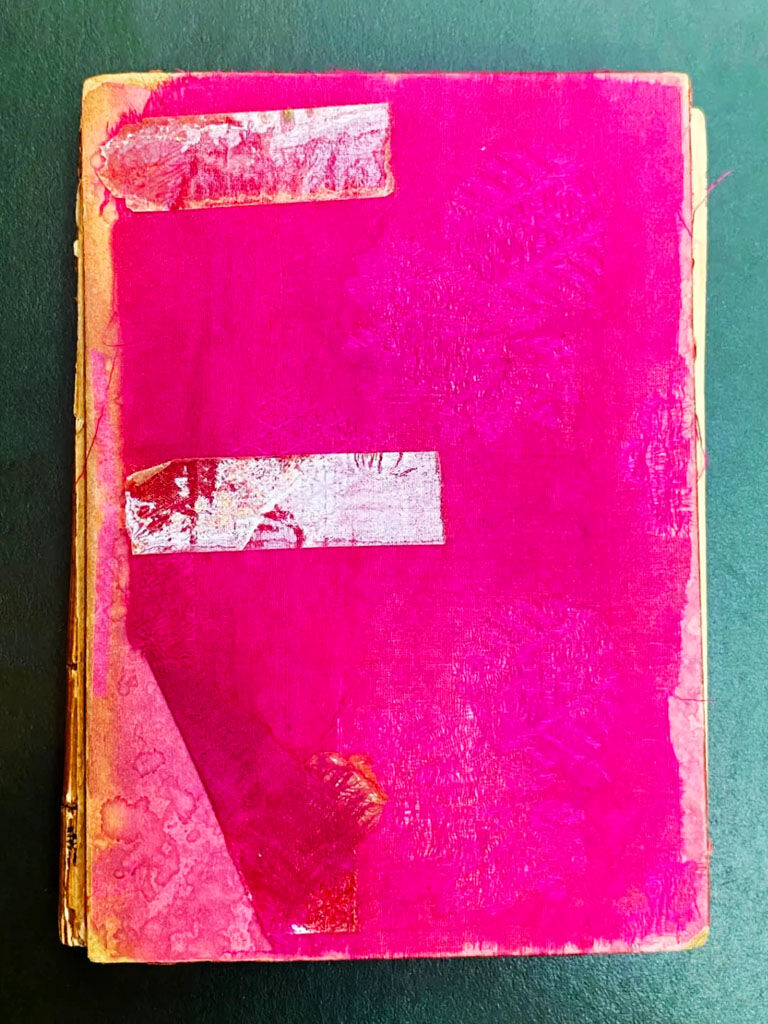
Theoretical physicist J. Robert Oppenheimer’s small, fuchsia pink copy of the Bhagavad Gita is split much like the atom, falling apart at the seams as if emulating the nuclear fission reaction its owner was well acquainted with. But much like someone unsuccessfully tried to piece the book back together with tape, history could never return to the time before the bomb; the Pandora’s box of science had been opened.
Oppenheimer drew particular inspiration from the 700-verse Hindu scripture as director of the Los Alamos Laboratory in New Mexico, where he oversaw the development of nuclear weapons for the Manhattan Project during World War II.
The son of German and secular Jewish parents, Oppenheimer led the program to produce these bombs before other international forces could, a response motivated in part — despite his personal unobservance — by the targeted persecution of his given faith.
When the United States used that technology against Japan in what are still the only two wartime applications of such devices to this day, ending the six-year conflict, Oppenheimer was named “the father of the atomic bomb.”
Oppenheimer’s life is the subject of Christopher Nolan’s biographical thriller “Oppenheimer,” based on the Pulitzer Prize-winning 2005 book by Kai Bird and Martin J. Sherwin, “American Prometheus: The Triumph and Tragedy of J. Robert Oppenheimer.”
Even before the film premiered in July, Princeton embraced the Oppenheimer buzz, proud that he spent the last two decades of his life in town while serving as the director of the Institute for Advanced Study, an independent theoretic research and intellectual center where Nolan shot on location.
Princeton University acquired Oppenheimer’s library in the years following his death from throat cancer in 1967, its contents spanning a total of 178 items in 25 boxes with various — and sometimes copious — inscriptions and annotations.
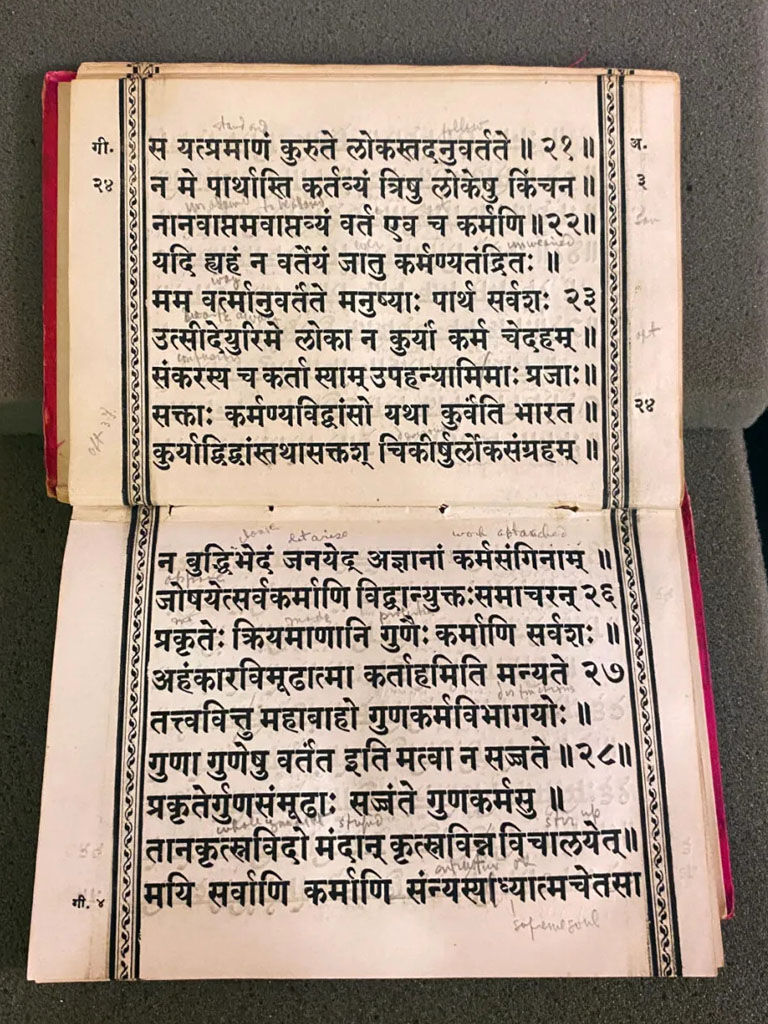
One of these is Oppenheimer’s copy of the Bhagavad Gita, the Sanskrit spiritual text whose title translates to “Song of God.” The visual contrast between the exterior color and his light pencil markings evokes what is arguably Oppenheimer’s most infamous quote, one that he allegedly recalled from the Bhagavad Gita either while watching the first “Trinity” nuclear test on July 16, 1945, or in a 1965 reflection on the moment the mushroom cloud rose from the desert: “Now I am become Death, the destroyer of worlds.”
Emma Sarconi, a reference professional and outreach specialist for special collections at Princeton University’s Firestone Library, co-authored a July article on the Oppenheimer collection alongside Stephen Ferguson, the associate university librarian for external engagement, for the PUL Special Collections blog, “An Open Mind: Robert J. Oppenheimer’s Collection of Books at the Princeton University Library.”
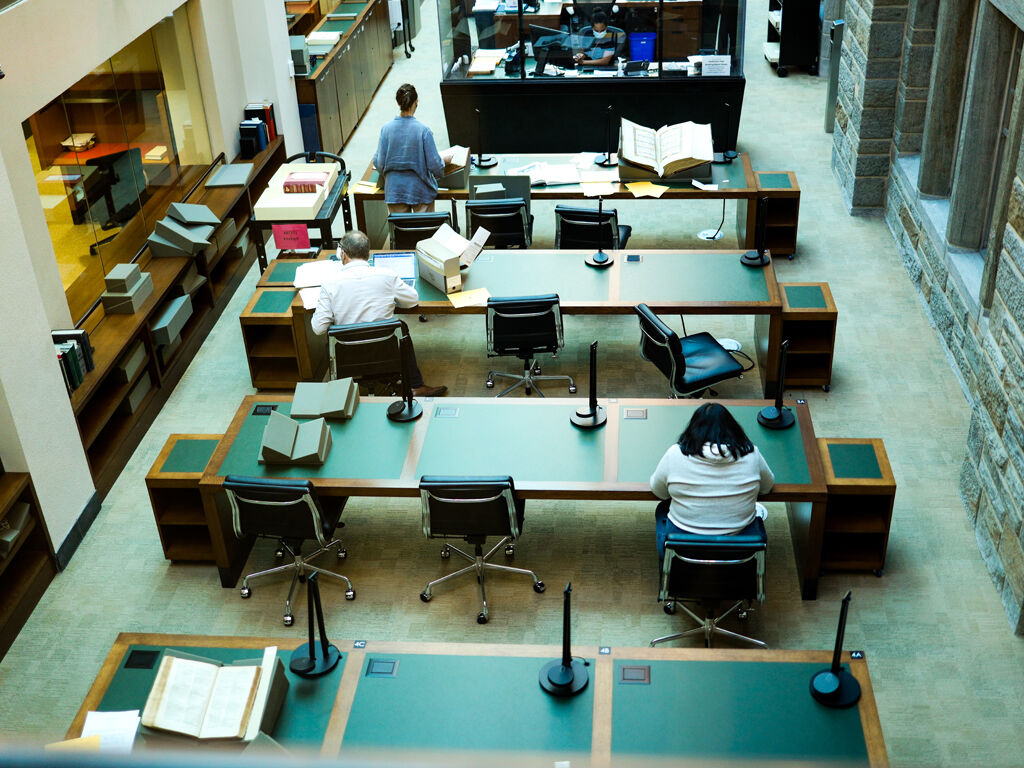
Many of Sarconi’s responsibilities are based in the Reading Room at the Firestone Library on Princeton University’s campus, where she supports researchers and connects them to the collections. She has also worked on special projects like the “Archival Silences Working Group’’ and “Her Book” while overseeing the “Curated Collections” program, an initiative where Princeton University affiliates can produce digital exhibits of their own.
Sarconi explained that anyone, not just those affiliated with the university, can request to view items from the university’s special collections in the Reading Room at Firestone Library. Researchers must make reservations for the “Books formerly owned by J. Robert Oppenheimer” collection, which is stored offsite, at least three days in advance.
For a step-by-step guide to the process or any inquiries, see the “Ask Us!” form on the PUL website, library.princeton.edu/special-collections/ask-us.
Gloves are not required to handle objects in the Reading Room unless they are delicate, such as photographs, according to Sarconi, and she recommended that guests wash up and examine them with “clean, dry hands.”
But members of the public who decide to explore how Oppenheimer’s personality and psyche show through his choice of books will find parallels with Sarconi’s own journey as a special collections librarian, where she began “thinking about what the book can tell us as an object, not just as a text,” during her undergraduate years.
Sarconi graduated from the University of Toronto with a bachelor’s degree in book and media studies, but after working in publishing, she missed the rarity of special collections libraries. She then earned a master’s degree in library science from Long Island University with a focus on special collections, as well as a master’s degree in English literature from New York University in a concurrent graduate school program.
“At NYU, I specialized mostly in material written in English, published in the United States and in England after 1800, with a book history lens,” she said. “I’ve always been a big reader, but thinking about the social life of a book really opened up a whole new world to me.”
This could mean exploring questions like, as Sarconi explained, “Who owned this book before it was in my hands here today?’ How was the binding created? Who printed it? Why did they print it? It might be an authorial study; who wrote this book? In what context did they write the book?”
Sarconi received her general librarianship training at NYU’s Bobst Library and worked at the Brooklyn Historical Society, but she also spent a summer in Idaho as the Hemingway in Idaho research fellow, where she worked with the books that the famous author had left behind in his Ketchum home for the Community Library, the public library that acquired the historic Hemingway House and Preserve.
Drawing from her research, Sarconi explained that materials end up in the stewardship of special collections in a multitude of ways, with many items bequeathed by donors, whether their personal belongings or on behalf of another, as well as PUL directly purchasing or holding them.
Oppenheimer’s collection is a “combination” of these factors, she added. Following his death, the books were relocated from his house as director to another on the Institute grounds, where his wife, biologist-botanist Katherine “Kitty” Oppenheimer, lived with the couple’s daughter, nicknamed Toni.
After her mother died a few years later, Toni, a translator who was born in Los Alamos and attended Miss Fine’s School in Princeton, now known as the Princeton Day School, presumably donated the collection to the Bryn Mawr Book Sale, “an annual scholarship-fundraising event held each spring in Princeton since 1932,” the blog post continued.
Robert Fraser, a former PUL curator of rare books, was requested to counsel on the significance of the collection in terms of its monetary and research value. Fraser understood their relevance and selected books that Alexander Wainwright, then the assistant university librarian for acquisitions, effected the purchase of via the Charles F. Wells Library Fund during the 1973–74 academic year.
The books then remained in storage for a number of years until the early 2000s, when Ferguson, then the head of the department, formally accessioned the materials and created a digitized guide: “Books formerly owned by J. Robert Oppenheimer,” arranged either alphabetically by author or by date of publication, lists each item, a description, and its corresponding call number.
Ferguson approached Sarconi, who co-manages the PUL blog at the Seeley G. Mudd Manuscript Library with colleague April Armstrong, about writing the piece before the film’s premiere. Sarconi had not known they even had Oppenheimer’s library until then, but when she started browsing through the content of the boxes, the collection’s diverse range of subject matters, genres, and disciplines conveyed stories that went beyond the pages.
“What really struck me was the variety of material that he had in his library. It wasn’t just these scientific tomes,” she said. “He also had T.S. Eliot and other forms of literature, novels, and poetry, and so this was a person who was broadly curious, and I think that’s really easy to forget when we know a person based on one part of their life.”
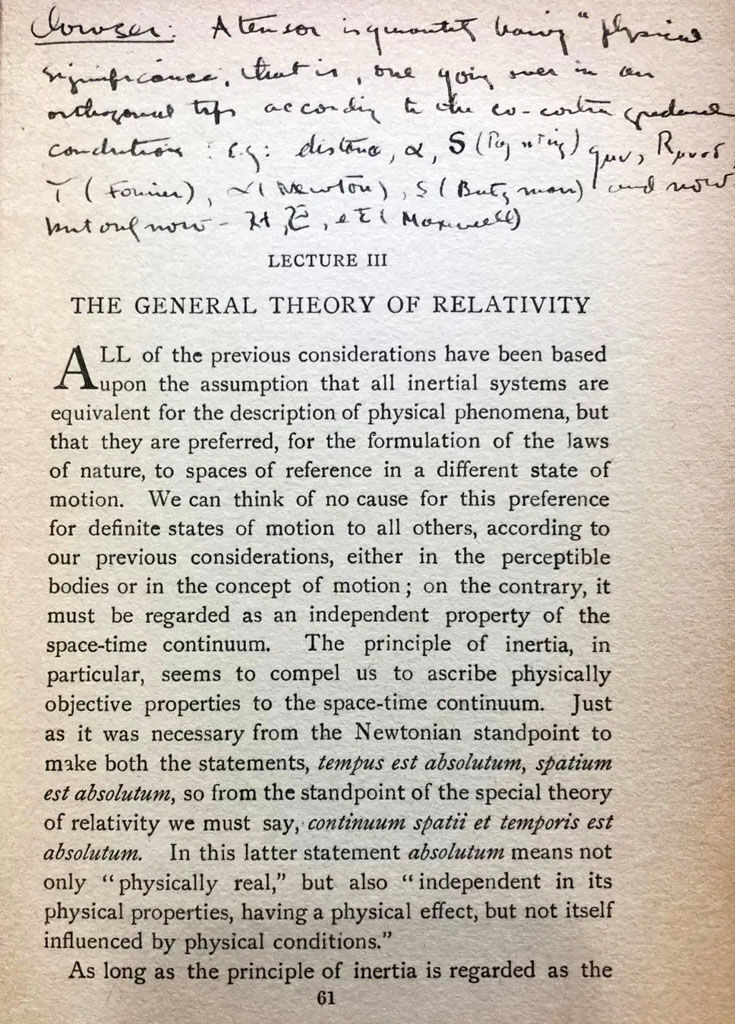
While a majority of the books are, notably, gifts to Oppenheimer, some are clearly his personal copies, with the thorough markings to prove it. For example, Oppenheimer’s copy of Albert Einstein’s “The Meaning of Relativity,” a collection of four lectures that had been delivered at Princeton University and published by Princeton University Press, “the first book by Einstein to be produced by an American publisher,” is described as “heavily annotated” (Oppenheimer 30).
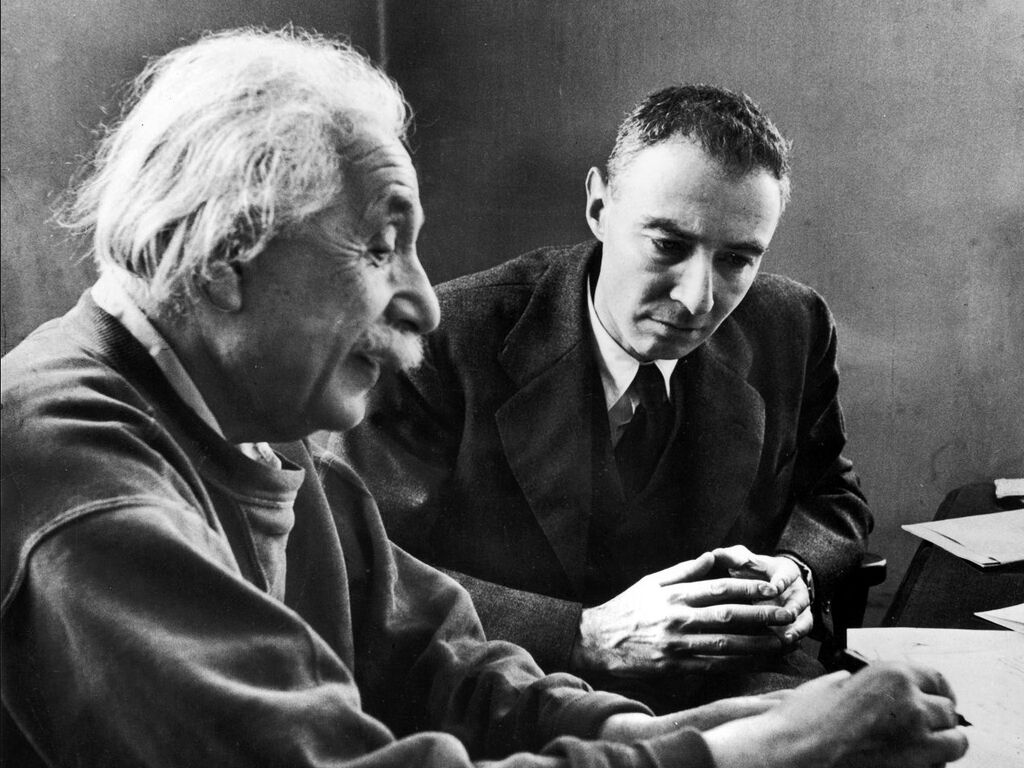
In contrast to the 2023 movie, which depicts mostly fictitious talks between the two, Einstein and Oppenheimer were more colleagues than friends. Despite their generational, scientific, and political differences, the men developed a greater mutual respect for each other in their later years, particularly after Oppenheimer moved to Princeton in 1947, where Einstein was his colleague at the Institute for Advanced Study until the latter’s death in 1955.
Oppenheimer is most recognized for his scientific and intellectual interests, but his unique position at Los Alamos placed him at the crossroads of politics, history, and philosophy.
For starters, Sarconi described Felix Adler’s “An Ethical Philosophy of Life: Presented in Its Main Outlines” (Oppenheimer 1) as “well-used” and dated as being from 1918, a considerably early point in Oppenheimer’s life, implying that “he held onto this book for a long time.”
Adler was known as the founder of the New York Society for Ethical Culture and the “Ethical Culture Movement,” a humanist philosophy that advocated for social reforms. Oppenheimer, who befriended and romanced members of the Communist Party — never formally identifying as one but being vocal about the causes he supported — likely read Adler’s words sometime in his youth, with Sarconi observing that while this tells us Oppenheimer was “thinking concretely” about ethics in this way, he would still go on to create the atomic bomb.
Sarconi observed that while going through the collection, many of the authors expressed “admiration” for Oppenheimer in their inscriptions, “and some of it is interesting within the context of what they’re thanking him for.”
He even owned historical examinations about the consequences of his actions, she added, referring to D. S. Kothari’s book “Nuclear Explosions and Their Effects,” which indicates “an acknowledgement of his role in this larger story.”
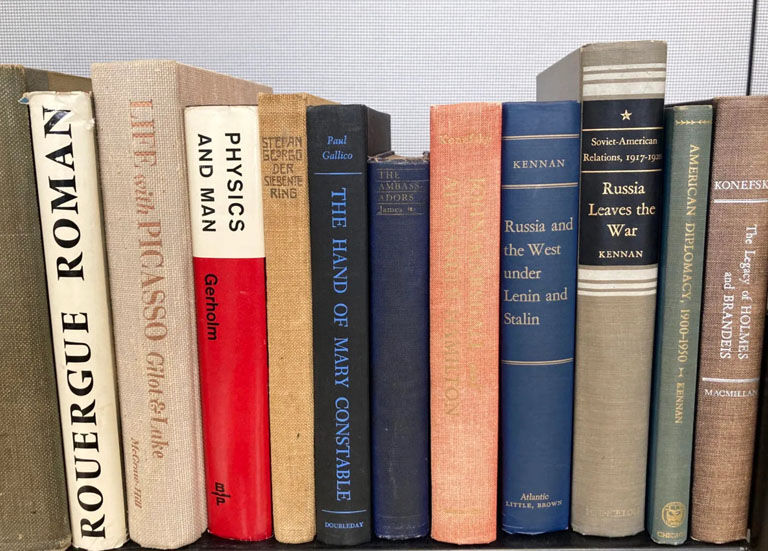
Oppenheimer’s collection is also rich with connections to local Princeton figures like diplomat and Princeton graduate George F. Kennan, the author of “Russia Leaves the War” (Oppenheimer 66), which won the 1957 Pulitzer Prize for History. Another book is from Arthur S. Link, the historian and former professor who spent more than three decades chronicling and compiling the documents of Woodrow Wilson — the former president of Princeton University and the United States of America, as well as Governor of New Jersey — into “The Papers of Woodrow Wilson,” published by the Princeton University Press.
In one of those works, “Wilson, Volume II: The New Freedom” (Oppenheimer 85), Link wrote the following: “For J. Robert Oppenheimer, whose service to the nation and mankind perpetuates the ideals of Woodrow Wilson. With the admiration and regard of Arthur S. Link and with his gratitude for the year 1954–1955 at the Institute for Advanced Study, where this book was written.”
Oppenheimer was also a teacher, as shown in his copy of “Introduction to Concepts and Theories in Physical Science” by Gerald James Holton, inscribed with the following quote: “To J.R. Oppenheimer – In appreciation of his interest in the problems of education…this source and reference book for student use attempts to handle the teaching of the historical and philosophical context of elementary physical science without sacrificing the maximum permissible rigor of the scientific material. I shall appreciate your comments.”
True to Oppenheimer’s multilingual abilities, his library features literature in languages other than English, such as German, Swedish, and French. His copy of Erich Auerbach’s famous literary criticism “Mimesis: The Representation of Reality in Western Literature” (Oppenheimer 5) and another, more worn collection of poems by philosopher and translator Otto Hellinghaus (Oppenheimer 54), both German, demonstrate the dichotomy between the titles he owned.
Once living in Princeton, Oppenheimer attended shows at the McCarter Theater and saw at least one film, a later showing of Jean Renoir’s 1937 anti-war movie “The Grand Illusion,” at the Princeton Garden Theatre, which allegedly brought him to tears.
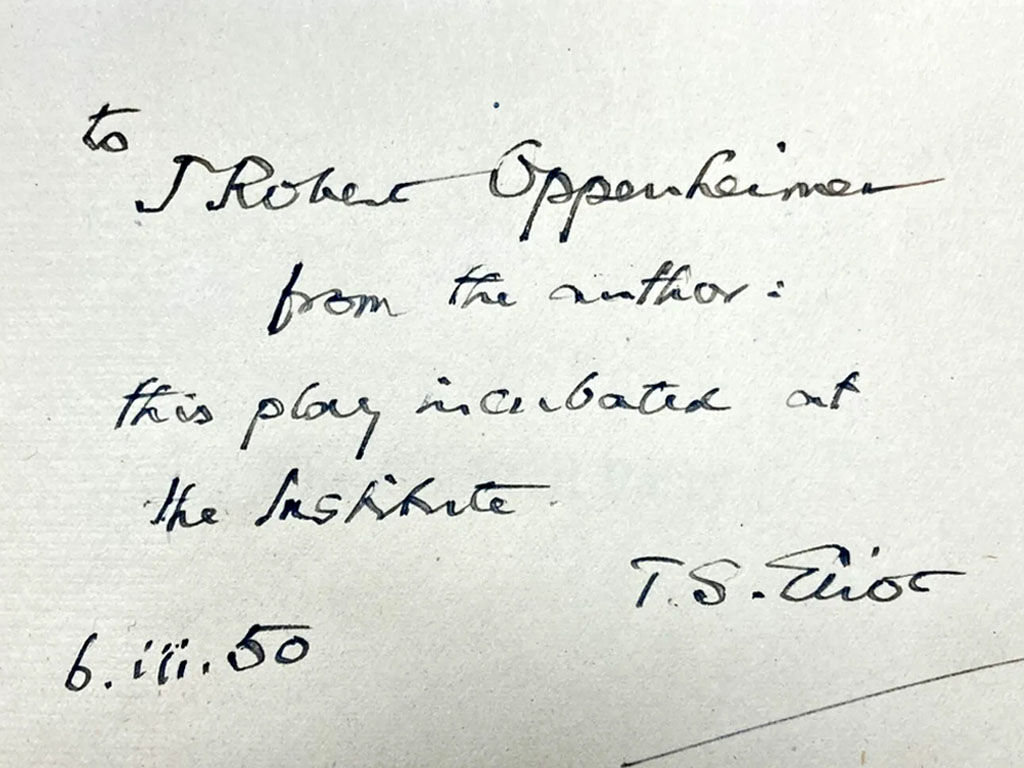
He owned copies of comedic plays like “The Cocktail Party” by T.S. Eliot, who wrote in his inscription that the piece had been “incubated at the Institute” back when Eliot was a visiting scholar in 1950, and Christopher Fry’s “The Lady’s Not for Burning,” where the playwright signed “To Oppy and Kitty,” evoking Oppenheimer’s nickname.
“A lot of these books are also donated to or inscribed to Robert and Kitty Oppenheimer, which I think is also a really interesting window into their life as a couple,” Sarconi said. “This book collection tells us that he was not a person [who] stood alone; they were very much a unit to the people who gave these books to him.”
Other works, like “Abraham Lincoln: Complete Works, Comprising His Speeches, Letters, State Papers, and Miscellaneous Writings” (Oppenheimer 82); “Looking Backward, 2000–1887,” a utopian science fiction novel by Edward Bellamy (Oppenheimer 6); and “Poems in Places: A Collection Including Poems for Small Apartments” by Edward Newman Horn (Oppenheimer 58), show “the breadth of this collection,” according to Sarconi.
Circling back to the Hindu scripture, Sarconi added that it seemed like “Oppenheimer’s relationship with the Bhagavad Gita was a lifelong one.” The film, despite using the Bhagavad Gita in a “highly imagined context,” likely “broadened the number of people who maybe know the way in which this one text really affected this person or was built into their life.”
Oppenheimer never strictly practiced Hinduism but found himself drawn to the philosophies present throughout the Bhagavad Gita, which are explained in relation to his oft-contradictive personality by James Temperton in the WIRED article “‘Now I Am Become Death, the Destroyer of Worlds.’ The Story of Oppenheimer’s Infamous Quote,” from July 21.
Oppenheimer studied at both Harvard and Cambridge before he taught at the University of California, Berkeley, where he also learned Sanskrit to interpret the Bhagavad Gita.
“Our copy is minimally translated by him. It sounds like he was really relying on the book to offer him counsel in moments of need. The movie certainly, I think, if it doesn’t dive into that entire story, helps you dip your toe into it. It might help people take the next step and Google his relationship and learn more, and then they could come here and see the book — our copy — which was his copy of the book itself” (Oppenheimer 7).
What caught Sarconi’s attention upon seeing Oppenheimer’s copy were two key points: “One, it’s bright pink, which in the Barbenheimer age is a beautiful and wonderful coincidence,” she said, referring to the colloquial shorthand for the dual summer release of “Barbie” and “Oppenheimer,” a pop culture phenomenon where eager cinemagoers attended both premieres in themed outfits.
“But the other thing about it is that it is destroyed, right? This is a book that was extremely well used. A book doesn’t get like this without somebody really opening and closing it quite a lot throughout their lifetime, or its lifetime. You also have these strips of tape across the front that indicate that someone at one point was trying to repair it — that repair did not hold — [and] the front and back boards, as we say, are completely falling off.”
“Once you dive into the book, you can see that there are really light pencil marks throughout, both in the margin and above the text,” she added, noting that they worked with Ellen Ambrosone, a South Asian studies librarian who was able to read Sanskrit somewhat, to see whether the “infamous line” was translated.
“Unfortunately, it is not, because that would be just too perfect, but the fact that he was translating it all is pretty significant,” she said. “I’m really excited that we have this item, and we’re getting it out there that we have this item so that people can, again, take the time to dig in and think about who Oppenheimer was, what was this book to him, [and] how was he thinking about this book, especially within the context of his work on the atomic bomb?’”
After the United States dropped the nuclear devices developed under Oppenheimer’s leadership on the Japanese cities of Hiroshima and Nagasaki on August 6 and 9, 1945, respectively, Oppenheimer was deemed a national hero, far removed from the civilians of the impacted nation.
Science and nuclear technology historian Alex Wellerstein is a professor at the Stevens Institute of Technology in Hoboken. In his 2020 Bulletin of Atomic Scientists article, “Counting the Dead at Hiroshima and Nagasaki,” he reviewed reports on the total number of deaths, analyzing the difference between the inconsistent data sources with the following statement: “The United States military estimated that around 70,000 people died at Hiroshima, though later independent estimates argued that the actual number was 140,000 dead. In both cases, the majority of the deaths occurred on the day of the bombing itself, with nearly all of them taking place by the end of 1945.”
Sarconi wanted to acknowledge the whole truth of Oppenheimer’s legacy and the devastation he was directly responsible for as part of the Manhattan Project, keeping the repercussions of this “celebrity quality” in mind throughout writing the blog post.
“I think that you can just learn a lot about a person based on the books that they have, who gave them to them, and in what context,” Sarconi continued. “When you have this person who is known for this extremely significant thing that they contributed to, it’s easy to forget the effect of that.”
“We don’t know exactly what he thought about what was happening [or] his role in the long arm of history, but we know what his role is in the long arm of history, and on the one hand, you can hold him up as this scientific genius — and he did do something that was scientifically genius — but he also did something that was truly terrible, terror-inspiring, and I think we have to hold both of those things at once,” she explained, especially as it pertains to conversations about “the effect of genius.”
She emphasized that when analyzing Oppenheimer as a person, it is equally crucial to take into account that his innovation bears the scars of the lives lost.
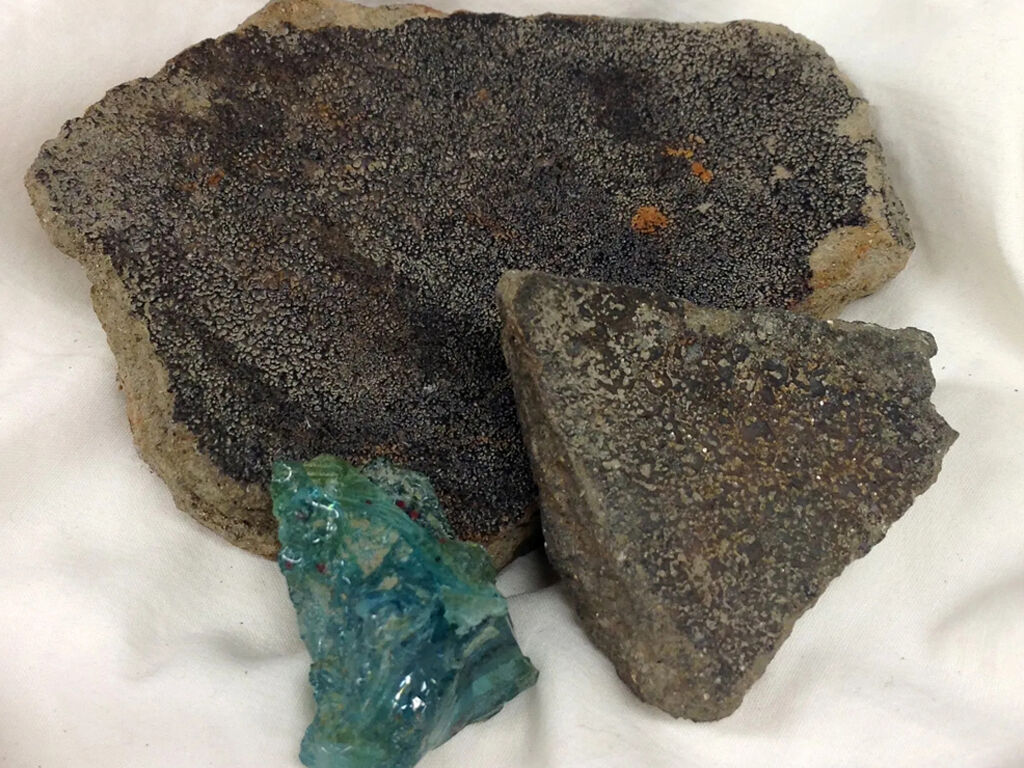
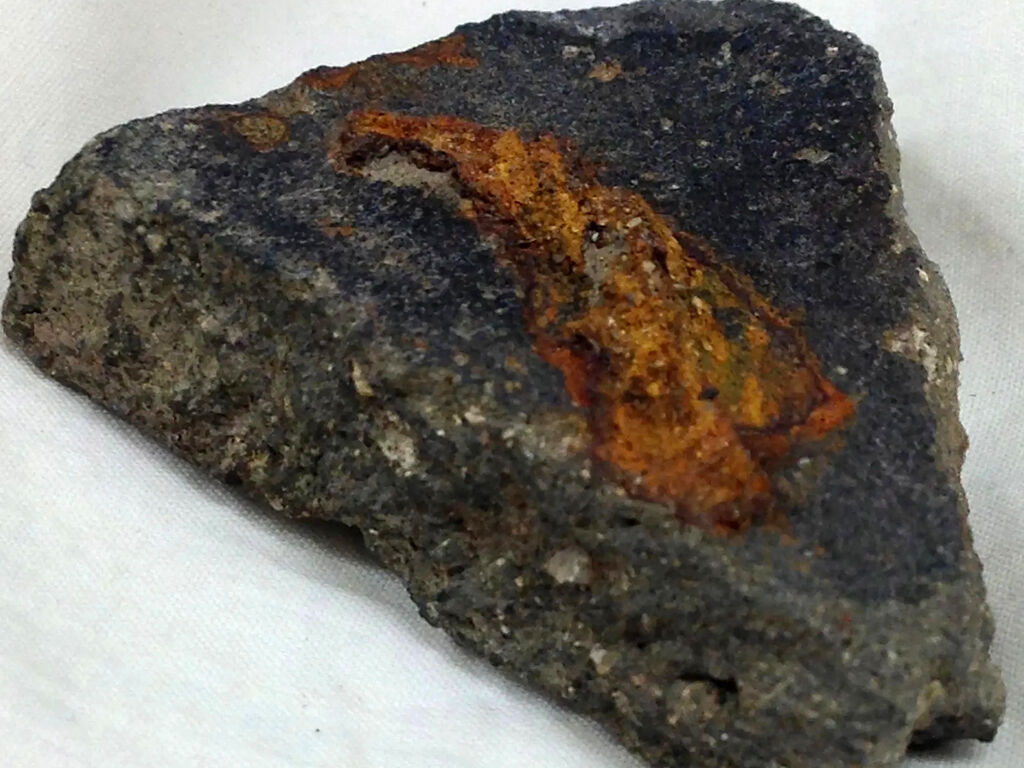
The Mudd Library, the institutional archives of the PUL Special Collections, documents several Japanese responses to the bombings, such as the seven “Atomic-Bombed Roof Tiles from Hiroshima University,” donated in 2012 by the Association of Hiroshima University for Sending Atomic-Bombed Roof Tiles.
According to the February 2013 Princeton University Archives’ accession announcement by Lynn Durgin, the pieces were recovered from “a river bed near ground zero of the atomic bomb explosion.”
The post continued: “Hiroshima University was decimated in the atomic bomb attack — most of its students and faculty members perished, and its buildings were demolished. In the post-war period, Hiroshima University’s president, Tatsuo Morito, reached out to universities worldwide to help to renew the institution by sending books for its library and saplings to bring its grounds back to life. Princeton was among the schools that responded in 1951 by providing both a book for the library’s collection and a monetary donation for the purchase of a native tree for the campus; and now, in celebration of its 80th anniversary, Hiroshima University is reciprocating by donating these artifacts.”
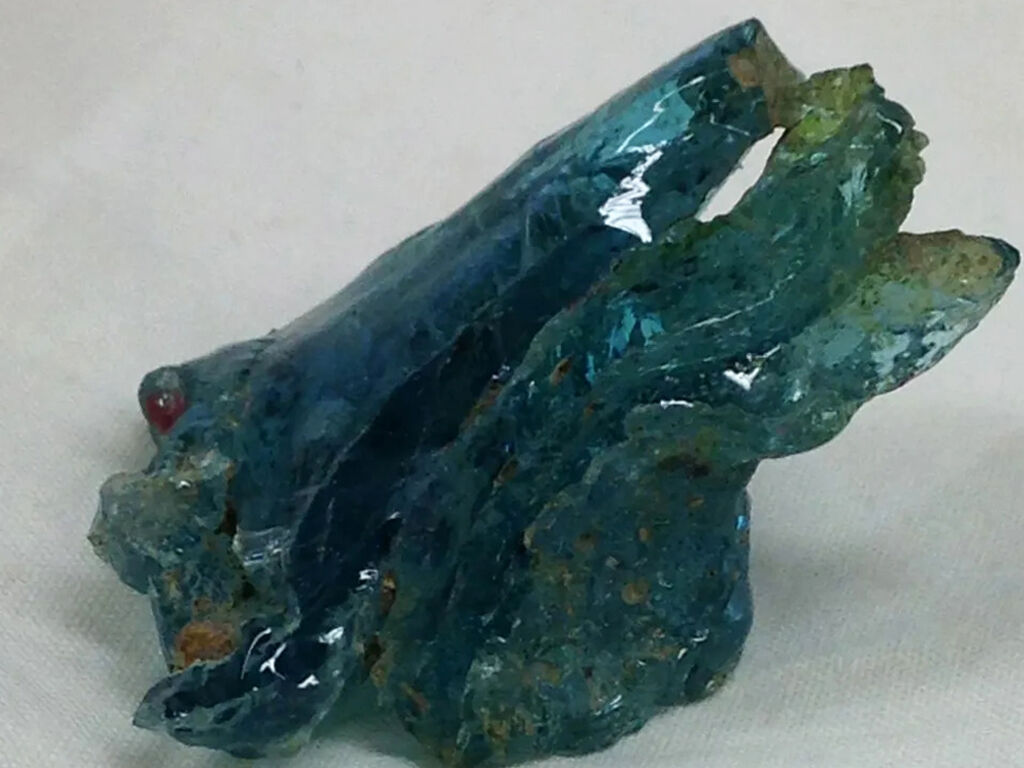
Rebun Kayo, the chairman of the “Association of Hiroshima University for Sending Atomic-Bombed Roof Tiles” at the time of the donation, stated in an accompanying letter that these “demonstrate the devastation of the inferno that the atomic bomb explosion left,” in which temperatures of approximately 9,032 degrees Fahrenheit “melted the surface of the roof tiles, leaving a bubbly appearance on them in a matter of a few seconds.”
“Atomic-bombed roof tiles have absorbed [the] blood and body fluids of tens of thousands of people who were inhumanely burned dead,” he continued. “They were burned by the 5000°C heat rays, leaving their skin scorched black, and the functions of their organs [were] destroyed by the radiation. They were desperately seeking water while repeatedly vomiting, bleeding all over their bodies, and throwing up blood. When they finally reached the river in their hour of death, at the end of their strength, they collapsed, only to be washed away in the river.”
Then-president of Hiroshima University, Toshimasa Asahara, also wrote: “The threat of nuclear weapons still exists in many areas of the world. It is our earnest desire, however, that the pain and sadness experienced in Hiroshima not be recreated anywhere else in the world. This wish is not only the wish of those of us living today but represents the silent voices of the 240,000 Hiroshima citizens who perished from the atomic bomb.”
As Japan grappled with its unfathomable loss, Oppenheimer was appointed chairman of the General Advisory Committee to the United States Atomic Energy Commission, where his fears about nuclear proliferation deepened and led him to speak out against the development of the hydrogen bomb.
Although Oppenheimer was praised for his scientific achievements at Los Alamos, his previous communist ties warranted ongoing federal surveillance. During the Red Scare in 1954, the FBI and the Atomic Energy Commission revoked his security clearance, just nine years after he changed the course of history; fittingly, Oppenheimer went on to own a copy of Richard H. Rovere’s “Senator Joe McCarthy” (Oppenheimer 129).
The U.S. Department of Energy, which still operates the facility known as the Los Alamos National Laboratory to this day, vacated the controversial decision in 2022.
Sarconi said there are still many “unanswered questions” about Oppenheimer’s PUL collection, which opens up a world of possibilities for inquisitive minds.
“I hope that in this space and as a librarian, a special collections librarian in particular, where we’re really working with sometimes what we call ‘the building blocks of history,’ there’s certainly bias in this space. We’re doing more and more to try and see people as a whole, the good and the bad, and how they really shaped the world we live in today. The thing about Oppenheimer is that, regardless of whether you think he is a villain or a hero, he dramatically shaped the world we live in today, and so that’s why I think this collection is really important,” she explained. “How can we understand this person [who] was so vital to our modern society?”
As Nolan’s star-studded yet self-aware biopic sets a path for Hollywood awards season, the town that Oppenheimer spent the final years of his life in has been eager to claim the figure as one of its own. But to do so, Princeton must accept the truth about the new era ushered in by his creation, just as Oppenheimer’s collection of books proved that he privately reflected on the consequences of his acts.
To access the “Books formerly owned by J. Robert Oppenheimer” collection, available under call number “Oppenheimer” for on-site viewing in the Firestone Library Reading Room, see the collection’s PUL catalog link.
The same rules apply to the roof tiles from Hiroshima University, which are stored at the Mudd Library location.
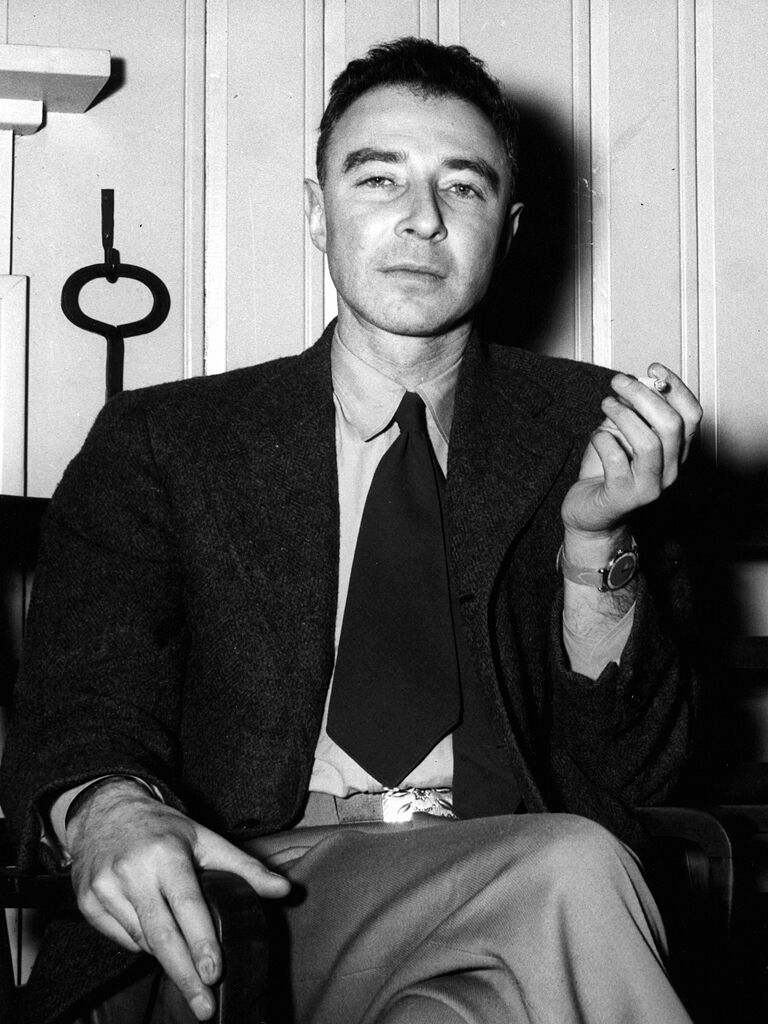
Theoretical physicist J. Robert Oppenheimer, "the father of the atomic bomb," at the Guest House in Oak Ridge, Tennessee, in February 1946. (Photo by Ed Westcott),
J. Robert Oppenheimer's copy of the sacred Hindu text known as the Bhagavad Gita, with a worn, pink cover, is a colorful introduction to the Princeton University Library collection of books he once owned.,
T.S. Eliot wrote in an inscription to Oppenheimer that his play 'The Cocktail Party' was 'incubated at the Institute.',

Sarconi highlighted another set of artifacts in the PUL Special Collections, several atomic-bombed roof tiles gifted by Hiroshima University in 2012, that show the impact of Oppenheimer's creation on Japan.,