Local officials are expressing outrage after Trenton Water Works revealed that an employee falsified water quality data for more than a year.
The public was first notified of the situation by TWW in a letter dated Nov. 27 to its 200,000 customers. The letter also stated that the N.J. Department of Environmental Protection found after an investigation that the utility failed to meet state and federal drinking water monitoring requirements during that time.
TWW did not post the notice online or notify the media about the employee’s actions.
The utility, which is owned and run by the city of Trenton, supplies approximately 29 million gallons of drinking water every day to all of Trenton and Ewing, and parts of Hamilton, Hopewell and Lawrence townships. It is also providing water service to Bordentown City on a temporary basis while repairs are made to its water-treatment plant.
Trenton Mayor Reed Gusciora on Dec. 3 released a public statement after anger erupted among officials and customers in the impacted communities. He explained that that TWW discovered in the fall of 2023 that a water sample collector—one of three employees responsible for this task—was falsifying drinking water data.
“This individual’s actions were a clear violation of public trust and are deeply disturbing,” said Gusciora.
He said that after discovering the violation, TWW notified the DEP of the employees’ action, referred the matter to law enforcement and took steps to fire the employee.
The DEP investigation stated that most of the water samples collected between October 2022 and December 2023 were invalid, and the state concluded that TWW failed to adequately monitor and test for the required contaminants during that time.
TWW is required to regularly test drinking water for specific contaminants, including disinfection byproducts, E. coli, total coliform, iron, manganese, alkalinity, pH and orthophosphate. These tests are used to determine if the water meets state and federal health standards.
In his statement, Gusciora expressed assurances that the water is safe and that TWW has “taken decisive steps to strengthen oversight of our water sample collection process.”
He said that TWW’s measures include installing GPS trackers on fleet vehicles; pairing employees with supervisors; requiring photo documentation of sample sites; utilizing tablets with specialized software; and providing additional training.
“TWW’s water quality testing is comprehensive and adheres to federal and state Safe Drinking Water Act regulations,” Gusciora said.
He added that although DEP invalidated a portion of the data collected over the 13-month period, “I want to assure the public that at no point was the water provided to consumers unsafe to drink.”
Officials in the affected communities reacted harshly to the news, with one calling for the state to take control of the utility.
The incident is the latest in a long list of problems that have plagued TWW for more than a decade. It has faced numerous issues over the years, including water quality concerns, regulatory violations and operational challenges.
Hamilton Mayor Jeff Martin called for “every government, business and community leader” to demand a state takeover. “Silence or passive statements when lives are at stake will no longer be an option.”
Martin added: “What this latest screw-up makes abundantly clear is that NJDEP must take away control and operations of Trenton Water Works from the City of Trenton. Too many promises have been broken and the health of too many is in the balance to trust the city can operate TWW.”
Martin said he expects that that a DEP report set to be released in 2025 will “expose even more systemic negligence at TWW.”
Ewing Mayor Bert Steinmann issued similar remarks, although he stopped short of calling for a state takeover.
“The health and safety of our residents must never be compromised, and this latest failure underscores a persistent inability of TWW to uphold its responsibilities,” Steinmann said. “While TWW claims there is no immediate public health risk, I share the frustration and mistrust felt by many Ewing residents and our neighboring communities.”
Steinmann urged the DEP to increase its regulatory scrutiny and to provide clear, ongoing communication about TWW’s compliance and improvements.
He said the township will advocate for emergency measures to support residents with specific health concerns and for more robust long-term reforms in TWW’s operations.
“Our residents deserve better, and we will continue to fight for the safety and quality of Ewing’s water supply,” Steinmann said.
He also reiterated that Ewing, along with Lawrence and Hamilton townships, have intervened in a lawsuit brought by DEP against TWW and will continue to use the litigation to ensure transparency and accountability in the utility’s operation.
Lawrence Township Municipal Manager Kevin Nerwinski called the situation “deeply troubling,” and also mentioned that township officials continue to advocate for the residents who are customers of TWW by intervening in the DEP lawsuit.
“It is incomprehensible that a single employee could control and manipulate critical monitoring data, potentially putting customers at risk with no checks and balances in place,” Nerwinski said.
“This is a major step back in the fight to restore trust and confidence in the quality of the drinking water produced and distributed to TWW customers,” he said. “We demand much better.”
The DEP in 2022 intervened in the daily operations of TWW after finding that it failed to address numerous problems in the provision of safe drinking water for many years.
In 2020, the state attorney general and DEP filed a lawsuit against TWW—which was later joined by the municipalities served by the water utility—seeking to compel the City of Trenton and the water utility to take the necessary actions after failing to comply with Administrative Consent Orders to provide safe drinking water.
The state has said that TWW needs significant improvements to aging infrastructure, including its 7-acre, open-air-reservoir that stores and provides already treated water to about 70 percent of TWW’s distribution system. The reservoir is in violation of a federal requirement that all outside reservoirs be covered.
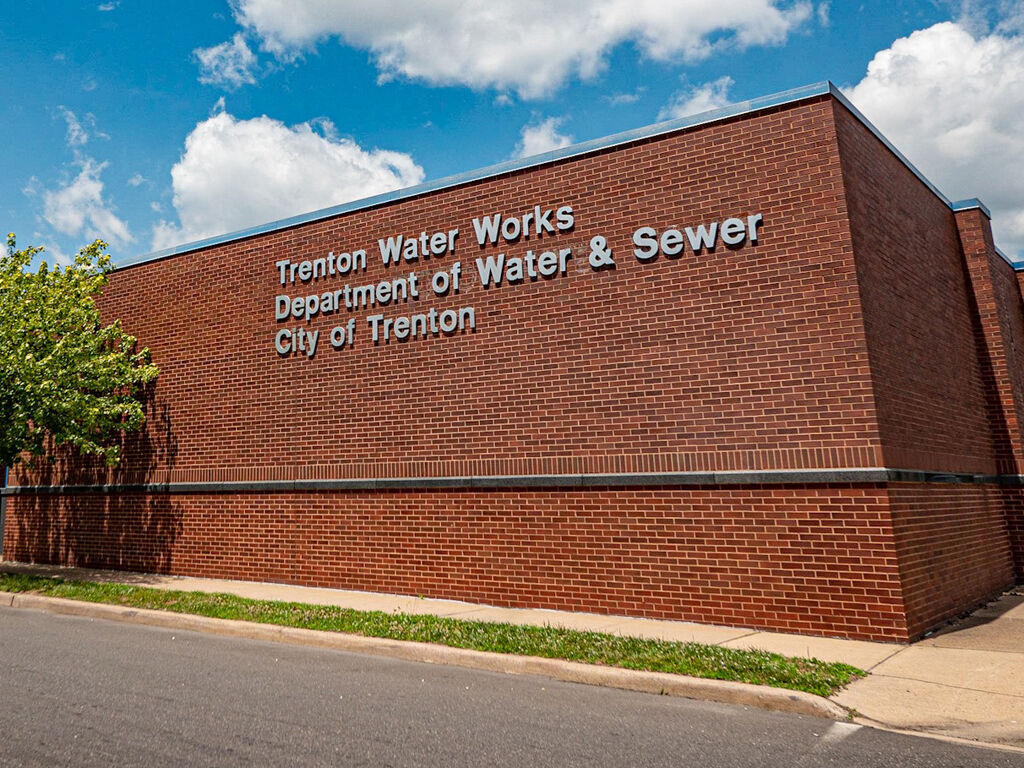
Trenton Water Works administrative building at 333 Cortland St., Trenton.,

