Music so rare it’s never been heard before in the United States, perhaps even the world.
This is what’s in store for listeners and lovers of ancient music when vocal ensemble Demestvo performs “Lost Polyphonies,” an evening of exceptional music from the 12th through 17th centuries.
Led by Anastasia Shmytova, a soprano, musicologist, and PhD candidate in the musicology department at Princeton University, the concert will offer early polyphony from France, Georgia, Russia, Byzantium, and England, including world premieres of newly transcribed chants that have not been heard for more than 300 years.
Alongside these pieces, the Demestvo ensemble and guest artists will perform new works by Princeton graduate composers Justin Wright, Lucy McKnight, and world renowned composer Caroline Shaw.
It is a truly varied program, created to showcase some of the radically divergent early polyphonic traditions.
The free concert takes place at the Princeton Theological Seminary Chapel, 64 Mercer Street, Princeton, on Thursday, December 5, 8 p.m. There will be a reception afterward, featuring wines from each of the countries and regions represented in the evening’s music.
Named after a Slavic polyphonic chant tradition, the Demestvo ensemble was conceived as part of Shmytova’s dissertation research on medieval Slavic chant and early polyphony. The ensemble is committed to bringing the unique sound world of this unheard music to contemporary audiences.
In addition to Shmytova, who founded Demestvo (pronounced de-mest-VO) in 2023, the ensemble consists of Lucy McKnight, who is studying composition at Princeton, Maddy Kushan, studying musicology, and Emma Simmons, a PhD candidate in the Department of Slavic Languages and Literature.
“All of us sing together in the university’s chamber choir, so that’s how we met,” Shmytova says. “It happened organically, we just all became friends. I was telling them about the chant I was transcribing, and we started meeting up to sing it. It started out as a weekly thing just for fun, then we realized we wanted to pursue it more seriously.”
Almost all the chants performed at the concert are sacred, except for a piece from France about the joys of living in medieval Paris.
“We’ll do two pieces from the 13th century, from the Montpellier Codex,” Shmytova says, referring to the large and rich collection of 13th century French polyphony.
As for the Georgian chant, the harmonies are so distinct to that country and region, Demestvo has been Skyping with an instructor in Tbilisi (the capital of Georgia) to polish the singular stylistic aspects.
The contemporary pieces are all responses to the ancient chants in the concert. Cellist, composer, multi-media artist, and Princeton PhD composition candidate Justin Wright (U.S. 1, September 27, 2023) has written and will perform a piece in response to the 12th century English chant taken from the “Winchester Troper.”
“Lucy’s piece is responding to a Slavic chant we’re doing, which adds nonsense syllables to the liturgical text, almost a lullaby, as though the angels that visited Jesus at his birth were singing to him,” Shmytova says.
“Caroline Shaw’s work is based on a chant by Hildegard of Bingen,” she says, referring to the German Benedictine abbess (1098-1179), who was also a writer, composer, philosopher, mystic, and visionary during the High Middle Ages.
She is especially pleased that Demestvo will be performing at the Theological Seminary. “The chapel there has wonderful acoustics, and it’s a more intimate setting than the university chapel,” Shmytova says, imagining what it must have been like to hear the sweet, haunting harmonies of these chants in a medieval cathedral.
Polyphony (literally “many voices” or “many sounds”) emerged and began developing in the late medieval period, specifically around the 12th century, with significant contributions from composers of the Notre Dame School in Paris.
This is where the practice of adding additional melodic lines to Gregorian chant laid the foundation for polyphony. It reached its peak of complexity during the Renaissance period with figures like Franco-Flemish Josquin des Prez and the Italian composer Giovanni Pierluigi da Palestrina further refining the technique of counterpoint within polyphonic composition
It was in the 17th century, however, when choral music in Russia and Ukraine flourished. This century was also considered the richest in the variety of sacred music styles in that part of the world.
Shmytova has immersed herself in this time period, painstakingly transposing the chant so that it can be read and performed by contemporary singers and musicians.
“It’s a time where there was a lot of music in Russia, and it’s very under-studied and rarely performed,” she says. “One of the things we’re doing at the concert is a world premiere, something that hasn’t been heard since the 17th century. As for the Byzantine pieces and the pieces from England, they’re all written in a specific notation, which has to be transcribed so that modern musicians can read it.”
“These are all prepared by scholars who specialize in these handwritten transcriptions,” she adds. “They are unpublished and therefore not performed very often in the United States if not all over the world.”
Shmytova was born in Saint Petersburg, Russia, and came to the United States with her parents at age four, settling in the Seattle, Washington area. Music has always been a part of her life.
“I grew up in the Russian Orthodox church, where my mother sang in the choir, and I used to go with her,” she says. “So I was a four-year old listening to and singing sacred music.”
“Both of my parents are musicians — my dad played in heavy metal bands, one of which was called Brazhnik Mertvaya Golova, which translates to Death’s head Hawkmoth (a type of butterfly). Some of these bands were quite famous in the St. Petersburg underground scene,” Shmytova says. “Mom was a singer-songwriter, but they didn’t have a formal education in music. It was then decided that I would get a formal education, and I was signed up for piano lessons around age four.”
Shmytova did her undergraduate work at Saint Petersburg State University (Russia), earning a bachelor of arts in 2017. She chose Princeton University for her master’s studies in musicology (2021) and PhD work, which she hopes to complete in 2026.
“I wanted to do my doctorate in the States, because I wanted to teach at an American or European university,” she says, noting Princeton is an outstanding school for music. She has been especially nurtured in her studies of notation and transcriptions of ancient Slavic and Russian music.
“Princeton has the best musicology department,” Shmytova says, “I’ve studied with Simon Morrison, who has published books about Soviet and Russian music – I knew his work from when I was a teenager. I’ve also had classes with Jamie Reuland and Rob Wegman, renowned specialists in Early Music. I got to take courses with all three, and they’ve been so helpful.”
“There are not many places to work on this in the U.S., but Princeton has given me a lot of support, for example, opportunities to study abroad, to study and Skype with professors in Russia, taking lessons in notation, etc. Princeton gives all of us a lot of resources,” she says.
Shmytova reflects that later Russian music is well-known, with composers such as Rachmaninoff, Tchaikovsky, Mussorgsky, etc., but earlier periods of Russian music are not widely studied.
“The rest of the world has no idea,” she says. “I think it’s really special music and exciting to hear for the first time.”
“As I am preparing my dissertation, I want to hear what these chants sound like, bring them to audiences, and bring them to life,” Shmytova says. “This has always been an idea of mine.”
Lost Polyphonies, Demestvo Ensemble, Princeton Theological Seminary Chapel, 64 Mercer Street, Princeton. Thursday, December 5, 8 p.m. Reception to follow. Free. For further information, email shmytova@princeton.edu. www.ptsem.edu.
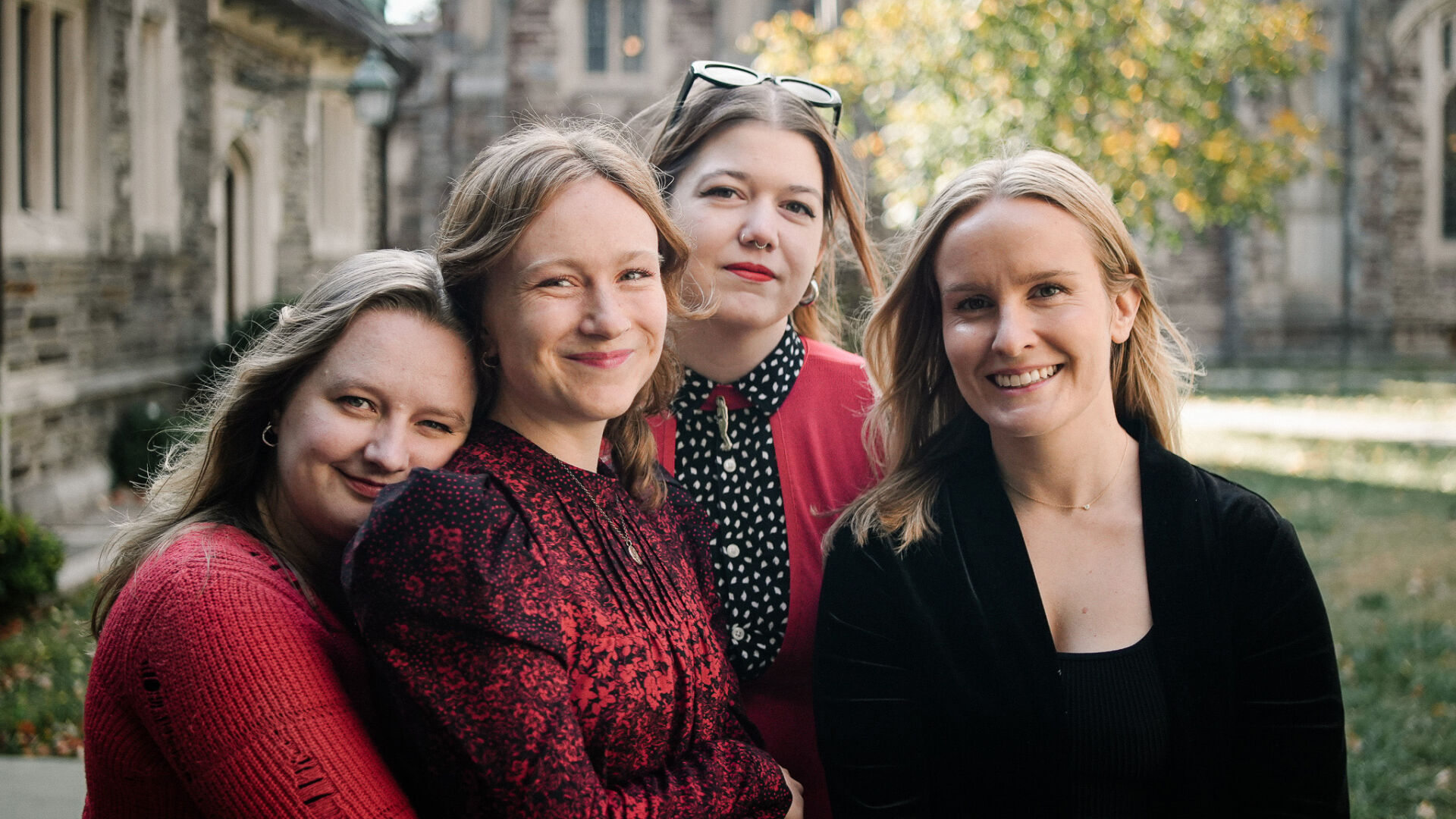
Demestvo includes, from left, Emma Simmons, Anastasia Shmytova, Lucy McKnight, and Maddy Kushan. The ensemble performs on Thursday, December 5, at Princeton Theological Seminary.,

