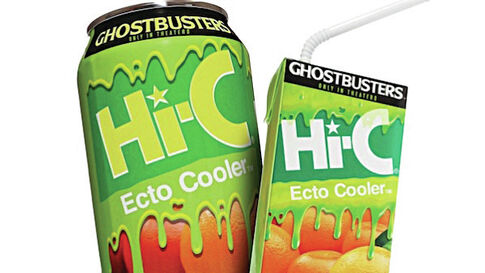
If my early childhood had a flavor, it’d be a super-sweet citrus concoction called Ecto Cooler.
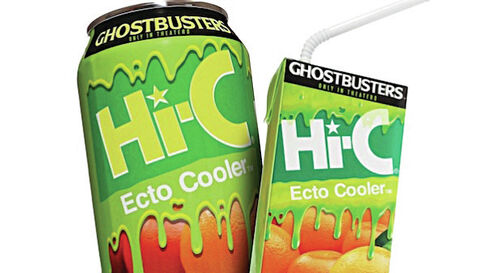
Released by Hi-C in 1989, Ecto Cooler came in packaging branded with Slimer, a neon green ghost from the Ghostbusters movies and cartoons. The drink itself mimicked Slimer’s unnatural color. Through the early 1990s, my blood most likely flowed in a similar hue—I had juice boxes of the stuff for school and 46-ounce aluminum cans of it at home, those old cans that you needed to punch holes in. I was crazy about Ghostbusters, and I was crazy about Ecto Cooler.
In anticipation of the July release of the Ghostbusters reboot, Coca-Cola—which owns Hi-C—rebooted Ecto Cooler. The drink hadn’t been on shelves in nearly 15 years, and I hadn’t tasted a sip of it in far longer. But, for some reason, seeing the advertisements for the new Ecto Cooler—41 grams of sugar in a serving—awoke the 4-year old inside of me. I needed it.
So did a lot of other people, apparently. Stores have been selling out of the stuff, and 12-packs have been going on eBay for twice retail value. Walmart, one of the preferred carriers of the drink (seriously), didn’t have any in stock at the local stores, but offered customers the option to order Ecto Cooler online and have it shipped to the store. So I did.
My package arrived the next day, kept deep in the bowels of Walmart’s store room, packaged in a brown cardboard box and locked in a cage, as if Walmart was concerned about the Ecto Cooler’s safety. The Walmart employee who retrieved the item was roughly my age, and when he handed me my box full of Ecto Cooler, he smiled one of those knowing smiles.
“Nice,” he said. There wasn’t an ounce of sarcasm in his voice. He knew what this drink meant to our generation.
As did Coca-Cola and Columbia Pictures. They didn’t release the drink and the movie on a whim. They knew they could tap into a powerful current running through our society—the Nostalgia Economy.
And this economy is strong. This summer, 13 of the top 15 grossing movies were sequels or remakes of previously existing movies or adaptions of pop culture icons. Pokémon Go reached heights no mobile game has before. Nintendo announced it will release something in November called the NES Classic, a $60 piece of equipment that comes loaded with 30 video games from the 1980s and early ’90s. Sega announced it has started work on a Sonic the Hedgehog movie. Two Viacom properties—Nickelodeon and MTV—have begun dedicating large blocks of time to decades-old programming on The Splat and MTV Classic. The X-Files returned in 2016. A new MacGyver series will premier Sept. 23. A new Star Trek series is coming in January. And consumers bought a record $251.7 billion in Star Wars merchandise in the last year.
Or, as one meme put it, “Everyone’s playing Pokémon, Blink-182 has a No. 1 song, and a Clinton is running for president. What year is it again?”
So arises another question: are we out of ideas, or has nostalgia always been so strong?
“Now it may be more obvious, but this kind of thing is not new,” said Robert Thompson, director of the Bleier Center for Television and Popular Culture at Syracuse University. “The entertainment industry is looking for things that are low risk. You’ve got these properties that have all this equity. They’ve been sold once already.”
Thompson, in an interview, likened it to a house after paying off the mortgage—why move on from something you’ve invested in and has been proven to work when the alternative is less certain? There’s the added bonus that studios are capturing old audiences who will buy in because of nostalgia, as well as new people who may have missed the original craze.
Nostalgia has been working like this for years. In the 1970s, there was a ’50s revival, and shows like Happy Days, Laverne and Shirley, and MASH ruled the day. In the 1980s, The Brady Bunch spawned what Thompson called a “cottage industry,” with a movie, a show and a traveling performance. And now, in the 2010s, it’s time for the 1980s and 1990s.
Thompson guessed one of the reasons the trend is more apparent is there are far more entertainment options now than ever before. Streaming services like Amazon Instant, Hulu and Netflix are making original programming, in addition to network television, cable TV, movie studios, video game studios and record labels. There’s more nostalgia simply because there is more stuff.
Thompson pointed to Netflix’s Fuller House, a follow-up to the hit 1990s series Full House, as an example of a production that probably would not have been made in a world with fewer entertainment outlets. Netflix also has gone in on more-recent hits, such as Gilmore Girls and Arrested Development, and released a series called The Get Down, based in late 1970s New York that pays tribute to the rise of hip-hop music. HBO also hit on the 1970s music scene this year with Vinyl.
But nostalgia does not guarantee success. For every idea that works, Thompson said there are many more that don’t, like The Love Boat: The Next Wave.
“In the end, it’s got to be good, or else people aren’t going to watch it,” Thompson said.
That goes similarly for products, too. Which reminds me—anyone interested in purchasing 10 cans of Ecto Cooler?
,