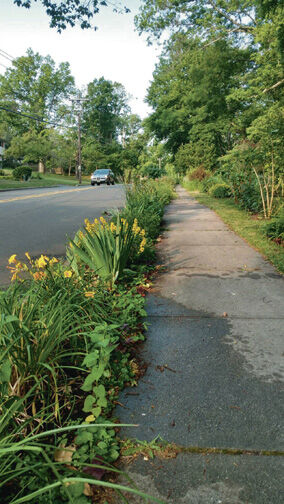
The old saying that imitation is the sincerest form of flattery popped into my head five years ago when I was walking down Jefferson Road. There was an attractive planting between the sidewalk and the street, one filled with ornamental grasses, an annual or two, and a perennial or two. Given its location, it looked like an easy care setting and one that in essence is a public art form.
I think I’ll try that, I thought, and so I did, creating a street garden that serves two purposes: it is not only a colorful display but also one that discourages students at the high school across the street from loitering and dropping cigarette butts on my side.
The first step in creating such a garden is to clear a space. My husband, grumbling all the while, completed this task. He had to use a shovel to scrape off the grass and weeds covering the space. A street garden can be as big or as small as one likes. I opted for a 20-foot length at the end of our townhouse complex.
Had I wanted to create a truly admirable display, I would have encouraged (well, begged actually) my husband to dig deeper to make sure all weeds were removed and then added topsoil. As it was, a friend was cleaning out orange daylilies and I decided these tough plants would either smother or obscure any weeds in the space and that’s what they did. The daylilies were planted, a couple of yellow and red ones were added, and they all bloomed. I did nothing to care for them and the students moved on to other areas to dispose of cigaret butts.
After the first year, there were two noticeable drawbacks to my street garden: there was only a four-week bloom period and the bare ground looked a mess in winter. I attempted to ameliorate this by planting green miscanthus grass in the midst of the daylilies. Once the daylilies had finished blooming, I thought of their foliage as water splashes and the five to six-feet tall miscanthus grasses in their middle as soaring fountains. It worked. In addition, the miscanthus grass, faded to a sturdy straw color, provided a structural feature in winter when the surrounding ground was bare.
My little street garden now had some color and structure but I wanted a bit more. A friend was cleaning out a Siberian iris known as “Caesar’s Brother,” a perennial with deep bluish-purple flowers in early June, and I was a grateful recipient. I planted a rhizome or two at the end of the daylily bed and these now bear flowers before the daylilies open.
And then I thought I needed a bit of color at the end of the season in September and chose a pink-flowered sedum that I have had for over 40 years. I have long known it as Sedum spectabile but it has now been reclassified — so annoying when botanists do this — to the unwieldy name of Hylotelephium spectabile. It came from my father’s childhood home in Dodge City, Kansas, and has an obvious sentimental attraction for me. It tends to seed itself and I transplanted some of these from my patio garden to the far edge of the street garden, right between the daylilies and the curb, and there they reliably produce heads of pink flowers. As with the daylilies and the miscanthus, neither the iris nor the sedum requires any care at all.
Well, let’s amend that last statement a bit. None of these plants can survive a healthy squirt from a passing dog. That’s why it’s crucial to leave unplanted, generally grass-filled, spaces near a street garden. One hopes that dog walkers will appreciate the color and variety and will steer their dogs toward the grass areas. To date, that has been the case with my street gardens.
Always seeking to be honest with myself, I looked at my street garden and recognized that it was attractive but was nowhere near imitating the first street garden I saw and, thus, was not flattering. When another friend was cleaning out Shasta daisies, I decided it was time to create a new street garden, one that would live up to the sincerest form of flattery.
My husband was not pleased with this decision. To make his task less onerous, I made the space smaller than the daylily border. The seven-foot long area also has much more sun and allows me to include a greater variety. After spewing words that shall not be repeated here and a good three or more hours of work, my husband cleared the allotted space, digging
much deeper than before, added compost from the Maher Ecological Center, and dug it all in.
I put the Shasta daisies along the sidewalk area of the garden. These are tough, white flowered plants that form a 30-inch wall protecting the plants bordering the street. If you snip them, you can have flowers all July and August and bouquets indoor. In front of the daisies, I have lower growing perennials with purple and honey-toned flowers. None of these plants are rare or expensive — that would be an invitation for someone to surreptitiously remove them during the night.
That’s my experience but if you wish to be inspired by more creative and colorful combinations, take a stroll or drive around town to see some really neat efforts. Streets that boast a fair number of street gardens include Grover, Hawthorne, Jefferson, Moore, Mountain, Spruce, and Wilson.
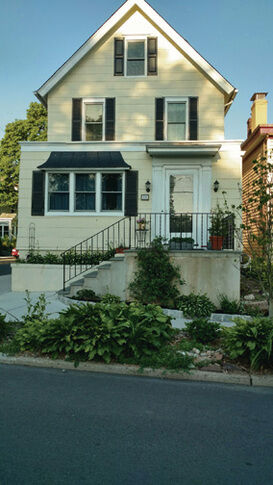
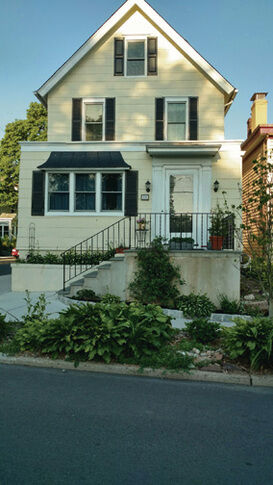
On these streets you will see a corner filled with hostas and other perennials popping up from white rocks; a sliver of a ground planted with colorful portulacas and chives; and a border decorated with orange, purple, and green heuchera foliage that starts at the street, leaps over the sidewalk, and leads to the front entrance of a house. Another street garden is an extension of the garden on the lawn side of the street — red roses and yellow coreopsis flowers are in a semicircle in the sidewalk area.
Still another garden, this one in a wider patch between sidewalk and street, has grass on both sides — thereby protecting the planting from dogs and walkers. The most exquisite of all and a true masterpiece of a garden is located on Terhune between Grover and Randall. Definitely check that one out.
I view all of these as public art, a gift of gardeners to beautifying Princeton and I am grateful to them. You too may wish to imitate and all flattery will be welcomed.
Princeton resident Patricia A. Taylor is the author of seven garden books and hundreds of articles in the New York Times, San Francisco Chronicle, Philadelphia Inquirer, and, closer to home, the Trenton Times, Princeton Packet, and U.S. 1.
,
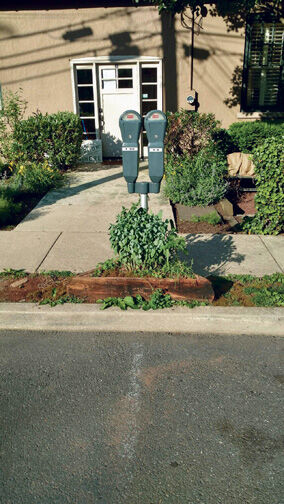
The street garden on Terhune Road between Grover and Randall may be the longest in town.,