It’s Monday, barely past 10 a.m., in only the second week of classes, and Cason Crane already entertains thoughts of crawling back into bed.
He’s got six hours of classes ahead of him, kicking off a week in which he is probably going to spend as much time on homework as he does in class, take care of other obligations outside of college and find time to train for an Ironman triathlon in November.
He goes to class, of course, putting one foot in front of the other across the Princeton University campus until he finds the right room and settles in for his day.
At age 23, Crane is already a seasoned endurance athlete whose first endurance sports love, mountain climbing, taught him that very lesson early — the way to climb a mountain, any mountain, is one step at a time.
That’s also how you find your way back down, and that’s a direct link to another lesson Crane has learned by being the kind of athlete who scales the highest peaks Earth has to offer and runs a marathon after cycling 112 miles, after swimming 2.4 miles — that just because you’ve done something that most people would consider impossible, it doesn’t mean you’re done.
“It doesn’t mean everything else is easy,” he said. “It’s not ‘if you can climb a mountain you can do anything.’ I can compare Everest to Princeton, and Princeton sometimes is harder, mentally. Each challenge is its own. But at least Everest has a great view.”
Not a bad perspective from a guy who’s afraid of heights.
And yet, Crane, a junior at Princeton, considers himself entirely outshined by the company he’s about to keep. On Saturday and Sunday, Oct. 10 and 11, the biggest fish in the small pond of endurance sports will gather at Princeton for the second National Endurance Sports Summit, or NESS. Crane will, as he did last year, do a presentation at NESS and humbly said that “the only reason I’m there is because I’m at Princeton.”
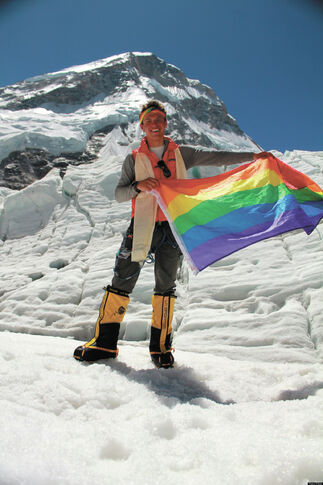
Perhaps, but lots of people in and around Princeton have done hardcore endurance sports and few have the bullet points on their resume that he has. He’s done three Ironmans, numerous triathlons and races, scaled the fabled Seven Summits — meaning he summited the highest mountain on each continent, becoming the first openly gay athlete to do so — and founded a nonprofit endeavor to help gay youth (and raised money by climbing mountains for it).
So maybe the perspective of someone who’s had so many different views of the world is more attuned than the perspectives most of us carry around.
Princeton graduate Joe Benun, Class of 2015, is the main brain behind NESS. Benun founded Team U at Princeton, an entirely student-run organization that remains the only intercollegiate fundraising endurance team in the world and looks to raise awareness for endurance sports.
Benun led the effort to put NESS together for 2014 because, he said, endurance athletes are a different breed who compete in different ways. Unlike team sports that operate in leagues and levels, endurance sports are usually individual pursuits. Athletes are out there, usually on their own, even in a crowd, for hours. Sometimes days. They train by themselves. And even though they compete against others, they ultimately compete against themselves; their limits, their sense of what’s possible.
That gets lonely sometimes, Benun said. So a conference that brings together the various disciplines of endurance sports, from ultramarathon racing to long-distance cycling to cross-country skiing, brings together these incredibly durable athletes to learn, to share, and to motivate each other.
“There’s nothing like this out there,” Benun said, meaning that there is no other event that brings together so many endurance athletes. “If there is, it’s a race.”
Benun said this year’s conference was a little easier to build because he’d already done it once, and because he learned not to pack so much in as last year, he said. That’s not to say it’s been easy to make happen. Just not so alien a process, which fits neatly into what Crane was saying about everything being its own challenge.
The toughest part in an endurance challenge, it turns out, is being halfway through one and feeling the pain and strain and realizing you have to do that much just to get finished, Crane said.
Crane started his life in endurance sports in middle school, when he ran his first triathlon. His introduction to mountain climbing came three years later, when he and his mother, Isabella de la Houssaye, found it together. They wanted to do something important together, and they came across the idea of climbing Mt. Kilimanjaro, Africa’s highest peak. Unwittingly, Crane and his mom set out on the first of his Seven Summits quest, during what he calls “the bonding adventure of our choice.”
Crane said he and his mother have the unique ability to find the next adventure each will embark upon, and the two have shared many endurance challenges that would cow most people. But beyond the marathons and Ironmans, they’ve discovered quieter athletic pursuits, including yoga, which Crane said he nudged his originally resistant mother towards.
“I said, ‘Just try it. At least supplement your exercise with it.’” he said. “Now she’s a certified yoga instructor.”
Crane, who grew up in Lawrence Township and attended Princeton Day School, as well as school in Hong Kong for a while, draws an immense amount from his parents. He openly credits them with being the greatest inspiration in his life.
His mother, always athletic, had knee surgery in her 20s and stopped running until she was 40. She swam a lot in the interim, and then decided to risk it and start running. In the 11 years since, she’s moved from 5k races to a pair of Ironmans that she ran with Crane.
Crane’s father, David, is the other half of this inspiration. The senior Crane is the CEO of NRG Energy, and his maverick thoughts on energy (at least that’s how the energy industry sees it much of the time) profoundly influence the younger.
“He’s a huge role model for me,” Crane said. “His example goes beyond what he’s taught me; living his life, being a revolutionary figure in the energy industry. He’s helped me identify my core values and stick to them to believe in the right thing to do and to believe it’s the right thing in the long run.”
If you caught the parallel to endurance sports, you’re spot on. Crane refers to his father’s ability to build NRG as “endurance in business.” But beyond his business acumen, Crane said, his father is just a great person and excellent dad, who himself participates in endurance sports. He and one of Crane’s four younger brothers just finished the Hightstown triathlon this year.
“He works incredibly hard, but he still spends every weekend with us that he can; he still comes to my brother’s cross-country meets; still goes out with me to get ice cream in town,” he said. “A lot of fathers have to make time for their families, but he isn’t making time, he’s just able to do it. He’s just got this magic balance.”
The inspiration he draws from his parents certainly propelled him to the tops of the world’s tallest peaks, a feat which he completed with the summiting of Mt. McKinley (officially renamed as Denali this year) in June of 2013. This, by the way, was a mere two months after summiting Everest, guided by New Zealand climber Lydia Bradey, the first woman to climb to the top of Mount Everest without using supplemental oxygen.
What also propelled him was the urge to do something he believed in. Crane came out as gay at age 14 and, even in the generally liberal Princeton, had to deal with people who found his sexual preference to be upsetting. And while he said his parents were always supportive and that his own coming out was not really problematic for him, he knows it’s often a very difficult road for young gay people.
One example of how bad it can get is his childhood friend, Charlotte, a gay teen who committed suicide rather than live through the harsh bullying and intolerance she faced. Crane, devastated, wanted to volunteer for the Trevor Project, a suicide prevention organization for gay youths.
The trouble was, Crane was not yet 18, and the Trevor Project could not let him volunteer. Crane talked with some friends and family and, upon completing high school, launched Rainbow Summits, which would raise money through his mountain climbing endeavors to directly benefit the Trevor Project. By the time Crane summited McKinley, he had helped raise more than $135,000 for the cause.
Rainbow Summits is still active and accepting donations on the Trevor Project’s behalf, but Crane is doing less with it while he’s in school. He still uses it as an outreach platform, however, to give talks and reach out to young people who might need some encouragement to find the courage to be themselves.
Somewhat surprising for Crane was realizing that sports can be a boon to gay kids. “Sports can be great and sports can be horrible for gay athletes,” he said. On the bad side, there are some sports or leagues that make their dislike of gay athletes known. But on the other side, there’s often a familial nurturing that gay teens especially should not overlook.
“Sports are an incredibly important part of the coming-out process,” Crane said. “I’ve had a couple LGBT friends who were very nervous about coming out to their team. But when they did, they found that teams often become closer. It’s not divisive, it unites them.”
Still, Crane looks forward to the day when gay athletes are just athletes, the way women who vote are just voters now, and no one worries about the fact that they’re female, the way people did when suffrage first happened. Gay or not, he said, endurance sports teach the values of one step at a time and keeping the end in sight.
But he’s still aware of the parallels.
“The real heroes are the ones who get up every day and persevere,” he said. “Even when they think they just can’t do it.”
,

