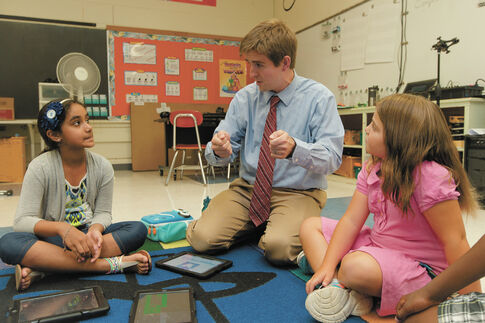
Lawrence Elementary School music teacher Daniel Beal instructs Nethra Santapur and Rachel Maest. (Photo by Suzette J. Lucas.)
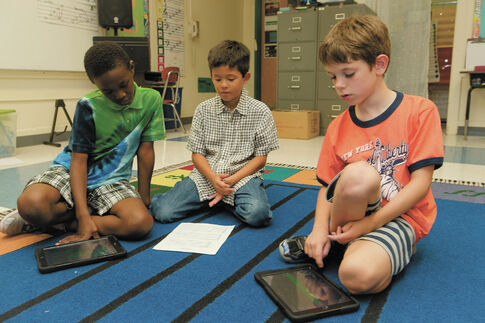
Maako Fangajei, Caleb Anderson and Michael Wedeking work with iPads to create a musical score. (Photo by Suzette J. Lucas.)
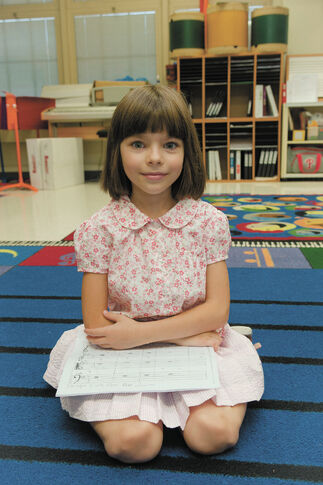
Maia Ionescu sits with several pages of sheet music. (Photo by Suzette J. Lucas.)
By Madeleine Maccar
A collaboration between local elementary schools and the Princeton Symphony Orchestra is giving six district students a chance to not only flex their musical composition muscles but also try their hands at something every child wishes for: a few nights of getting to tell the adults what to do.
Thanks to the PSO BRAVO! Program, the Quartweet Project and a few determined teachers, third grade students at Lawrenceville, Ben Franklin, Eldridge Park and Slackwood elementary schools are getting a multidisciplinary learning opportunity outside the classroom that will culminate in original 140-note-or-less scores, brought to to life at the hands of Germany’s Signum Quartet.
Lawrenceville Elementary music teacher Daniel Beal is one of the integral forces behind this unique experience, and he is certain that the students’ debut as musical storytellers will become a memory they carry with them for the rest of their lives.
“I think it’s really going to blow their minds,” Beal said. “Professional, international musicians are going to be playing their music right in front of them and taking commands from them. They’re officially composers who get to coach these musicians.”
While PSO BRAVO! has been uniting professional musicians and students since 1995, PSO executive director Marc Uys said that this is the first time that PSO and Lawrenceville Elementary have worked hand in hand.
According to Beal, the Quartweet Project would have never come to fruition if not for Stephanie Wedeking, whom he credits for facilitating the connection between him and Uys.
Uys was looking for a way to involve the the Signum Quartet, which PSO would be showcasing and, after getting the green light from district Educational Technology and Related Arts supervisor Damian Bariexca, Beal wanted to utilize iPad-based music composition tools.
Their desire to celebrate budding songwriters was the crucial element in connecting the dots, and they ended up having the six students—one picked from each of the other elementary schools and three LES students hand-selected by Beal at the end of the 2014-2015 school year—each write their own quartweet.
Students chosen to write scores were Caleb Anderson, Maako Fangajei, Maia Ionescu, Rachel Maest, Nethra Santapur and Michael Wedeking.
“The basic concept behind a quartweet is the idea that so much of today’s communication is taking place on social media, and to explore that as a forum for writing music,” Uys said. “As a fun way to parallel Twitter, we are asking composers to write pieces for a string quartet that have no more than 140 notes, to parallel the limits on characters on Twitter. There are all kinds of fun things that can be done with that, and it’s not a huge task: One can focus without being overwhelmed by writing a long piece of music.”
A thoroughly 21st-century twist on musical composition, the Twitter-inspired limit on each score is just one of the many modern flourishes punctuating the PSO and Lawrence Township partnership. Part of what piqued Uys’s interest was the challenge of tasking young minds with writing their own songs, as well as the addition of a technological component that would set students to composing music for a first and second violin, a cello and a viola entirely on iPads.
Students are getting quite the technological education, indeed, with their songs being composed and tested on iPads before the notes are committed to a digital score.
The program GarageBand exports the finished song part by part, allowing the final product to be printed as sheet music—or in the students’ cases, emailed to the Signum Quartet in Germany where violist Xandi van Dijk has been transferring each song to a sheet of playable music.
“It’s quite a journey from the iPad screen to the final product,” Beal said.
Beal said that introducing teaching artist Jessica Meyer, a Juilliard trained violist and composer, to the program “brought the project to a whole other level,” in terms of broadening the musical vocabulary, techniques and vision available to the students as storytellers.
“She teaches them to understand the multitude of sounds you can make with a string instrument: You can take a regular melody and transform it in 10 different ways just based on string techniques,” Beal said. “She also is huge into getting kids to improvise and compose through storytelling and imagery, like the ways playing a violin can make something sound exciting, happy, scary, like a windy day or a boat on an ocean. What started out as just writing something that sounds nice became telling a story.”
Beal said that his students took right to the modified assignment, using the musical medium to tell their own stories.
For example, Maest took her inspiration from a family road trip, watching four butterflies—represented by the quartet’s four instruments—from her car window, which are interrupted by car horns and give way to her family’s arrival at their hotel, and Fangajei narrated a car race, pitting the viola and second violin in a race against each other as the other two instruments cheer each one on. He chose to end the song before its race was over, letting the symphonic audience decide who they thought was the winner.
Wedeking, meanwhile, used his composition as a vehicle to honor his love of roller coasters, starting with the suspense of a slowly rising ride represented by ascending notes and ending with the viola’s pizzicato plucking emulating the riders’ departure.
“The detail involved is insane and it totally transformed the process,” Beal said.
Giving students a nontraditional avenue to tell their stories is only one of the project’s benefits. Both Beal and Uys said that the six third-graders have gained everything from a new language in which to express themselves creatively to the confidence befitting their talents—in addition to the unique experience of hearing their works performed by renowned professional musicians.
“Certainly for those six kids, I’m sure they’ll never forget doing this, it’s an opportunity to really feel free and express themselves and have the guidance of some of the top practitioners in the world,” Uys said.
“They got a chance to conceive a real, legitimate piece of music from beginning to end,” Beal said. “Their confidence as creative musicians has really been spurred. I can see the looks on my kids’ faces when they like something. All three of my kids are pretty shy, and I think this is a good example of how music can really bring shy kids out of the woodwork if you provide the right opportunities for them. These kids you didn’t really know had these talents can really do something special.”
Aside from the manifold rewards the Quartweet Project offers in and of itself, both Beal and Uys agree that the undeniable moment of recognition on a child’s face when they discover that their love of music is on par with their knack for creating it has made this just as wildly beneficial of an experience for them as it has for the children they’ve watched blossom over the course of the program.
“I’m in the business of trying to let people have those ‘wow’ moments, when you know that something stuck and you’ve done something wonderful for another human being,” Uys said. “The rewarding thing is facilitating moments like that in young people’s lives because we all can probably trace our own passions back to a single moment in our childhood where we’ve connected to something. For me, being on the other side of those ‘wow’ moments, you also experience that connection, too.”
With the Signum Quartet giving a trio of performances that were scheduled for Sept. 28, Sept. 29 and Oct. 1 featuring songs by some of Lawrence Township’s youngest composers played among some of classical music’s biggest names, Beal is certain that the enormity of the experience will not be lost on the students—especially when their work is played for their classmates.
“I told all six of them recently that these pieces of music they’ve written is just not just going to live on this paper, it’s not just going to be on this iPad, it’s going to be in front of these four musicians,” he said. “We’re going to bring them on stage, there are going to be pictures—I don’t think they’ll ever forget that a string quartet from another country came here to play a piece of music that they wrote.”
,