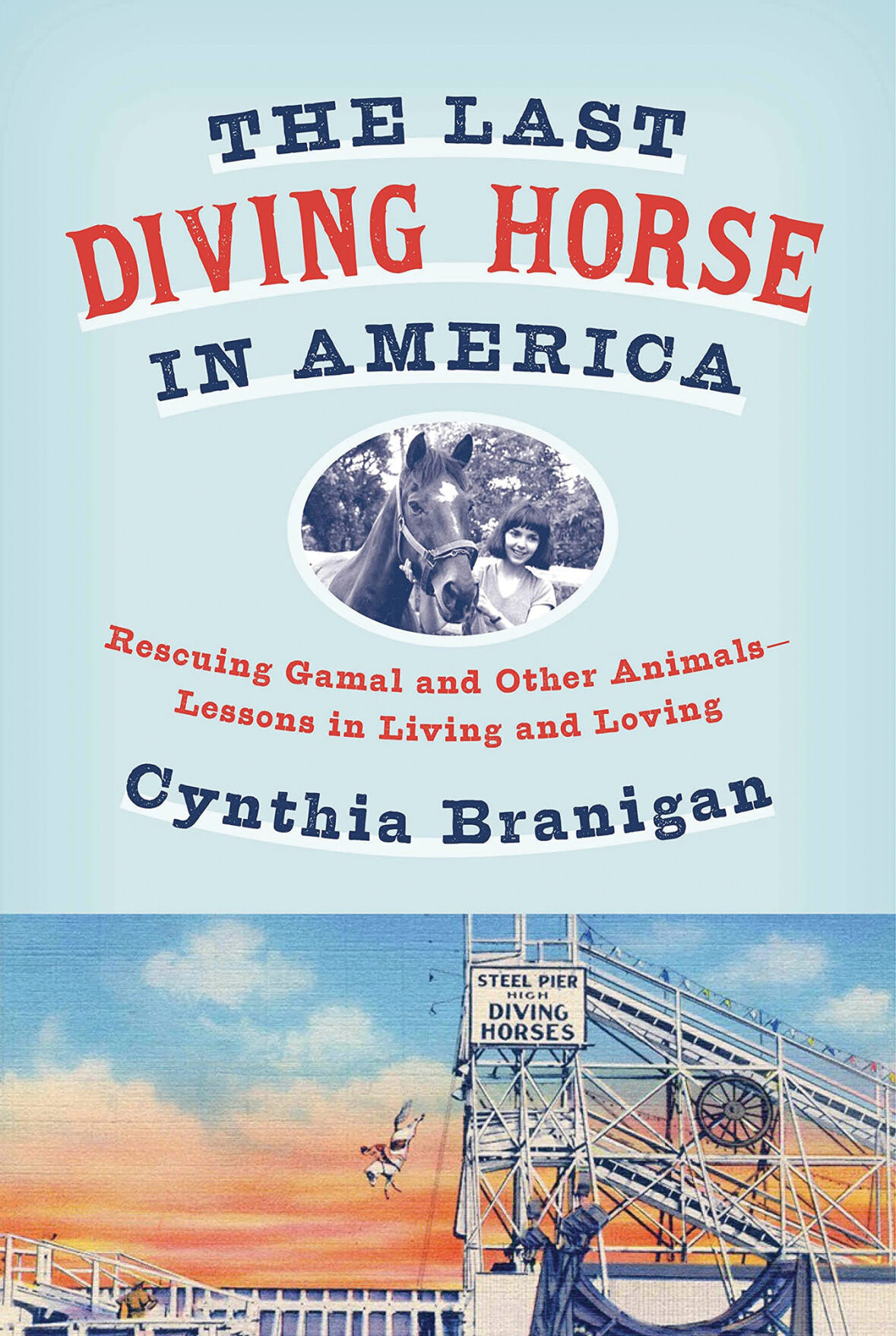
“The Last Diving Horse in America” is Lawrenceville native Cynthia A. Branigan’s book that mixes a personal journey, a friendship, and a slice of New Jersey and American history.
The book’s title can be interpreted literally Branigan, now a resident of New Hope, Pennsylvania, tells her encounter with a horse that had once amused and amazed audiences by appearing with a rider on a high platform and then diving from a great height into a body of water.
Using a prose that is often elegiac in tone, Branigan recounts a personal memory of a horse that will “always be in that invisible sacred place that others cannot see, but which each of us carries within ourselves.”
Yet the same tone also fits the recollection of an era when thousands flocked each year to Atlantic City to witness such a spectacle that eventually and rightfully became unpopular to the public’s sensibilities but is now a distant memory of many, including myself.
Here Branigan thoughtfully recreates the sensation of seeing Atlantic City’s Steel Pier’s “High Diving Horses” and her own soul stirring that led to saving a horse:
Gamal, the horse, who would become mine, was born in the early 1950s, as was I. For all I know, we entered the world in the same year, month, and day.
He, a Texas native, went on to the more traditional horse pursuits of barrel racing and rodeos before being tapped for the unconventional career of diving. I was born in suburban New Jersey, and it was my father’s fond hope that, after he invested in my education and travel, I enter a respectable profession of some sort. Instead, I became an inveterate rescuer of displaced animals. It was through our disparate occupations that Gamal and I wound up together.
There was a time when horses, flying through the air, could have been said to reflect the promise of America — the notion that anything, even the impossible, was possible. But as the decades wore on, people began to see the diving horse act as little more than animal cruelty. Eventually, diving horses became no more than a vacationer’s distant memory.
The horses performed at the far end of the Steel Pier, far from the boardwalk, far from ordinary reality. Although it was dark outside, the lights on the pier were blinding. Every sight and sound seemed exaggerated, even grotesque: insistent barkers urging people to take a chance on whatever game they were hosting; the deafening noise of the rides; the piercing pop-pop-bing coming from the shooting gallery; and the announcement “All aboard, all aboard to the bottom of the ocean,” where a diving bell took people a few feet beneath the surface of the Atlantic to its murky bottom.
(One summer my parents and I) arrived just in time for the diving horse’s last performance of the day. A dizzying crisscross of bare light bulbs was strung overhead, but when the act began, they were turned off and spotlights fixed on the horses ramp and platform. Even with the carnival atmosphere, the scent of French fries mixed with salt air, the crowd jostling for position, despite all of that, the horse had an allure that eclipsed all human activity beneath him. In my altered state of consciousness, it felt like the ocean itself was breathing as waves drew away, then crashed forward onto the pilings below. A voice boomed from the loudspeaker, “Ladies and gentlemen, prepare yourself for the thrill of a minute. We present Carver’s Steel Pier High-Diving Horse!” A hush came over the crowd.
Out of the darkness, and off to one side, a gray horse appeared with a handler. The horse was fitted only with a harness. As he and the handler reached the bottom of the carpeted ramp, the handler set loose the horse. There was no hesitation, the horse ran forward. The instant he reached the platform at the top, a helmeted woman in a bathing suit, who I had noticed before, leapt onto his bare back, leaned into him, and held on to the harness. They became one.
The horse was now in complete control. He could have sailed forward, but seemed in no rush. He was the star and would do things on his terms. He lingered and surveyed the audience, as if taking stock, seeing how many were in the crowd that night, or making sure they were paying attention. He gazed out at the ocean, then back again at the crowd.
Without warning, he kicked off from the platform and soared through the humid night air with precision and dignity. It was a terrifying sight, and an unforgettable one. The dive took but a few seconds; but to me, the searing image of the horse’s body, pointing like a perfect arrow at his target below, seemed to run in slow motion. I was in awe of his taut muscles, his concentration, his willingness to perform. His plunge into the water was flawless.
Once the horse and his rider emerged from the tank, he trotted to an older woman who fed him carrots, while the same man who turned him loose now rubbed him down with towels. The overhead lights came back on, the audience dispersed, and things went back to the way they were. But I had some trouble returning to ordinary reality.
The wind picked up as we left the pier and carried with it the slightest tinge of autumn. It was still summer, of course, deep summer. Yet the breeze contained a new dimension now, a sad, wistful reminder that things would not be this way much longer, that change was coming whether we wanted it or not. I remembered that we were leaving Atlantic City the next day, and not long after that another school year would begin.
I closed my eyes and pictured the diving horse, not as he stood on the platform, nor as he emerged triumphant from the tank; but in midair, leaping into the unknown. I did not want the act to end, did not want the summer to end. But as much as I wanted this, I knew I could not stop time, could not keep the horse suspended in space.
This realization brought on more tears, and my mother asked what was wrong. I did not have the words for the emotion, so I told her I was tired, had too much sun. That much was true; but there was more. Something about how I regarded the world was shaken up that night. Some puzzle beyond the ken of an 11-year-old, had been set before me and would take years to solve.
“The Last Diving Horse in America,” Cynthia A. Branigan, 280 pages, $28, Pantheon Books.
,