For most people in New Jersey, the decision of where to go on a winter vacation is pretty simple—head south, toward warmer weather. I say that’s for the birds. Thus, conflating elements of two Robert Frost poems, my family and I set out to take the snowy road less traveled.
The plan, formed in November of last year, seemed simple enough: drive up to Quebec after Christmas, stay a few days, and be home before the New Year. But in December, the Omicron variant arrived in North America, complicating matters. To cross into Canada, we would all need proof of negative Covid PCR tests, taken no more than 72 hours before arrival at the border; rapid antigen tests were not acceptable.
It typically takes 1 or 2 days to get the results of a PCR test, but because of high demand around the holidays, most labs warned that 3 to 5 days was more realistic. I had carefully scheduled tests for roughly 72 hours before our planned arrival at the border, but now it was out of my hands. We took store-bought antigen tests on Christmas Eve and tested negative, and none of us had symptoms, so I was confident we weren’t Covid carriers; that made it even more frustrating to consider canceling the trip.
In a kind of Covid Christmas miracle, we got our negative PCR results on Christmas Eve, which allowed me to abandon my contingency plans of sneaking across the border via forged documents, midnight canoe excursion, or Jedi mind trick.
In Quebec, most people speak French, though many have at least some knowledge of English as well. Along with cross-country skiing, fat-tire snow biking, and dogsledding, the trip offered the opportunity to experience a different culture and language without the hassle and expense of a plane ride.
No one in our family spoke the dominant language, so our attempts to adapt usually began with “Boujour,” and after a high-speed buzz of French from the recipient of that greeting, quickly ended with “Parlez-vous anglais ?” Most of the time, store clerks, wait staff, and hospitality employees could accomodate us, with a few rather charming difficulties here or there—unfamiliarity with the word “spill” yielded the warning, “When you carry the soup, it overflow from the edges, otherwise ‘Ow!’” But attempting to speak to an average Quebecois was a disorienting experience involving hand gestures, loud, slow talking, and quick typing into Google translate. There’s a big difference between choosing not to talk to people, the way an American tourist might ignore panhandlers on a New York City subway, and not having the ability to talk to people. I admit, there were several moments when I wished the British had simply finished the job of converting Canada to the English language, regardless of this province’s quaint French-European appeal. But being among non-English speakers, at least in the short term, brought an exciting vulnerability, the adrenaline rush of feeling like you’re really on your own.
It’s a feeling you also get driving around Quebec, because a few years ago, proposals for bilingual road signs were shelved in favor of a bewildering and often unintentionally amusing array of pictograms. Intended to be universally understood, they are, much like IKEA instructions, universally confusing and frustrating.
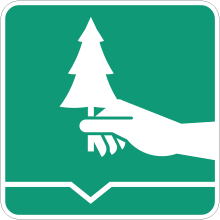
Devoid of context, interpreting these signs is like communicating with a bad Pictionary player. There are signs that seem to warn against driving into a cloud, or irritating the local wind god. A human hand holding what appears to be a fully-grown evergreen tree is not, as it first appears, a warning a that a giant is present, but rather an indication of a tree planting area. A person seemingly standing atop a bicycle on a yellow diamond shaped sign means a crossing for pedestrians and bikers is ahead, not, as I originally suspected, “Watch for passing circus performers.” The symbol for a spa or massage parlor looked, to me, like someone being mugged.
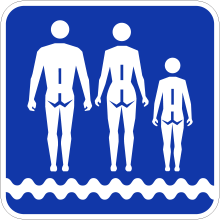
Other signs seem to warn drivers against impending cheese (approaching cheese factory), roaming soccer players (playground nearby), and vacationing penguins (Montreal Biodome). Interpreting the signs is a skill that improves with practice—for example, experience taught us that green signs are of a more general informational nature, while blue signs indicate tourist attractions. But unless you’re already on the lookout for a Naturism Center (a.k.a nudist colony), suddenly sighting a bare-bottomed family on a road sign seems likely to cause more traffic problems than it solves.
Along with the pictograms, the language still offered additional hurdles. Some green signs featured a picture of a camera and a bit of French—I thought these might indicate scenic areas where one might wish to take a photo. One read “FEU ROUGE,” which literally means “red fire.” Take a picture of the red fire? Another sign read “VITESSE FEU ROUGE,” and since “vitesse” means “speed,” this seemed to be alerting drivers to speedy red fire—an alarming prospect, to be sure, but apparently one still worthy of a photo stop. A secondary meaning of “feu rouge,” however, is “red light,” and finally it clicked (no pun intended)—there was a traffic camera at that corner, keeping its digital eye open for punishable driving infractions.
In the evenings, we played Milles Bornes, the classic French card game, with its goal of accumulating auto mileage and avoiding obstacles like flat tires and stop lights. Between rounds, I envisioned a new, Quebec-centric version that would incorporate the province’s unique signage for added difficulty and entertainment.
Quebec felt like America as viewed from The Twilight Zone—somewhat familiar, but always slightly askew. There, Réno-Dépôt exists alongside Home Depot, but both are dominated by BMR, a hardware store chain owned by a Canadian agricultural cooperative. Instead of CVS and Starbucks, the pharmacies and coffee shops are named after people called Jean Coutu and Tim Horton. People buy gas at stations called “Irving,” which are often paired with Couche-Tard, a convenience store chain known for its mascot, a red winking owl named “Jandrice.” Couche-Tard, fittingly, translates into English as “night owl,” but the Urban Dictionary also cites its adoption as an affectionate insult, “often used between friends.”
Perhaps the strangest business sighting of all was a restaurant chain called Boston Pizza—founded by four Greek immigrants in Alberta, Canada, and named after a city not particularly known for its pizza. There are lots of Boston Pizza restaurants in Quebec, but none in Boston, Massachusetts; the company’s U.S. restaurants tend to be located in states like Arkansas, Montana, and North Dakota, where apparently people don’t know any better.
Quebec’s cuisine is an interesting mélange of traditional French foods like crepes, adopted foreign favorites—nachos are everywhere—and Canadian innovations like poutine, french fries topped with cheese curds and gravy. New Jerseyans might recognize the latter as Disco Fries, a similar dish that substitutes melted cheese for fresh, raw-milk cheese curds. Cheese curds are illegal in the U.S. unless aged for 60 days, and bad Canadian curds might have been the cause of a stomach issue that sidelined my daughter for a day. Maybe that “impending cheese” road sign was a warning, after all.
Despite all the strangeness, it was a great trip. Quebec City is a beautiful glimpse of Old Europe in North America, and the Basilica of Saint-Anne-De-Beaupré is stunning, but it’s easy to not take Quebec too seriously when you see a sign at a ski resort touting its “SALLE DE FARTAGE.” If pressed to describe Quebec in one word, it would have to be… incroyable.
Peter Dabbene’s website is peterdabbene.com. His latest work, “Call Waiting,” can be seen at idleink.org. His book Complex Simplicity collects the first 101 editions of this column, along with essays and material published elsewhere. It is now available at Amazon.com or Lulu.com for $25 (print) or $4.99 (ebook).
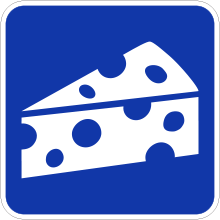
Beware of cheese.,