The Educational Testing Service campus in Lawrence Township is emerging as a key example of how municipalities and major property owners are responding to the changing economics of suburban office space.
The Township Council was expected to consider an ordinance on April 21 that would rezone part of the ETS campus at 660 Rosedale Road for residential use, a move that could set the stage for one of the largest redevelopment projects along the Route 1 corridor.
The measure, which was discussed by the Planning Board at its March 16 and April 6 meetings, would create a new Neighborhood-1 overlay zoning district.
The concept could allow up to 800 housing units on more than 75 acres of the campus, with a mix of market-rate and affordable housing, along with limited neighborhood-scale retail or service uses, forming a broader mixed-use redevelopment of a portion of the site.
That redevelopment area represents part of a much larger property. The ETS campus spans some 355 acres, and planning discussions have focused on converting land north of ETS Drive — an area that includes several underutilized and vacant office buildings — while maintaining existing uses elsewhere on the site.
The site has already been identified in the township’s Fourth Round Affordable Housing Compliance Plan as a key future location to help meet state-mandated obligations.
The designation is significant, because it means the township is not reacting to a development proposal, but is actively steering one of its largest corporate properties toward residential reuse as part of a low- and moderate-income housing mandate.
For ETS, the shift reflects deeper changes in its core business and the broader testing industry. For decades, the nonprofit was closely tied to the administration of the SAT and other standardized exams.
The campus shaped not only employment patterns but also the surrounding landscape, from preserved open space to community amenities.
That model has been jeapordized by the rise of test-optional admissions policies, increased competition in the education assessment market, and the disruption caused by the COVID-19 pandemic.
The loss of ETS’s long-standing SAT contract with the College Board marked a turning point, accelerating internal restructuring and prompting a reassessment of long-term space needs.
The result has been substantial vacancy across portions of the campus, particularly in older office buildings no longer aligned with current operational needs.
In addition, ETS has eliminated several hundred positions in Central Jersey since 2020 across multiple rounds of layoffs and buyouts.
In response, ETS has begun actively exploring redevelopment options, including the potential sale of land to private developers, positioning the property as a redevelopment asset rather than solely an employment center.
Within the past year, those explorations have aligned with the township’s housing strategy, creating a rare convergence between institutional downsizing and municipal planning goals.
That convergence is already being recognized at the municipal level.
“ETS is I think the biggest site happening right now,” said Lawrence Township Mayor Christopher Bobbitt in a recent interview.
“A lot of their older buildings are going to be torn down and developed… I’m not sure what the development looks like, but there will be an affordable piece in that,” Bobbitt said.
The March Planning Board meeting underscored how quickly that could come to fruition. A standing-room-only crowd attended as residents raised concerns about the scale of potential development.
Much of the reaction focused on density. Residents questioned whether the site—long viewed as a low-impact corporate neighbor—could accommodate the proposed level of residential intensity without fundamentally altering the character of the area.
Environmental issues were also central to the discussion. Portions of the property include streams, wetlands, vernal pools and flood-prone areas tied to the Stony Brook.
Residents and environmental advocates raised concerns about stormwater management, habitat preservation and the capacity of existing infrastructure to absorb new development.
Township officials emphasized that no formal application has been submitted and that detailed studies, including traffic and environmental impact analyses, would only be conducted once a specific proposal is filed. At this stage, the zoning framework would establish what could be built, not what will be built, they said.
That distinction is critical from a business perspective. The ordinance and housing plan are not approvals—they are signals. They indicate how both the property owner and the municipality are thinking about the future value of the land.
And increasingly, that value is tied to housing.
* * *
Across Central New Jersey, and particularly along the Route 1 corridor, the traditional suburban office park model is under strain. Many of the region’s largest campuses were developed decades ago for single corporate users, with the expectation of stable, long-term occupancy.
Today, hybrid work arrangements and evolving business models have reduced the need for large centralized office footprints.
As a result, vacancy rates in many office buildings remain elevated, and landlords are facing rising maintenance costs with fewer tenants to offset them. In that environment, land itself becomes the primary asset.
Housing, by contrast, remains in short supply. Demand continues to outpace inventory, particularly in areas with strong access to jobs, transportation and regional amenities. That imbalance is pushing municipalities and property owners toward the same conclusion: residential redevelopment is often the most viable path forward.
ETS isn’t the only Lawrence Township trtact under consideration. The inclusion of sites like Quakerbridge Mall in the township’s housing plan reflects a broader willingness to layer residential uses onto existing commercial properties.
That shift is also being driven by the economics of development.
Bobbitt said earlier zoning at Quakerbridge Mall had not led to development, prompting officials to look at increasing allowable density to make projects more financially viable for affordable housing.
That reality is shaping how municipalities approach zoning decisions, particularly when it comes to large-scale redevelopment sites like ETS.
Other municipalities across the region are exploring similar strategies, whether through adaptive reuse, mixed-use overlays or full-scale redevelopment of underperforming office and retail sites.
What sets ETS apart is scale. At more than 350 acres, the campus represents one of the largest contiguous properties in the area. Even a partial redevelopment offers an opportunity to deliver a significant number of housing units in a single location.
That scale also makes it a strategic tool for meeting state affordable housing requirements. By concentrating development on a large tract, the township can avoid spreading smaller projects across multiple neighborhoods, a factor that often intensifies local opposition.
Still, the public response suggests that concentration does not eliminate concern—it shifts it.
At the March Planning Board meeting, some residents criticized what they saw as a lack of transparency, saying they were unaware of the site’s inclusion in the housing plan until recently. Others questioned who would ultimately develop the property and what the final project would look like.
Officials said they do not have information about a developer and emphasized that such arrangements would be decided by ETS as the property owner.
Planning concepts also indicate that the development could include a range of housing types, with approximately 20% set aside for affordable housing and up to 15% of units potentially designated for senior residents.
There is also the possibility that not all of the land will be developed. Preservation advocates have expressed interest in protecting portions of the site, particularly areas with environmental significance.
What’s clear is that change is likley inevitable for the ETS campus, but its the filan final form is yet to be determined.
“ETS is I think the biggest site happening right now,” Bobbitt said.
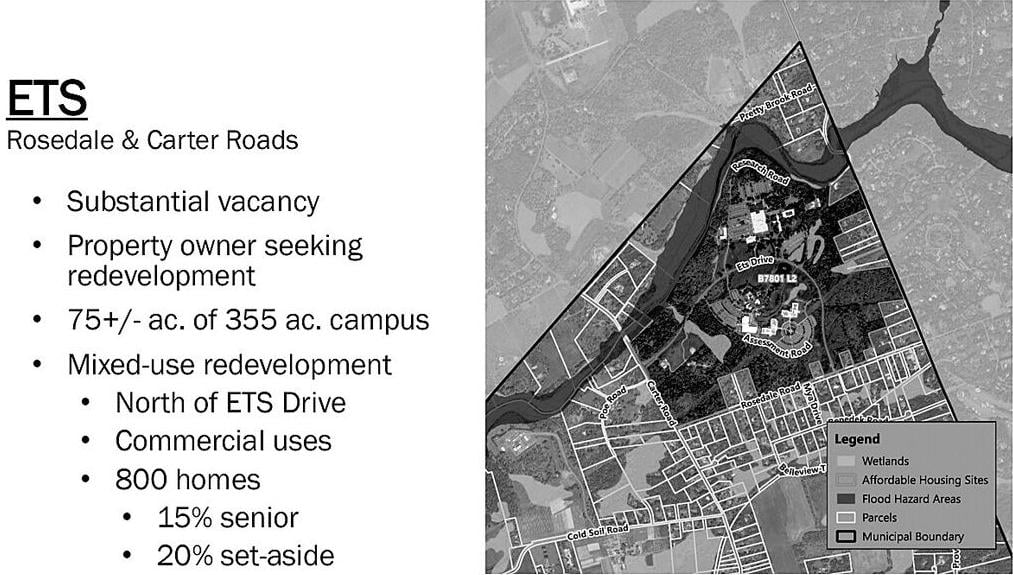
A proposed rezoning area at the Educational Testing Service campus in Lawrence Township highlights more than 75 acres north of ETS Drive that could be converted to mixed-use housing, including up to 800 units.,

