Editor’s note: Jersey Central Power & Light withdrew its application to install new transmission towers after The Messenger-Press went to press. The story below, which appears in the May issue, explains the background of the proposal and the community opposition it generated.
* * *
A proposed high-voltage transmission line upgrade in Millstone Township is drawing concern from residents who say the project could significantly alter the landscape, environment and character of their community.
The project, known as the “East Windsor-Smithburg 500-kV Upgrade,” would replace aging transmission infrastructure with higher-capacity lines along a roughly 9-mile corridor through Millstone and neighboring communities. The proposal by Jersey Central Power & Light (JCP&L) includes taller structures, expanded capacity and work within an existing utility easement.
The application is currently before the Millstone Township Zoning Board of Adjustment, where it requires multiple variances related to use and structure height. Public hearings have drawn strong turnout, with residents raising concerns about tree removal, environmental impacts, property values and the long-term purpose of the project.
The project attracted a full house at the March 25 meeting, and the board is scheduled to again hear the plan on May 27.
Residents have questioned how the project could affect local ecosystems and whether the expanded infrastructure is tied to broader regional energy demand.
The debate reflects a broader tension between infrastructure modernization and community impact, as residents weigh the need for reliable power against concerns about environmental change and quality of life.
Through its New Jersey Clean Energy Corridor (NJCEC) projects, JCP&L is helping “modernize New Jersey’s energy grid by upgrading existing high voltage transmission infrastructure and enabling the state to handle the growing demand for electricity now and for years to come,” according to company materials.
The project is part of a group of transmission upgrades awarded through a competitive solicitation process overseen by the New Jersey Board of Public Utilities, in coordination with regional grid operator PJM Interconnection. The broader NJCEC initiative includes multiple projects designed to strengthen the state’s electric grid and accommodate future energy demand, including the integration of renewable energy sources.
JCP&L is upgrading the existing East Windsor-Smithburg 230-kV single circuit transmission line to a double-circuit configuration to accommodate new 500-kV and 230-kV circuits. The existing right of way is approximately 9 miles in length with a typical easement width of 180 feet and is located in the townships of East Windsor, Millstone and Freehold and in the borough of Roosevelt.
JCP& says the projects will not require any new construction on undeveloped land outside of the utility’s owned property or existing right of way. The line construction is due to start in November, with a projected completion and service date of November 2028.
JCP&L officials say the design of the project relies on existing transmission corridors to minimize disruption to surrounding communities, part of a broader effort that will utilize approximately 40 miles of existing rights-of-way across multiple NJCEC projects.
The project requires zoning board approval for use and height variances. In Millstone, it spans 81 lots along more than 6 miles of an existing transmission corridor across multiple zoning districts. Utilities are not permitted in the Highway Commercial (HC) zone and are conditionally permitted in R-80, RU P, R-130, and R-170 zones.
JCP&L proposes replacing existing lattice towers with new steel monopoles on concrete foundations. The project has been modified so it now consists of 39 new structures comprising 44 steel monopoles, rather than the originally proposed 41 structures and 47 monopoles.
All work would occur within JCP&L’s existing utility easement, which is 180’ wide, with variations. However, portions of the existing corridor are currently wooded and will need clearing to allow for full use of the existing easement rights. Structure heights for the new monopoles will vary, ranging from approximately 62- to 197-feet-tall.
The project also includes expansion work at existing substations in East Windsor and Smithburg, which will be upgraded within their current footprints to support the enhanced transmission capacity.
At the Jan. 28 Zoning Board meeting, Lawrence Horzempa, FirstEnergy’s general manager of planning for JCP&L’s parent company, told the board that the current lines are at “end of their useful life,” having been installed about 60 years ago.
Lisa Post, whose farm abuts the power lines, said the trees closest to the current right of way are mature native trees supporting numerous species of wildlife.
“It’s going to be a hit to already marginalized populations,” she said. “So much for ‘green energy.’”
A JCP&L letter regarding the project states that the trees marked are “unhealthy, leaning or significantly encroaching.”
But Post says she believes JCP&L is widening the corridor so it can replace the current towers with much larger ones.
“Anything in their way is going, end of story. Saying that they’re removing sick/damaged trees is just a justification,” she said.
According to project materials, trees identified for removal typically include those that are dead, diseased, structurally compromised or at risk of falling into transmission lines, as well as those that could interfere with the safe operation of the upgraded system.
The company may also seek “priority tree rights” from adjacent property owners to address vegetation outside the immediate right-of-way that could pose a risk to the lines.
Post says he is also disturbed that the letter states that JCP&L will be spraying herbicides to keep their corridor open.
The letter states that “herbicide use on right of ways can create optimum plant and wildlife habitat” with no effect on adjacent or nearby properties.
Herbicides “significantly impact the environment by contaminating soil and water, reduce biodiversity, and harms non-target organisms,” Post says. “While designed for weed control, they persist in ecosystems, causing declines in pollinators, microorganisms, and aquatic life, often resulting in weed resistance and long-term ecosystem degradation”
She adds that there is a pond with reptiles, amphibians and fish in it adjacent to the area. “People fish in that pond. I assume they eat what they catch. I think it’s a big fat mess.”
At the March 25 Zoning Board meeting, it was stated that 2,060 trees in the easement are scheduled for removal.
However, a Jan. 12, 2026, letter signed by Shari M. Spero of CME Associates, the Zoning Board’s shade tree expert, states, “The Applicant has submitted the required tree removal information in accordance with Section 35-11-25.5. A total of three-thousand four hundred sixty-two (3462) trees were noted to be removed throughout the utility corridor, including thirty-seven (37) heritage sized trees in varying health conditions.”
From July to Sept., 2024, DuBois and Associates, LLC and SaveATree Consulting Group located, measured, and identified all trees 4 inches or greater within the specified tree removal area along the project corridor.
A Millstone Township Environmental Commission review dated Nov. 20, 2025, states, “The overall construction effort is expected to continue over an extended period, and the project should include routine environmental monitoring throughout the duration of the project. Continued oversight and observation for threatened and endangered species should be conducted throughout the phases of the project.”
The Environmental Commission asks that JCP&L provide comments as to how threatened and endangered species will be monitored throughout the project life.
JCP&L has said that environmental, geotechnical and land surveys are being conducted as part of the engineering process, and that the company is working with local and state agencies to identify structure locations, access roads and staging areas with the goal of minimizing environmental impacts where possible.
At the March 25 Zoning Board meeting, residents had many questions and concerns for the JCP&L representatives.
Charles Lenner asked about the project’s economic impact. He said he did a “quick search,” and that neighboring properties could face a devaluation hit between 3 and 15 percent. He noted a greater risk of childhood leukemia connection in children living close to high voltage power lines.
Lenner also raised concerns about the visual impact of the towers and said such development changes natural land into an urban place.
“It’s a dilemma,” he said. “The irony is we do not get any benefit. It goes through us, like a highway for North Jersey.”
Debbie Demille (a licensed driller) said, “The closer you are to the towers, the more you will lose [home] value.”
She estimated a devaluation of 5 -20%, and said that in going from 230 to 500 kV, there would be significant noise on monopoles.
JCP&L’s engineer said there will be a sound increase, and that while he did not do noise studies, an analysis was performed.
In the January meeting, Horzempa said that benefits of the project include: rebuilding transmission lines delivering directly to Millstone Township and surrounding areas; providing more reliable power; additional capacity; and providing additional transmission capacity and support to the surrounding area.
He made no specific mention of AI data centers, but the topic is an area of concern to many residents.
Although JCP&L has not identified specific projects driving the upgrade, utilities have cited growing electricity demand — including from data centers and emerging technologies — as part of long-term infrastructure planning.
Diane Rickman Davis said that some towns will likely approve data centers, and the current JCP&L infrastructure cannot support the necessary electricity requirements. She said that, nationwide, data centers are somehow approved against massive resident opposition.
“Gov. (Phil) Murphy approved utility rate hikes so that the residents will foot the bill for the higher voltage wires and towers needed to supply the data centers, that are not even in our town, and we did not approve,” Rickman Davis said. “The developers get a tax incentive to build the data center there. Surrounding towns are negatively impacted by the massive towers, trees lost, and home values decrease. Everyone’s electric bills go up.”
She stated that the data centers themselves come with significant negative impact to the surrounding area that cannot be contained within municipal boundaries—yet neighboring towns have no say in the approval process. “We get higher bills and lower property values, potentially some of the noise, air, and water pollution from the data centers in other towns. And we will still have regular power outages in Millstone Township.”
She doubts anything can be done about it because JCPL has the right of way.
“If there could be a moratorium on the data centers and common sense prevailed, maybe they could stop adding the high voltage wires that are strictly being installed to support data centers,” she said.
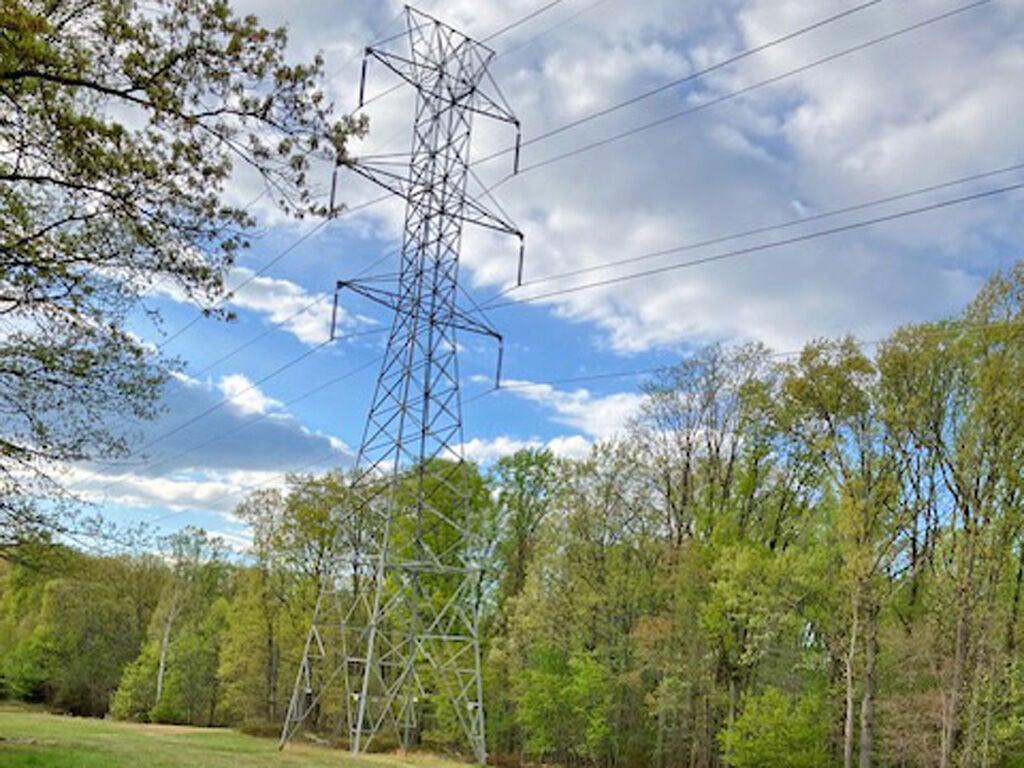
One of the lattice towers that was planned for replacement in Millstone by Jersey Central Power & Light . (Photo by Jane Meggitt).,

