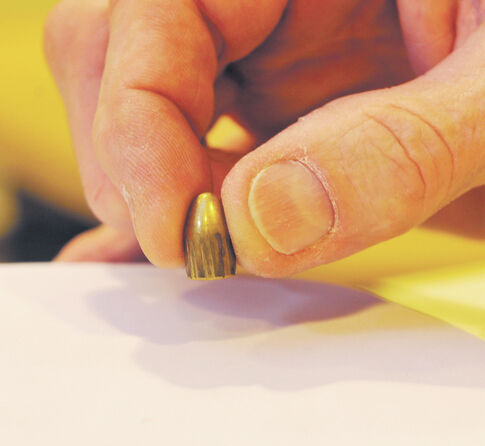
Leisinger shows the grooves a gun barrel makes on a bullet while it’s being fired. (Photo by Mark Czajkowski.)
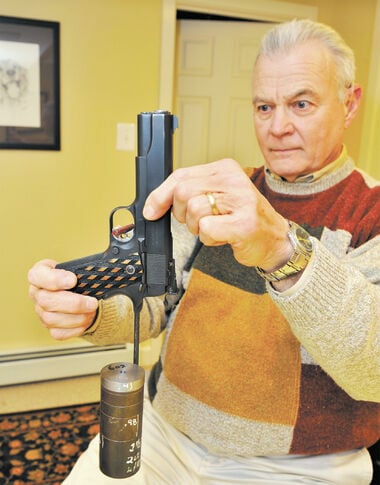
Ballistics expert Carl Leisinger demonstrates one of the tests that he performs on weapons as part of his work. (Photo by Mark Czajkowski.)
Ballistics expert Carl Leisinger helps determine whether a defendant is innocent or guilty
By Scott Morgan
You’re at a party, in the other room, when gunshots go off. Someone is dead. Someone else is about to be. And you, owner of a gun, are about to be arrested for murder.
Your attorney knows the only one way to keep you out of prison is to prove you weren’t anywhere near that murder weapon, so he calls the one person he can think of to get you off.
Not long ago, in Newark, Ewing resident Carl Leisinger answered this very call. A retired ballistics expert and major in the State Police, Leisinger now works the other side of most trials, as part of the defense team. He founded his own ballistics consulting firm, CAL III Enterprises, which operates on Pennington Road, in 2002 and has saved a hefty number of innocent suspects from serving time in prison.
Prosecution or defense, the process of analyzing a ballistics issue remains the same — part science, part Batman, all objective. Like a crash scene investigator, Leisinger sifts through the remains of accidents, tragedies and crimes to find out what really happened. In the Newark case, Leisinger snapped about 70 photos of the apartment and employed the decidedly low-tech placement of wooden dowels into the bullet holes to prove that the defendant wasn’t in the right place to be the shooter.
The dowels, you see, rest in the bullet holes in the walls. And when you let them go, they settle at angles that point to where the bullets came from. This, coupled with the fact that the caliber of the bullets in the defendant’s gun didn’t match those found in the victims, saved the man from a long prison stay for a violent crime he didn’t commit.
“I look at all the pieces of the puzzle and ask, ‘do they really fit?’” he said. He always did, but now that he’s no longer a policeman, Leisinger has something he (and most other cops) never had — time.
“In large cities, they go from murder to murder,” he said. “They go through cases quickly. I get to take my time.”
Certain statistics bear him out. The City of Detroit, for example, generally cannot solve 70 percent of its murders, most of which occur from a gun. Cases pile up fast and overwhelmed detectives run through evidence as quickly as possible. If there’s something to go on, great. If there isn’t? The case joins the 70 percent pile.
Even in cases where the police can look through a gun crime scene and piece together a collection of suspects and scenarios, detectives don’t always get a lot of time to investigate. And while most such cases are straightforward enough to place a shooter and a victim in a tragic orbit, some cases merely look as if one thing happened when in reality, quite another thing did.
What Leisinger looks for are the fingerprints that guns leave on bullets. Firearms leave trails of ballistic breadcrumbs all over a spent round. Short of stamping each bullet with a serial number on exit, guns imprint bullet fragments with such things as striations (from the rifling inside the barrel) and grooves of various widths.
The direction of the grooves, their width, their numbers — these are class characteristics, and they’re very telling. A bullet with five grooves and a righthand spin, for example, is likely going to be a Smith & Wesson. It certainly won’t be a Colt, because Colt fragments will show six grooves with a lefthand spin, Leisinger said. The spin of a bullet as it exits the barrel is based on direction of the grooves used by the manufacturer in its guns.
Narrowing this down further, Leisinger looks for machine markings or firing pin impressions in the fragments that can tell him exactly which gun made the markings. These are called individual characteristics.
“Class characteristics are like when you find the right church,” Leisinger said. “Individual characteristics are when you find the right pew.”
After more than 350 cases, Leisinger has developed a certain sixth sense about the evidence he sees. He can usually look at a fragment and identify the type of gun it came from. But then, guns are not just a major part of his career, they’re a hobby.
Leisinger, a lifelong shooting enthusiast, graduated from Guildford College in North Carolina at the height of the Vietnam War. With his pre-law degree, he wanted to be an attorney, but at the time, he said, “law school was for people with contacts.”
So Leisinger turned his legal intentions to law enforcement and joined the N.J. State Police in 1970. In 1977, he saw a posting in ballistics and stayed with it until he “retired” in 2002. Leisinger still does some part-time ballistics work for the NJSP, an arrangement he loves because he just gets to do the work he loves without contending with the realities of office life.
Leisinger earned his master’s in education from Seton Hall in 1991. He doesn’t teach, but he does lecture a lot to students in Pennsylvania and to various law enforcement officers. He’s also a heck of a rifle marksman — once captain of the NJSP team who can nail a target at 1,000 yards. Leisinger never served in the military, but has many friends who have and who have taught him shooting tactics.
He builds his own guns and loads his own ammunition. He likens his hobby to golf — which he has no use for, by the way — in that in both endeavors, your biggest opponent is yourself.
“You’re always trying to better yourself,” he said. He remains a national-class shooter.
Though chemistry plays into the science of ballistics, Leisinger did not follow his father, an executive at DuPont, into the chemical world. And though he does not have any family members who want to follow him into the field of ballistics, a 25-year-old nephew of a friend has become a protégé.
As you might expect, Leisinger is quite positive on guns and ambivalent on gun laws.
“I think gun laws are great for people who obey them,” he said.
The thing is, he said, stricter gun laws mostly affect law-abiding gun owners. Criminals, after all, couldn’t care less about gun laws, much less be bothered with the legal procedures required to buy one.
“In all the [criminal] cases but one that I’ve dealt with,” Leisinger said, “it was an illegal gun. There was one legal gun, but it was loaned, so it actually became an illegal gun.”
Not all cases are necessarily criminal, of course, even if they may at first look that way. Leisinger’s favorite case to work on was a shooting in a bar that involved a cop, the cop’s brother and three workers. The officer’s gun went off as he handed it to his brother, and the bullet hit the three workers at a 45-degree angle. But the shell itself never ejected from the gun; it remained in the barrel. A defense lawyer called Leisinger to tell him all this, and Leisinger immediately told him, “I can prove accidental discharge,” he said.
The quasi-scientific term for what happened is “limp wrist syndrome.” When you intentionally fire a handgun, Leisinger said, you tend to tense your arms, hands, and wrists. This gives the shell a sturdier platform from which to launch upon firing. But in the hand-to-hand (yes, friendly) exchange of this gun, the gun fired unexpectedly.
No one’s arms or hands were tensed for the impending shot, meaning the gun went off, both men let it go, and the shell got trapped inside. As for who actually triggered the shot?
“We don’t know,” Leisinger said. “But I was on the stand for six hours on that case.”
Ultimately, the court saw it Leisinger’s way, and the shot was deemed an accident. Leisinger, of course, loves to be able to clear the not-guilty, which sounds opposite of his former job as a law enforcement officer. However, he said, what he’s after on any investigation, now or 20 years ago, is objective fact. Science. Sometimes it clears the innocent, other times it catches a killer.
Take the case of a man in Atlantic County who shot and killed two young men at his vacation home. Leisinger matched a pair of .32 caliber bullets, but no one could get the man to admit he did the shooting. More problematic, there was no gun to match the bullets to. Ballistics matches, after all, occur because investigators fire rounds from the suspected gun and match microscopic details to evidence rounds.
Ultimately, the gun was found in a potted plant the man had given to a neighbor upon returning from vacation. It took nearly 70 shots to blow out the rust and crud inside the gun and get a match to the bullets.
“The guy finally owned up,” Leisinger said.
From the comfort of his patio overlooking his yard, Leisinger investigates and recollects evidence in cases like that all the time. And for him, life after full-time police work is good.
“I sit out there and think ‘I’m actually getting paid to do this,’” he said.
,