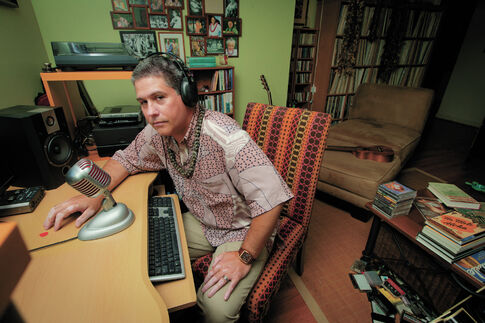
What more authentically Hawaiian image could there be than a guy named Bill sitting in his basement radio station in Ewing, surrounded by a collection of a quarter-million tunes on everything from MP3 to eight-track?
What, you don’t think a guy born in Philly and raised in Mercer County can be the real deal? All right, well maybe the question isn’t whether Bill Wynne could be a major name in Hawaiian music, but whether he should be. And a lot of people in Hawaii would agree that he shouldn’t.
But a rather sizable amount of Hawaiian music buffs, performers and culture guardians are really glad he and his radio station are around. See, Wynne, a legitimate Hawaiian musician known for his falsetto stylings and earworm-inducing strings, is a bit of a paradox smack dab in the middle of a culture that likes its traditions to remain entirely traditional.
He’s one of the few people about whom it would not be hyperbole to say, he’s an insider on the outside and an outsider artist with his finger on the proverbial pulse of Hawaiian music culture.
That said, he’s not an artist. Nor a musician. Not professionally, anyway. Being a musician as a job will get you thin and put you at the mercy of forces beyond your control, he said. And that statement will make a lot more sense in a few minutes.
First, what you need to know to better understand the binary stew Wynne occupies and to better understand the man himself is a brief overview of Hawaiian music as a cultural bastion. Hawaiians take their culture very seriously. Like, Mr. T. prepping to fight Rocky-level seriously. And traditional, composed in the Hawaiian language music is a main beam in the foundation of that culture.
Historically, Hawaiian was an oral-tradition society, meaning history and stories were passed down by telling them, often through song. Even after European settlers upended the society several centuries ago and introduced writing, the story of what it means to be Hawaiian comes through song.
And Hawaiian traditionalists want that music to stay traditional. As in, if you want to reach certain sanctioned plateaus among some in the Hawaiian music scene, you have to play it exactly how it was written and played by the original composer, Wynne said.
If you want to record it, you need to get the composer’s personal permission (or that of close survivors), which you can only do if you play it exactly as written. And you really should be Hawaiian, and not a Filipino, Spanish, Lithuanian, English, Welsh, German and Cherokee mix who believes Hawaiian music can evolve and still be purely Hawaiian culturally.
To be fair, Hawaiian culture certainly has been exploited in music, movies, art and so on. Hollywood is fond of filching aspects of Hawaiian society and making fads and kitsch out of the pieces. So Wynne understands the cultural discontent that he generates as a guy about as far away from Hawaii as you can get and still be in the same country.
But he doesn’t play his music, nor anyone else’s for the 50 percent who think he has no business playing it, and it would be a grave mistake to think of Wynne as just some Jersey boy with a fixation on trade winds. He’s been playing Hawaiian music since he was a kid (he’s almost 45 now), is the offspring of seasoned Hawaiian musicians, and believes he knows as much or more about the traditions, culture and history of Hawaiian music than anyone on the archipelago.
Hence the radio station, Ho’olohe Hou Radio, which broadcasts over the internet platform, Live365. Perhaps fittingly, the journey the radio station took to become a real thing came with its own dramas. It began with Wynne’s own collection of Hawaiian tunes — thousands of them — that he originally aired over a podcast he put together in 2007 because he wanted to share the songs and maybe introduce the world to Hawaiian sounds, whether they were traditional or not.
“Then some lawyer friends came by and told me I had to stop,” Wynne said. It seemed his charitable donation to the airwaves violated copyright and broadcast laws and, had he decided to continue, would have cost him $50,000 a download, per song. Stretched over 2,500 or so listeners, Wynne felt it more economical to shut down.
He briefly relaunched through a radio station begun by Don Narup, called 50th State Radio, which worked well until Narup died of throat cancer that no one knew he had. With no succession plan to carry on the station, 50th State Radio abruptly disappeared.
Between 2008 and 2012, Wynne and his collection sat dormant. “But people would ask me, ‘Where’s the music?’” he said. On top of that, Wynne had, as he had been doing, making his own music and performing it in Hawaii, and was so good at it, he had hula professionals coming to him for advice.
“I thought, ‘OK, they’re going outside Hawaii to find their own music, I have to do something,’” Wynne said. He decided to launch a blog, which allowed him to play pieces of songs as part of critical review. By the spring of 2014, he was averaging 300 to 400 downloads a month. By November, he hit 8,500.
Wynne turned to Kickstarter to fund his new radio endeavor. The campaign ended in August and brought in more money than he’d asked for. “I asked for $6,000 and got $10,000,” he said. One thousand of that came from a guy in Hawaii who had listened to Wynne’s broadcast for an hour and heard songs by his father, aunt and grandmother. The man told Wynne that his work was too important, because he was “bringing back the voices of the dead” who still mean so much to the living.
This sentiment is shared by some rather impressive names in the Hawaiian music scene. Ku’uipo Kumukahi, president of the Hawaiian Music Hall of Fame, called Wynne “ a treasure chest, and his collected recordings are the gems within.” Wynne’s contribution to what Kumukahi said is a dying Hawaiian art form is almost too great to put into words.
“When I think of the beauty of Hawaii, my ancestors, traditions and culture,” she said, “I think about the all elders of my family sitting in my home sharing stories, thoughts, genealogical history, Hawaiian values and loving on all the children in the room. I liken that to the collection Bill presents because it is what is familiar to me — comforting; spiritually stimulating. When I listen to the voices of his collection that have passed from this world, I feel they send back their mana’o.”
Mana’o means “thoughts through spiritual outreach,” Kumukahi said. Moreover, the music Wynne plays is not present in Hawaii — “especially in the libraries of radio stations in Hawaii owned by mainland corporations,” she said “It’s just not in their DNA to have such a library in their Hawaii stations, let alone a Hawaiian radio station in Hawaii.”
Wynne formally launched his station on July 3, which is a significant date in Hawaiian music history. On that date in 1935, “Hawaii Calls,” the first transcontinental broadcast of Hawaiian music from the islands, aired for the very first time and introduced much of the mainland to the evocative sounds of Hawaii.
Wynne is big on history in his broadcasts. He likes to refer to Ho’olohe Hou Radio as “edutainment,” where the music comes with a healthy side of tidbits, perspectives, historical facts and meaningful dates. On September 7, for example, Wynne did a piece to honor the date in 1950 when the song “Mele Kalikimaka” was released.
He’s also big on making sure artists played get paid, as it should be. His unintentional transgression into copyright violation a few years earlier taught him well, as did his head for business. When he’s not attending the station, Wynne is a product manager at ETS, just a few minutes from home. He started as a temp there about 25 years ago and worked his way up, eschewing all the while the lure of trying to be a full-time musician.
“My father was a professional musician and we starved,” he said. “Music is not a vocation.”
This puts Wynne in a rather enviable spot, as does his home in Ewing. While he takes part in Hawaiian music contests (yes, in Hawaii) and is actually “a celebrity in one state in the union,” he said, being outside the Aloha State keeps him away from the politics that plague Hawaiian music these days. And by having his own money outside of music, he doesn’t have to play by the same rules as musician friends there who must stay anchored to strict tradition for song construction and recording.
In other words, Wynne doesn’t have to listen to the 50 percent who dislike him and his outsider perspective.
Interestingly enough, Wynne started out hating Hawaiian music because, well, that was his parents’ music. He disliked the slow, languorous sounds of the islands his dad played and preferred the sounds of the Rolling Stones and other 1970s rock acts. But Hawaiian friends would return to the mainland with more modern, bolder, more rock-like Hawaiian tunes that were leading the Hawaiian Renaissance in the 70s. From that point on, it was true love.
With the station in full swing, Wynne is spreading the word about his true love to more and more people every day. And he’s going to keep doing it, regardless of the naysayers, because it’s all about connecting culture, the past, the present, and the spirit.
“Bill has a connection with Hawaii and he has a genuine love to keep our music alive on the airwaves,” Kumukahi said. “For Hawaiians the word ‘connection’ is of high importance. We are connected to our people, ancestors, traditions, culture and, most of all our language. I call a gentleman like Bill ‘ohana’ (family). Another highly prized word.”
,

