According to the website sprocketschool.org, a volunteer-run organization devoted to assembling “a collection of information, history, and suggested best practices for film exhibition in the 21st century,” there are just 23 theaters in Pennsylvania, New Jersey, and Delaware that still have the capability to show 35mm film.
Making the Princeton Garden Theater number 24 on that list is one of the top priorities of Chris Collier, executive director of Renew Theaters, the nonprofit that has been managing the venue for the past decade. “July celebrates 10 years of Renew Theaters’ management of the Garden,” Collier notes. “We want to begin our next decade by bringing new levels of quality and film history to the theater.”
Collier plans to make that happen by reintroducing the capability to show rare and classic archival films that are for the most part only available on reels of 35mm film. In addition, Renew will be upgrading the quality of the Garden’s digital projectors.
Why upgrade the digital projectors? “The digital projectors were installed in 2012, before Renew Theaters took over operation of the space, and they were the lowest level of digital projectors that were available,” he explains. “Our goal is to upgrade the digital projectors so that we can show 4k digital, which we can’t do right now. A lot of the digital restorations and other digital presentations are in that format.”
Collier explains what the switch from 2k to 4k resolution will mean to audience members. “Think about watching a high-res Blu-ray disc at home at 180 pixel resolution,” he says. “The resolution of film is many times that. The basic digital projector is 2k resolution, quadruple that of your home video, and when you move up to 4k it’s eight times the quality of a standard Blu-ray.
“That’s approaching the quality of 35mm film,” he continues, “so when you’re looking at a pristine restored film you notice additional details in the background and details in the way the director structured a scene that you can’t appreciate on a standard Blu-ray, and definitely not on your phone when something is streamed at the lowest possible bandwidth.”
Collier is planning to resolve another issue that affects the enhanced presentation of both digital and 35mm films. “When the digital projectors were installed, the 35mm equipment was removed from the Garden completely,” he says. “Another challenge is that the screens were actually set to — and this is getting pretty technical — a fixed top and bottom masking, so you could only make the projected image wider or narrower, not taller or shorter. (Note: Think of “masking” as analogous to the mat that surrounds a framed photo.)
“So for a ‘scope’ image, which is your widescreen rectangle, the image is about as wide as the screen, but when you show a standard format film, the projected image must be smaller, and if you were to show a classic Hollywood film, which is more square, it’s really small, about half the screen. When we were closed during the pandemic, we replaced the screen in theater #1 with a much larger screen with movable masking, so we can get the largest possible image no matter what the format of the film we’re showing. That’s what we needed to have in place before we could put 35mm capability back.”
Obtaining 35mm projectors was another challenge, Collier notes, for the simple reason that no one is manufacturing them anymore. Fortunately, Princeton University came to the rescue. “A venue within the university was getting rid of their film projection equipment,” he elaborates. “We asked if they would save those projectors and have them moved to the Garden, and they’re already sitting in the projection booth. New portals need to be installed, and there’s some electrical work to be done. We also need to find lamp housings and lenses to adapt the projectors for use in the Garden’s larger space, and we need to raise the funds to make all that happen.”
Many of today’s would-be movie-goers grew up immersed in a digital world, watching movies at home or on their phones versus in a theater, and may not appreciate the importance of making movies shot on 35mm film available. What is Collier’s take on what was lost or gained in the switch from 35mm to digital?
“One of the goals of the Garden is that we see ourselves not just as a movie theater but also as a cinema history museum, and 35mm film was the medium on which films were presented from the 1880s through the 2010s, when the major switch to digital began,” he says. “There is 100-plus years of film history there, so one important goal is being able to showcase film history in the way that film was previously done. There are hundreds and hundreds of titles that have not been restored and transferred to digital, that you can only get from film archives or private collectors.
“I also think there’s something magical about hearing the chattering of the projector as the film goes through, and in knowing that the projector is being run by a person versus a computer,” he continues. “To run a 35mm show we’ve got to have two people in the projection booth, because film has become so rare that you need to have two projectors. Each reel is about 2,000 feet long, about 20 minutes worth. Your typical film is about two hours long, about 12,000 feet of film.”
Collier describes the precisely choreographed moves that must be executed by projectionists when showing a film. “Each reel of film has a leader, a protective head and tail about 10 feet long that keeps it from getting scratched when it’s on the reel. When you showed a film in a multiplex, you’d cut the tail off of reel one and cut the head off of reel two, and so on, and tape them together into one giant film.
“In the archival film era we’re in now, you don’t want to be cutting and splicing reels of film, so you need two projectors. You start reel #1 on projector #1, and when you see a small dot in the corner (of the projected image) you have several seconds to get the second projector started, get the projector up to speed and get the bulb warm enough so that it’s ready to go. When a second dot appears, the changeover dot, you switch to projector #2, smoothly alternating between the two projectors until you’ve shown the last reel.”
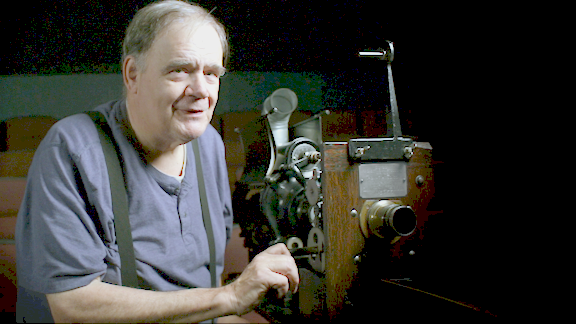
Which brings up another challenge faced by Collier; finding projectionists who can make the magic of presenting a 35mm show happen. Yes, it is a challenge, he admits, but one that Renew has been able to meet. “Projectionists are a dying breed and a very rare find at this point in time,” he admits. “That said, we have been incredibly lucky. The reason that the Ambler (a historic movie theater in Ambler, Pennsylvania, that’s managed by Renew) has a 35mm film festival is that we had a longstanding relationship with a local film preservationist and collector, Lou DiCrescenzo, who passed away in January.
“Lou donated projectors and a number of films to us,” he says.”One of his projectors is currently on display in the lobby of the Garden. He also mentored Jesse Crooks, our head projectionist and director of operations, to the extent that I’d say he is now one of the main qualified 35mm projectionists on the East Coast. We we are really, really lucky to have him. He is a true treasure of our staff and has been taking the time from these 35mm film festivals to take other staff members under his wing and train them. This past year we had five projectionists who Jesse had trained and brought into that craft, and we have a number of staff members at the Garden who are very, very eager to learn that skill as well.
“I think one of the other exciting things about this is that it’s not just keeping the history of film alive, it’s also keeping the technology and the idea of how this medium works alive through training our projectionists. We’re lucky to have that completely in-house. We actually rent Jesse out to other theaters!”
Collier notes that this year marks the fourth 35mm festival at the Ambler, which began in 2018, with a three-year hiatus during the pandemic. Has the success of the festival given him confidence that it would also work at the Garden? “Absolutely,” he says. “People really love it, it’s one of our most special weekends at the Ambler. We’ve also seen that of all the theaters that we operate, the Garden has the most adventurous audience, perhaps the most educated audience, and the fact that we are currently limited in terms of the availability of content is unfortunate.
“We want the Garden to be able to live up to it’s bona fides in being across the street from Princeton University. We want to be able to show the best restorations available, we want to be able to show the best archival content, and we want all of that cinema history to be available to our Princeton audience.”
What’s the current status of the projects? What remains to be done? “Our first goal is to upgrade the digital projectors from (2k to 4k),” Collier says. “We are in the fundraising stage for that, and we’re going to use that as the springboard to install the wiring and other work that needs to be done to put the 35mm projectors in place.
“We have the projectors, the largest portion of the cost,” he continues. “Finding the other parts we need shouldn’t take long, and I’m confident in our fundraising ability. It’s the technology pipeline that’s a concern. The lag time in getting the digital projectors delivered and finding the parts we need for the 35mm projectors could potentially slow us up, but I suspect that everything can be accomplished in less than two years, depending on how quickly we can secure the funding.”
Does Collier see the return to showing 35mm films as part of the trend to return to analog media? Vinyl has been growing in popularity for quite a while, film cameras, CD or even vinyl jukeboxes, and cassette tapes. Is some of that driving it from an audience perspective? “It’s not the driving reason, but lots of people are interested in that return to the past, and digging in to those classic forms,” he notes. “I can say when we have a 35mm show that our attendance tends to be markedly higher than a digital show.
“I think people know that it is something special and rare, and something you can’t experience anywhere else, so it’s a reason to come celebrate film on the big screen as a community. Lots of the films can be viewed at home from the streaming services, but this is something unique. If you don’t see it that night, you may never see it again.”
Princeton Garden Theatre, 160 Nassau Street, Princeton. www.princetongardentheatre.org.
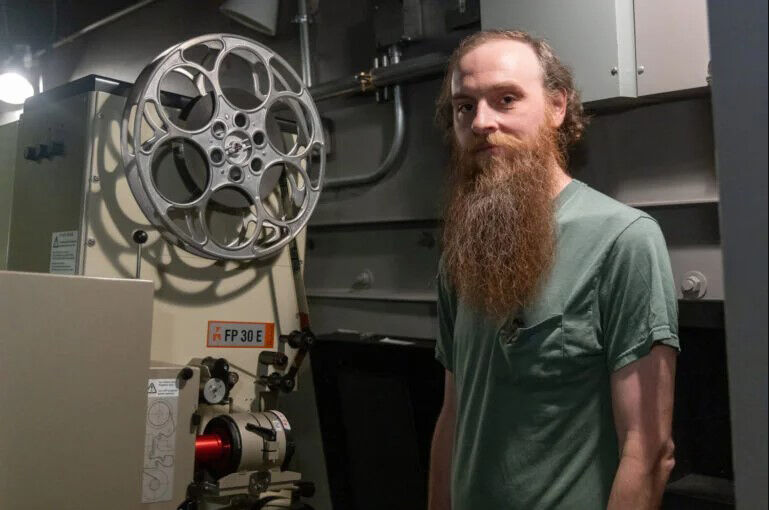
The Garden Theatre’s Jesse Crooks is an expert on 35mm film projection. Photo by Kimberly Paynter/WHYY.,