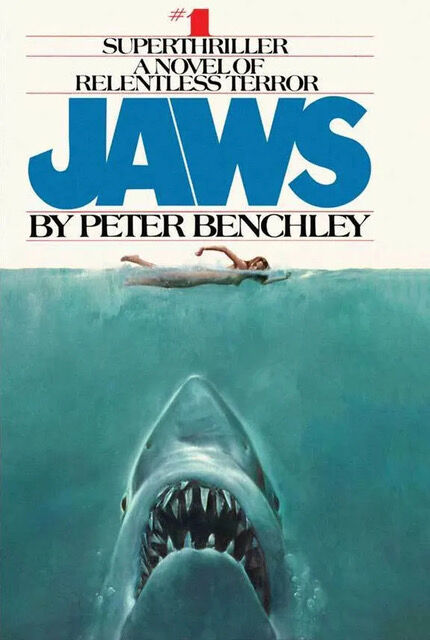
Princeton has a rich literary heritage, but it seems an unlikely place for an author to write a riveting novel about a great white shark. The town is landlocked; the Atlantic Ocean, where those carnivores ply the depths, lies 30 miles east. The most dangerous predators in Princeton’s waters are the snapping turtles in Carnegie Lake.
But a young journalist named Peter Benchley and his wife, Wendy, chose Princeton in which to raise a family after Peter’s Washington, D.C. gig as a speechwriter for President Lyndon Johnson ended in January, 1969.
Peter had read a story about a fisherman who caught a 4,550-pound great white with rod and reel off Long Island’s Montauk Point. Like a shark’s tooth the size of a shot glass lodged in the hull of a capsized boat, the idea of a two-and-a-half-ton shark stuck in Benchley’s craw. He transformed his fixation into a thriller called “Jaws.”
Benchley’s bestseller began just down the road from Princeton. As he recounted, “I sat down in the back of a furnace supply store in Pennington, New Jersey, and began to tap out the first eight pages of ‘Jaws’ which to this day were never changed — not a comma was changed, those first eight pages were exactly as they came forth from my subconscious.”
Doubleday published “Jaws” in February of 1974. The hardcover edition spent 44 weeks on the bestseller list. The paperback version with its iconic cover — a blend of titillation and terror — became the ultimate airport read, with many a copy seen peeking out of a tote-bag on its way to a boarding gate. Ironically, it also became that summer’s ultimate beach read as legions of baby-oiled sunbathers feverishly turned its pages.
As a book, “Jaws” became a #1 bestseller; its film adaptation a year later by a young Steven Spielberg would become the stuff of Hollywood legends, ushering in the summer blockbuster concept, smashing box office records, and netting three Academy Awards.
Fifty years on, the overwhelming successes of both the book and the movie seem givens, but it wasn’t always that way. Wendy Benchley had to laugh at her initial reaction: “Peter said to me, ‘I have an idea for a story, and it’s about a shark that terrorizes a New England town’ and I said, ‘Peter, that is just the most foolish idea I have ever heard, you know, think of something else, honey.’”
Fortunately for all of us, Peter Benchley kept plugging away at his book. And he networked. Benchley’s literary agent arranged a series of meetings with the editors of the big publishing firms. Over lunch with Doubleday editor Thomas Congdon, Benchley pitched his fish story, and Congdon was hooked, offering $1,000 for the first 100 pages, part of what would eventually be a $7,500 advance.
Benchley had landed a book deal. He completed the manuscript in about a year and a half, but in the early going, he almost sabotaged success: initially, he wrote the first four chapters as if the story were a dark comedy! Suffice to say, Congdon sent him back to his typewriter.
As a novel, Jaws has many parallels with the grandaddy of all American seafaring adventures, “Moby Dick,” particularly — spoiler alert — the demise of one of its main characters, the Captain Ahab-like Quint; unlike his grisly death in the film, Quint dies when a rope tethered to a harpoon wraps around his leg and he is whipped off the boat and dragged under by the shark.
There’s also a curious parallel between the authors: Peter Benchley and Herman Melville wrote from landlocked locales. Melville penned much of “Moby Dick” in his western Massachusetts home, where, from his second-floor study, he gazed out at the rolling backs . . . of the Berkshire mountains.
After the success of “Jaws,” Benchley continued to write bestsellers from his Princeton home. His follow-up novel, “The Deep,” was also adapted into a film, another summer blockbuster that actually surpassed “Jaws” in its first weekend’s ticket sales.
More profoundly, Benchley discovered the elegant beauty of the great white shark, as well as its perilously fragile habitat. He became a champion of the sea, putting his fame and talents in the service of ocean conservation and awareness. “Save the sharks, and we can save the oceans,” said the man who created one of Hollywood’s most memorable aquatic villains.
Benchley’s thriller continues to grip audiences 50 years later. As Wendy Benchley recently told me, “I think it’s a testament to the power of good storytelling, compelling characters, and our primal need to make sense of things we fear and cannot control. As the late E.O. Wilson, Harvard’s renowned entomologist and naturalist, observed: ‘We are not afraid of predators; we’re transfixed by them . . . in a deeply tribal way we love our monsters.’”
Editor’s note: Peter Benchley died in 2006 at the age of 65, but his legacy lives on in part through the Princeton Garden Theater’s “Jaws Fest,” an annual screening of the classic film.
This year’s event takes place Wednesday, June 26, at 7 p.m., and features “Jaws”-themed trivia prior to the screening and a post-film presentation by Wendy Benchley on how the book and movie led to work in ocean conservation and marine policy.
The theater is located at 160 Nassau Street, Princeton. Tickets are $15.50. For more information, visit www.princetongardentheatre.org.
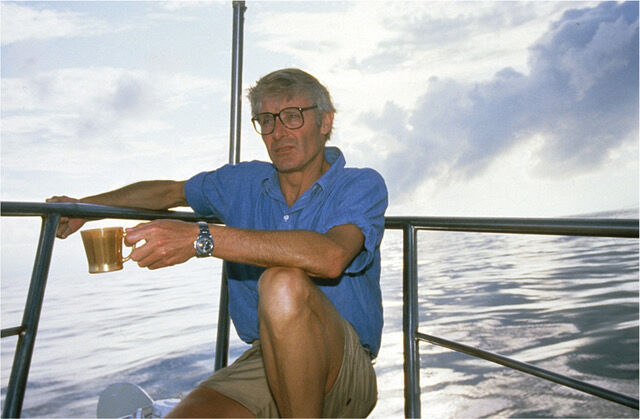
"Jaws" author Peter Benchley sailing in New England in 1996. Photo courtesy of Wendy Benchley.,