Jason Robert Brown’s “The Last Five Years” treads familiar ground in an unusual way.
The musical chronicles a half-decade relationship between an ambitious novelist and a less confident but equally determined actress, yet the two rarely intersect on stage.
Twice maybe, logically at the time of the couple’s marriage.
The challenge in staging the piece is retaining some connection, and tension, between the lovers while exploring the individual paths each travels as he and she face the arduous task of simultaneously juggling pressing personal objectives and a partner’s needs.
In Eliyana Abraham’s character-oriented production for Princeton Summer Theater, those challenges are met.
Abraham’s mounting is spare yet nuanced and detailed enough for Brown’s story, told almost entirely through song, to emerge in a clear, lively fashion. Almost every choice Abraham makes enhances Brown’s intentions and the general production while never overwhelming it.
Because of that her audience gets to know Brown’s characters in depth. Thank the ebullient Julien Alam and thoughtful, textured Kate Short for that. They provide the clarity and energy of the show. They create two separate, distinct, and knowable people who, as is the common case in two-hander musicals, fall in love that doesn’t last.
Although I am not averse to spoilers, I’ve not giving anything away here. Short’s Cathy tells you in the first lyric in the show that her life, and therefore marriage (something we don’t know about yet) with Alam’s Jamie is over.
Of course, when you meet Jamie, he’s head-over-heels, literally in Alam’s case, about seeing and becoming infatuated with a woman (Cathy) who will turn his mother suicidal because he is Jewish, and she is a “shikse,” a Gentile.
Cathy’s doleful dejection vs. Jamie’s archly expressed exhilaration is explained by Brown constructing “The Last Five Years” on contrapuntal timelines. We encounter Cathy, alone and blaming Jamie, at the end of the five years while we meet Jamie at the moment he spots Cathy across a crowded room and, following Hammersteinian wisdom, flies to her side.
Watching Alam, the surprise is that he doesn’t actually fly. His first number is an exercise in perpetual motion. He’s like human liquid fusion, never stopping for a moment and matching every word, nay every syllable, with a gesture, contortion, moue, or gymnastic feat that would exhaust Salome and is, frankly, dizzying though potent and exciting to watch if only to see how physically nimble and in command of his body Alam is.
Given Brown’s conceit, Jamie’s arc is easier to follow than Cathy’s. His songs, circumstances, and emotions define where we are in the relationship while Cathy’s at times set you calculating, “Oh, yes, I see, his scene was before their engagement, and hers is from after they’re married.”
The casting of Alam and Short may be among Abraham’s best decisions.
The differences in their styles add to the differences that are part of their characters, Alam is aggressive yet has a way of internalizing Jamie’s reaction to problems until the hiccups blow into dilemmas that demand attention. Short, though quieter and much less outwardly emotional, takes all situations, at any level of concern, to heart. The irony in the Summer Theater production is Jamie’s directness, almost to the point of pragmatism, makes you more sympathetic to him than to Cathy, who is open about what she feels but so much more subdued in her expression, you see how her passiveness contributes more to the wrinkles in her and Jamie’s marriage than does his attraction to a starry life available to both of them once Jamie becomes a popular best-selling writer whose books are featured in store windows.
For instance, before you see how Jamie is hurting the marriage, you see Cathy refusing to dress up to attend a banquet where Jamie is about to receive an accolade and that is important to his career and that merits his wife’s presence. This reluctance could be a reaction to an earlier scene of Cathy’s, in which Jamie doesn’t support her while she performs in summer stock in Ohio, but it doesn’t register as an eye-for-an-eye as much as it does stubbornness and deliberate pique.
Especially when you place the two incidents on Brown’s seesawing timeline and realize the disappointment in Ohio may not have occurred yet.
Brown’s timelines also keep Cathy and Jamie from being on stage together. Alam and Short generally appear solo to sing the latest chapter in his or her existence.
Abraham helps relieve this theatrical vacuum where she can. She is canny in placing the character not in action onstage, obviously not responding to what the other character is doing — he or she can’t know that — but giving some structure and texture to a scene by, say, letting us watch Jamie scribble on a notepad in their New York apartment while Cathy laments his absence and sings about bonding with some fellow actors in Ohio.
In one excellent stroke, at just about the place where Brown’s timelines intersect, Abraham affects the transition from separate worlds to relieving togetherness by having both characters in a car, Cathy originally driving while singing her number, then passing a steering wheel prop to Jamie when it’s his turn to sing to us.
Abraham’s production entertains throughout, but it rises to new heights when Jamie and Cathy can finally be on stage singing with instead of about each other and letting us witness their affection and regard first-hand.
These scenes, one depicting the couple’s engagement, one their marriage, create a warmth that is otherwise missing from the show.
Alam is particularly affecting in these scenes. We are used to seeing his Jamie as a collection of overcharged nerves that can’t tolerate stillness and require effusive expression.
Though Alam is shrewd enough to calm Jamie as he matures and becomes more successful in the literary world, he changes Jamie’s intensity from manic and anxious to loving and visibly content as he places a ring on Cathy’s finger and sings about his future with her.
Short, in turn, responds demurely, showing her happiness more subtly, as befits her Cathy, yet conveying a transition in Cathy from someone who is unsure, self-critical, and tentative about believing she’ll get anything she wants to someone who can bask in the sweetness of Jamie’s proposal and believe her life is rosy after all.
The meeting of Jamie and Cathy onstage makes for wonderful sequences, which is important because the one element Abraham’s staging seems to cry for the most is romance.
As you see Jamie and Cathy is their separate worlds at different times, you understand and are involved in their situations, but what is not seen, even when Abraham can find ways to have both characters on stage, is the connection between the pair.
Brown’s songs cover what is going on, at times in ironic or sardonic ways, but you see Cathy and Jamie as individual entities who are having a relationship and care about each other, but who seem to care about their careers more, a boyfriend or girlfriend being a nicety, occasional icing on the cake.
Though Jamie sings about loving Cathy, and Cathy sings about winning an unexpected love, the distance between the characters becomes an emotional distance on stage. The scenes in which they’re united changes that, but only for those scenes.
The romantic void doesn’t significantly mar Abraham’s production. In fact, it is unquestionably the best, most polished, most professional mounting I’ve seen since the 1990s on the Princeton Summer Theater stage, musicians Asher Muldoon, Natalie O’Leary, and Faith Wangermann, who also has an effective walk-on, included.
Julien Alam and Kate Short exude that polish and professionalism.
Each begins his/her performance a tad too dramatically, although not dangerously or distressing so.
Alam, as mentioned, is a veritable Dervish through his first three numbers. I couldn’t figure how many more wiggles, hand gestures, facial expressions, or dance steps he could do and remain alive until the end of the show.
Invigorating and fun as it is to witness Alam’s athleticism, you want to cry, “Whoa, half of that, please.” Then, as time passes, Alam tempers his zeal. You stop being impressed with his physicality and begin to admire the depth he gives Jamie.
Alam’s is a secure, bravado performance. Now at NYU studying acting, he should do well in a theater career.
Kate Short looks positively stricken when she comes onstage to announce “Jamie’s gone.” It’s the opening moment of the stage, and you worry Cathy’s grief is already too great for Short to build from.
Of course, Short has the backwards timeline, so making Cathy’s sadness dramatic makes theatrical sense.
Like Alam, Short brings Cathy to a more human scale as “The Last Five Years” unfolds. She gives winning subtlety to the character, the sense of a girl/woman who doesn’t quite believe in herself but gains confidence via a loving relationship and escalating career success, even though she has a longer road than Jamie to travel on her professional journey.
Once past some overkill, Alam and Short contrast well. I keep wondering how much richer Abraham could make her production if Brown’s conceit allowed her to place Cathy on stage in crucial scenes in which her presence is represented by a chair to which Jamie sings.
Yoshi Tanokura’s set neatly separates New York from Ohio while giving space for Brown’s story to be played. Bex Jones’ costumes are perfect, period, even to the sweater Cathy borrows from her theater’s wardrobe department.
The Last Five Years, Princeton Summer Theater, Hamilton Murray Theater, Princeton University. Enter campus via Chapel or Elm Drive. Through Sunday, July 21. Showtimes are 8 p.m. Thursday through Saturday and 2 p.m. Saturday and Sunday. Tickets range are $35 for evenings and $30 for matinees. www.princetonsummertheater.org.
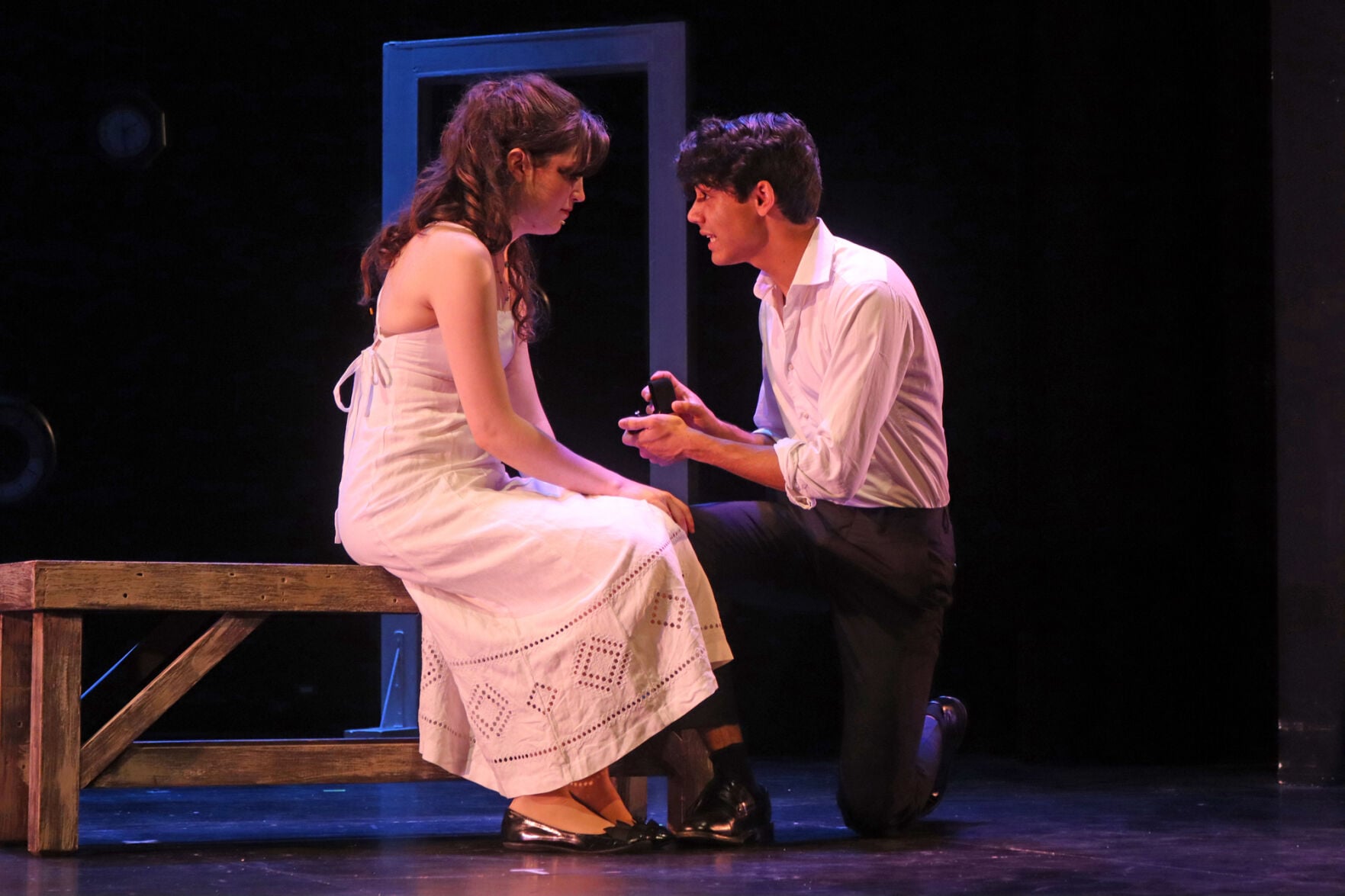
Kate Short and Julien Alam in ‘The Last Five Years,’ which continues through July 21 at Princeton Summer Theater.,

