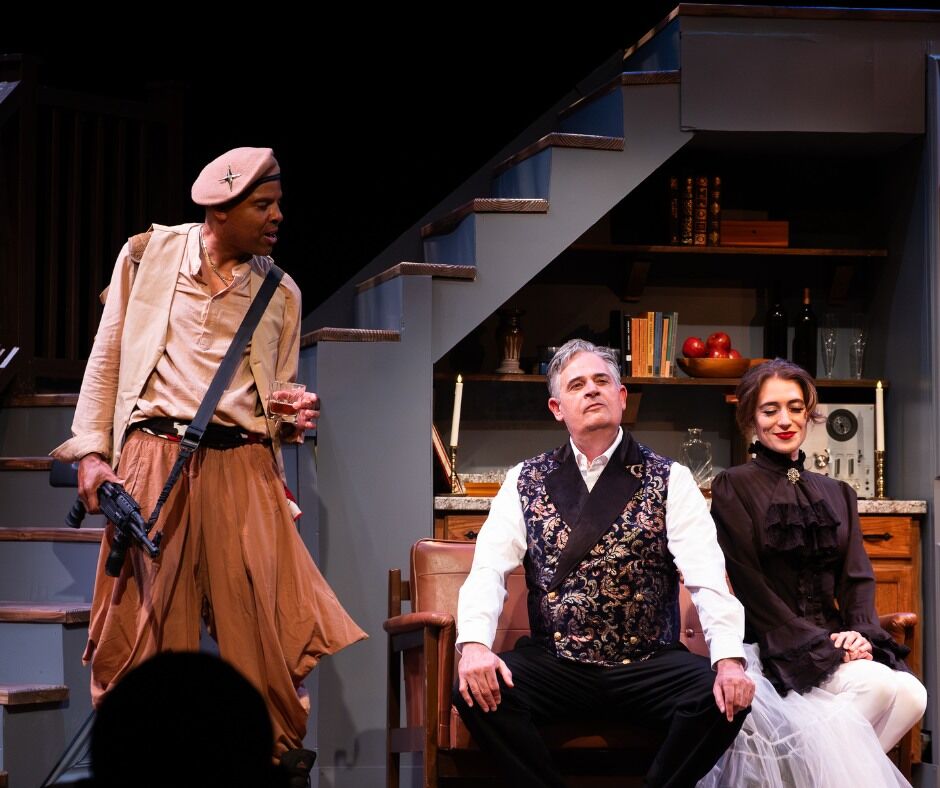
“Dutchman” and “The Slave,” provocative allegories that reveal both the talent and political mind of playwright, poet, and philosopher Amiri Baraka, powerfully confront racial tensions, its causes, and attitudes towards in Ozzie Jones’ gripping and telling productions for Trenton’s Passage Theatre.
Jones and a dynamic cast of Phillip Brown, Deidre Rose, and Peter Bisgaier spare nothing as they head straight on to the drama inherent in Baraka’s 1964 one-acts. Written during one of the most active and productive periods in civil rights advancement, the plays also hold back nothing as Baraka aims for and sparks controversy by creating bold, vivid scenes that illustrate his personal point of view while referring to history and giving all of his characters enough say to present their truths among ideas he chooses to stress.
Baraka obviously wants to move his audience. He is not about being gentle or subtle. “Dutchman” and “The Slave” are each direct, the former displaying Baraka’s view of how race relations have been for hundreds of years, and especially since Europeans set sights on parts of Africa as a place to settle, “The Slave” being a study of entrenched stances, beliefs, and behaviors that lead to extreme clashes and seem impervious to logic, updated reason, or even heated debate that might lead to more rational, as opposed to rationalized, solutions.
Jones and company capture every bit of Baraka’s intense emotion as well as every occasion of his wit, irony, contradiction, and call to action.
Baraka is speaking his mind via confrontational theater. One may not agree with everything he posits or all he has his characters state, but much of what is seen in “Dutchman” and “The Slave” is undeniable in terms of how matters have and can be manifested. Baraka offers the cultured raw, the hidden and accepted that can’t mask or restrain the actual. Jones, Brown, Rose, and Bisgaier bring it to stirring life. Some of what happens in both plays may shock and disturb different auditors’ sensibilities or personal outlooks, but all that happens is courageously and unstintingly depicted by Jones and his cast.
No one can leave Passage’s production without dozens of thoughts and questions swirling through their heads. I cringe a little at sounding like a concerned 21st century worrywart as I use words like “shock” and “disturb.” They are not meant as fashionable trigger warnings — I laugh heartily at those — but as a tribute to the stark honesty Brown, Rose, and Bisgaier bring to the stage, honesty so palpable it makes room for the parody, affectation, and winking use of cliche Baraka and Jones use in bringing the playwright’s 1964 pieces to meaningful 2025 life.
Passage’s choice of “Dutchman” and “The Slave” in tandem with Crossroad Theatre’s choice to do Lynn Nottage’s “Crumbs From the Table of Joy” (and later Athol Fugard, John Kani, and Winston Ntshona’s “Sizwe Banzi Is Dead”) illustrates a point that has been swimming in my head for several seasons now. While I appreciate the efforts both theaters make to present the homegrown and create pieces from scratch, I’ve always believed they would benefit from doing more of the tried and true, balancing their seasons with works by artists like Baraka, Nottage, and Fugard among others.
Passage has provided several interesting and entertaining pieces in recent years, but in Ozzie Jones’ production of “Dutchman” and “The Slave,” it shows its mettle in bringing classics to vibrant existence. This becomes more important when one considers how dormant “Dutchman” and “The Slave” have been for all theaters’ repertoires. Baraka may be showing audiences the dramatic lay of the intellectual land in 1964, but Brishen Miller and Jones at Passage insightfully reveal how contemporary, or timeless, Baraka’s double is.
“Dutchman” and “The Slave” are not two easy pieces.
Each requires thought and orchestration. Jones and company provide that with compound interest as they avoid making the plays into the set rhetorical pieces they can become and focusing on their human side, rough and multi-faceted as that may be.
“Dutchman” takes place on the New York subway. A well-dressed, well-mannered young Black man (Brown), traveling to visit a friend, takes a seat and begins his ride, at times idly glancing at a newspaper or minding his own business in reverie.
Jones employs a joke by having Brown enter dressed as a doddering old man who sheds his wig and dusty clothes to reveal the spruce, obviously meticulous younger man en route to his destination.
Jones breaks the possible claustrophobic subway car by using the aisle to having sexy young woman (Rose), complete with stark white mini-skirt, go-go boots, and flowing blond wig, sashay her way down a lit aisle, flirting with some of the men she encounters on her way to the car Brown’s character, Clay, occupies alone.
The woman, Lula, is the “Dutchman,” the invader of peacefully occupied space who intends to make her presence known.
Seduction is the obvious order of the day, and Lula might figure on using her stereotypical feminine charms to land her prey, but that direct approach doesn’t suit her. Perhaps she sees that in the pristine, benign way Brown presents Clay, direct onslaught might not work.
Teasing, taunting, ridicule, and insult, techniques of the invader, become her tools. She invokes snide comments about Clay’s sophisticated look and possible assimilation before going to the heart of her repertoire with racial slurs, all the while keeping that feminine mystique so identified with the assured sex kitten.
Clay being too resistant, Lula ups her game, thrusting hips and doing provocative dance moves to which Clay still doesn’t succumb.
Not getting what she wants, she unsheathes the talons of the invader, going for the throat in every conceivable way.
“Dutchman” becomes a shorthand study in interruption, invasion, insistence, and conquering by a force that won’t take no for an answer, never thinking it has to, against an unwilling foe whose coy refusal blossoms into angry rebellion that gives the invader the impetus to do what she came for in the first place.
Baraka has shown the act of colonization in modern, one-on-one form. Jones, Brown, and Rose has made it so you can’t take your eyes off of it. They employ cliches and expected reactions while showing they have more up their sleeve. What starts as an annoyance, some girl plying unwanted and possibly dubious charms, becomes a conflagration.
An historical idea finds the right dramatic context, and Jones, Brown, and Rose bring it home palpably and engrossingly.
Jones is as clever at the opening of “The Slave” as he was at lights up on “Dutchman.” He employs the boarding passenger that witnesses the end of “Dutchman” (Bisgaier) as someone who cleans up one scene and leads us to the next, literally by grabbing a chain attached to a turntable and joining Rose to reveal the posh urban living room set designer Marie Laster has hidden behind the subway set-up.
“The Slave” mounts arguments, some piercing, some rhetorically useful if not outright pat, that set one ping-ponging between points of view, some sound, some convenient, as a man (Brown), a revolutionary leading a successful civil war, invades the apartment of a rich, connected couple (Rose and Bisgaier) who happen to be his ex-wife and her new husband,
He and the wife have two daughters, sleeping upstairs from the living room where the action takes place, whom he has come to claim and have by his side as the revolution replaces one government with the one he expects to spearhead.
Baraka enlists all ideas, good and bad, as the revolutionary, Walker, makes his case and pronouncement to his ex, Grace, and the professor to whom she is now married, Brad.
It is stimulating to hear the banter and the stances, even expected ones. Whether one agrees with all that is said, or sees how one side may have some merit while not completely carrying the day, it’s both entertaining and enlightening to recall the kind of discussion that was rampant in the ’60s, a dialogue that might continue to day, but without the intelligent heft Baraka and his characters give it.
Baraka is clear about the outcome he wants. Obvious though that may be, it doesn’t spoil the sparring, posturing, and logic, good or forced, that flies across the Passage stage in the capable hands of Brown, Rose, and Bisgaier.
I have seen Phillip Brown more than a dozen times in the last couple seasons, and I have never seen him stronger that in Jones’ production of “Dutchman” and “The Slave.”
Some of that has to with Brown having lots of material and ideas to draw from. Whatever the reason, he masterfully transforms from a milquetoast who doesn’t want to be bothered to roaring resistance in “Dutchman” and finds subtlety, charm, and humanity in a revolutionary who could have just as easily been played as unrelentingly doctrinaire in “The Slave.”
Brown’s vulnerability in “Dutchman” and variety of moods in “The Slave,” a reference to people being married to supplied thoughts instead of forging philosophies of their own, informs the plays and helps them realize their greatness.
Deidre Rose skillfully combines since-day-one sexiness with cunningly dark intention as the temptress supremacist in “Dutchman.” She really shines in “The Slave,” in which she parodies a well-heeled socialite, Bryn Mawr accent and all, while showing her Grace is the most rational, untainted character of any we’ll see in Passage’s double bill.
Rose is canny in how she manages the Grace who is the doyenne of a cultured Manhattan home and the Grace who understands Walker and can reason with him sans the cant Brad cannot help spouting.
Peter Bisgaier turns in another of his fine-etched performances as a man who has a point he hopes will prevail even as he symbolizes the person whose arguments are most likely to infuriate an adversary.
Marie Laster’s turntable set serves both the starkness of a subway car and the opulence of sophisticated wealth. Tiffany Bacon’s costumes are gems, especially her outfit for Grace in “The Slave,: with his prim, perfectly tailored, bow at the neck blouse over a slip, open at the front that recalls the vamp in “Dutchman.” Alyssandra Docherty’s lighting gives Jones’s idea of using the theater aisle its total effect. It also adds to the ominousness of “The Slave.” Larry Parker’s sound design adds to the tension in “The Slave.” Both shows benefit from the props designed by Melody Marshall.
Dutchman and The Slave, Passage Theatre, Mill Hill Playhouse, 205 East Front Street, Trenton. Through Sunday, November 16 at 7 p.m. Thursday and Friday and 2 p.m. Wednesday, Saturday, and Sunday. $35. www.passagetheatre.org or 609-392-0766.