On June 8, 1968, Princeton composer Frank Lewin listened to the funeral of Robert F. Kennedy over the radio from St. Patrick’s Cathedral in New York.
Afterward, in common with one or two million of his fellow Americans, he was seized by an impulse to pay his respects as Kennedy’s funeral train traveled from Penn Station to Washington, from which Kennedy’s remains would be transported to their final resting place at Arlington National Cemetery.
Such was the turnout along the Mid-Atlantic corridor that it took over eight hours for the train to complete the 225-mile trip. Lewin stood with his daughters on the crowded platform at Princeton Junction as Kennedy passed slowly by.
The solemnity of the occasion inspired him to write a funeral Mass, which was heard for the first time, as part of a memorial service at Princeton University Chapel on May 27, 1969.
On Saturday, May 9, “Mass for the Dead (Requiem for Robert F. Kennedy)” will return to the chapel, 57 years later, for a concert performance by Princeton Pro Musica. The program, titled “American Resonance,” will also include Leonard Bernstein’s “Chichester Psalms” and Margaret Bonds’ “St. Francis’ Prayer.” Artistic Director Ryan Brandau will conduct.
In addition, Princeton University Organist Eric Plutz will perform other American works on the chapel’s Mander-Skinner organ, the very instrument Lewin had in mind when composing his Requiem. The concert will begin at 4 p.m.
An associated event, a panel discussion about Lewin’s work, will be held earlier in the week, on Tuesday, May 5, at Princeton Public Library. Brandau will be joined by two of the composer’s daughters, Naomi and Miriam. They will talk about Lewin’s creative inspirations, share some behind-the-scenes stories, and play some musical excerpts.
The panel discussion will take place at 5 p.m. Admission is free, but registration on the library’s website is encouraged. princetonlibrary.libnet.info/event/16299593.
The 1960s was a decade of unrest and often fatal violence. Robert’s brother, President John F. Kennedy, was assassinated in 1963. Martin Luther King, Jr. was killed only two months before RFK.
A letter from Frank Lewin to a friend, the celebrated harmonica player Larry Adler, captures something of the emotional exhaustion of the era.
Dear Larry,
Another one of those series of days when the whole country stops…. And then the scenes on television: the unimaginable strength of the women, the ceremonies…. This death, to me, was the most shocking if such a comparative is possible.
Saturday a friend of ours from California and our three girls and I went to the little railroad station from which, you will remember, one goes to New York. We waited for the train, which had been delayed by an accident and a slow progress past crowds of people all down the line. When it passed one could see the many dignitaries looking out, and in the last car Rose Kennedy waved to the crowd (there were about 4000 people on the Princeton Junction platforms)…. How those people have stood it during the past four days, physically, is a marvel.
I think the most moving point of this whole bizarre series of days was the eulogy Ted delivered during the service in St. Patrick’s. A great part of the eulogy was an excerpt from Robert’s speech in South Africa…. and at the conclusion he spoke of his brother in human terms and barely managed to keep control of himself.
Well, another part of the legend, but why does it have to be this way?
Lewin was 43 when RFK, eight months his junior, was fatally shot by 24-year-old Sirhan Sirhan at the Ambassador Hotel in Los Angeles.
“I think Kennedy represented a real promise, a goodness, a hope that people of all types shared,” observed Miriam, during a Zoom call earlier this month. “I remember as a child being confused and upset, but for adults it must have been shattering when he was assassinated.”
Naomi, also on the call, recollected singing in the Princeton High School Choir for the Requiem’s first performance. The soloists on that occasion included soprano Sylvia Jones, tenor Leo Goeke, and baritone Robert Oliver. Nancianne Parella played the organ and William Trego directed the choir. “It was a real coming together of Princeton musical resources,” she said. A stand-out for her was her father’s setting of the Lord’s Prayer, which the composer revealed to her he had written when his mother was dying.
Further lending to a sense of immediacy, Lewin’s Requiem was one of the first Masses to be composed in English (as opposed to Latin), following the Catholic Church’s embrace of the vernacular in 1963.
The concelebrated mass was sponsored by the Aquinas Institute at Princeton University. The principal celebrant was the Rev. Christopher C. Reilly, Catholic chaplain at Princeton and a native of Trenton. Priests of the Aquinas Institute were concelebrants.
“My dad — nice Jewish boy — what did he know about a mass?” Naomi says.
Of course, he was familiar with masses from the great classical repertoire. “But he was moved by this entire situation. My dad always did his homework on everything. He was always very thorough. He really worked closely with the Aquinas Institute.”
Miriam adds: “Different religions didn’t really matter to Dad. He understood that everyone could find meaning and clarity through their own kind of worship.”
“It was a spiritual thing, rather than a religious thing,” says Naomi.
A recording of the service, with music, appeared on LP in 1969. It was reissued on compact disc on Albany Records in 2005. Currently, it’s also available for streaming on Spotify.
Over the years, the sisters have lobbied for more performances of the work. Significantly, it was presented in Frank’s birthplace, now Wroclaw, Poland (in 1925, Breslau, Germany) in 2022. Last season, it was performed by St. George’s Choral Society in New York City.
2025 would have been Frank’s centenary — and RFK’s too — but Princeton Pro Musica came back with an offer they couldn’t refuse. Miriam says: “They asked, ‘Would it be okay if we waited until 2026, so that we can do it in the chapel, with organ?’ And I said, ‘Oh yes! That would be lovely!”
The delay also allowed the Requiem to be presented as part of a season, at least half of which has been weighted toward American music, as like everyone else, Brandau has clearly been thinking about the country’s Semiquincentennial. Princeton Pro Musica’s March concert was devoted to works by Aaron Copland, Julia Wolfe, and Howard Hanson, who set texts by Abraham Lincoln, Abigail Adams, and Walt Whitman.
Lewin’s is a classic American story. A refugee whose birth family was driven out of Nazi Germany when he was a teenager, he spent a year in Cuba before settling in the United States in 1940. He made his home in Princeton, beginning in 1951.
He learned his craft, studying composition with, among others Roy Harris, Richard Donovan, and Paul Hindemith. He made a living by composing and arranging music for film and television, including dozens of episodes of “I Spy,” “Brenner,” “The Doctors and the Nurses,” and “The Defenders.”
He also wrote incidental music for productions of the plays of William Shakespeare and Tennessee Williams. He worked with Arthur Lithgow, father of actor John Lithgow and executive director of McCarter Theatre from 1963 to 1972, on a series of outdoor dramas. Among their other collaborations was a McCarter production of “The Tempest.”
In 1965 his cantata, “Music for the White House,” was performed by Westminster Choir at a state dinner hosted by President Lyndon B. Johnson. His opera, “Burning Bright,” after a novel of John Steinbeck, was given its first performance by the Opera Festival of New Jersey at McCarter in the year 2000.
Lewin also served as a professor at the Yale School of Music from 1971 to 1992, and at Columbia University School of the Arts from 1975 to 1989.
His daughters reminisce about life at home on Magnolia Lane —alas, the house is no longer standing — their father reading on his back on the living room floor or slipping downstairs to work.
“His studio was in the basement, and he would always refer to the piano he was working at as ‘the money-making machine,’” Naomi says.
Music for film and television helped keep food on the table, but Miriam observes that in his maturity, for himself, he wrote mostly for voice: the opera, the cantata, settings of the poems of William Blake and Edward Arlington Robinson.
He was resistant when Naomi suggested he set some Ogden Nash poems for her graduation recital at the Yale School of Music, which she knew would be a perfect fit, given his sense of humor. She recalls that when he finally took up an anthology of the poet’s work, he was lying on his back on the living room floor, reading and “laughing uproariously.” He titled his collection of songs “A Musical Nashery.”
For the last decade of his life, though visually impaired, he continued to work, preparing several CDs for Albany Records. Rossen Milanov — then associate conductor of the Philadelphia Orchestra, now music director of the Princeton Symphony Orchestra — recorded some of Lewin’s music with the New Symphony Orchestra of Milanov’s home town, Sofia (the largest city in Bulgaria).
Following Lewin’s death in 2008, at the age of 82, the family donated the “money-making machine” to Riverside School. His scores, papers, and recordings are housed at Princeton University’s Firestone Library.
Unsurprisingly, music has continued to play an important role in his daughters’ lives. Naomi became a WQXR radio personality and host of the weekly syndicated program “Classics for Kids.” She also produced features for NPR and the Metropolitan Opera.
In addition to being a documentary filmmaker, Miriam also produced classical music radio shows. She also manages the world’s oldest opera supertitle business.
A third daughter, Eva Radding, is a prayer leader and Torah chanter at her synagogue in Newton, Massachusetts. She also plays the flute. All three sisters will be attending the Princeton Pro Musica concert. Jayn Seigel, flutist in the Mass’ first performance, will also be in attendance.
Frank Lewin is buried in Princeton Cemetery. An audio file of “The Lord’s Prayer” and a PDF of the score, as well as more information about the composer, may be found at his website, www.franklewin.net.For more information about Princeton Pro Musica, visit www.princetonpromusica.org.
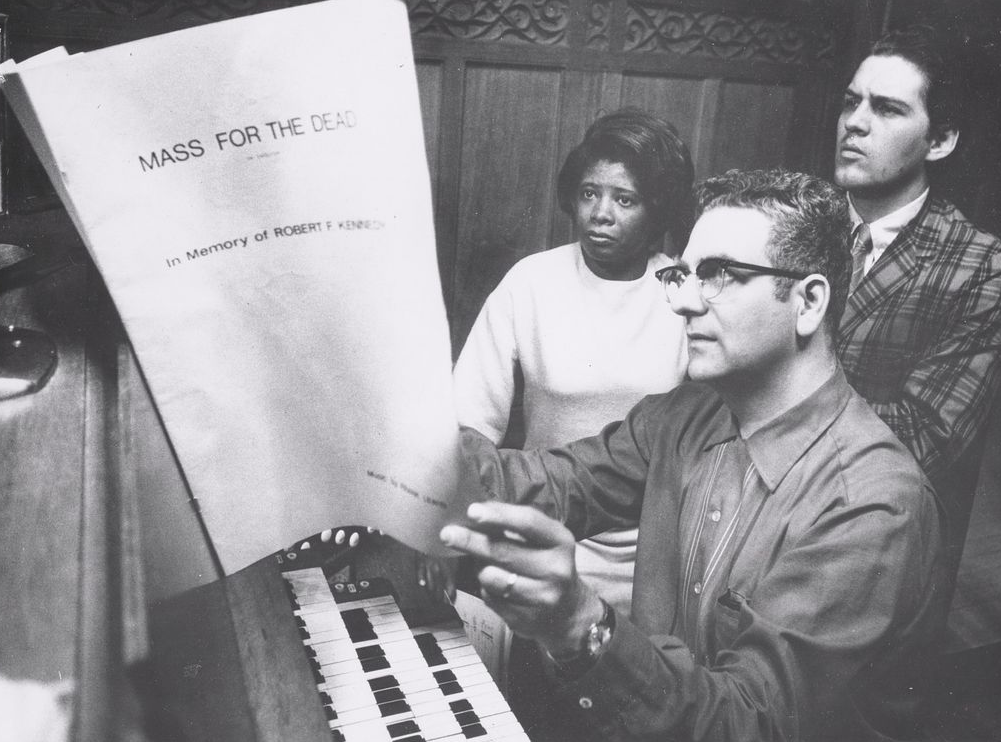
rank Lewin (seated) prepares his Kennedy Mass with soprano Sylvia Jones and tenor Leo Goeke. (Photo provided by Miriam Lewin.),

