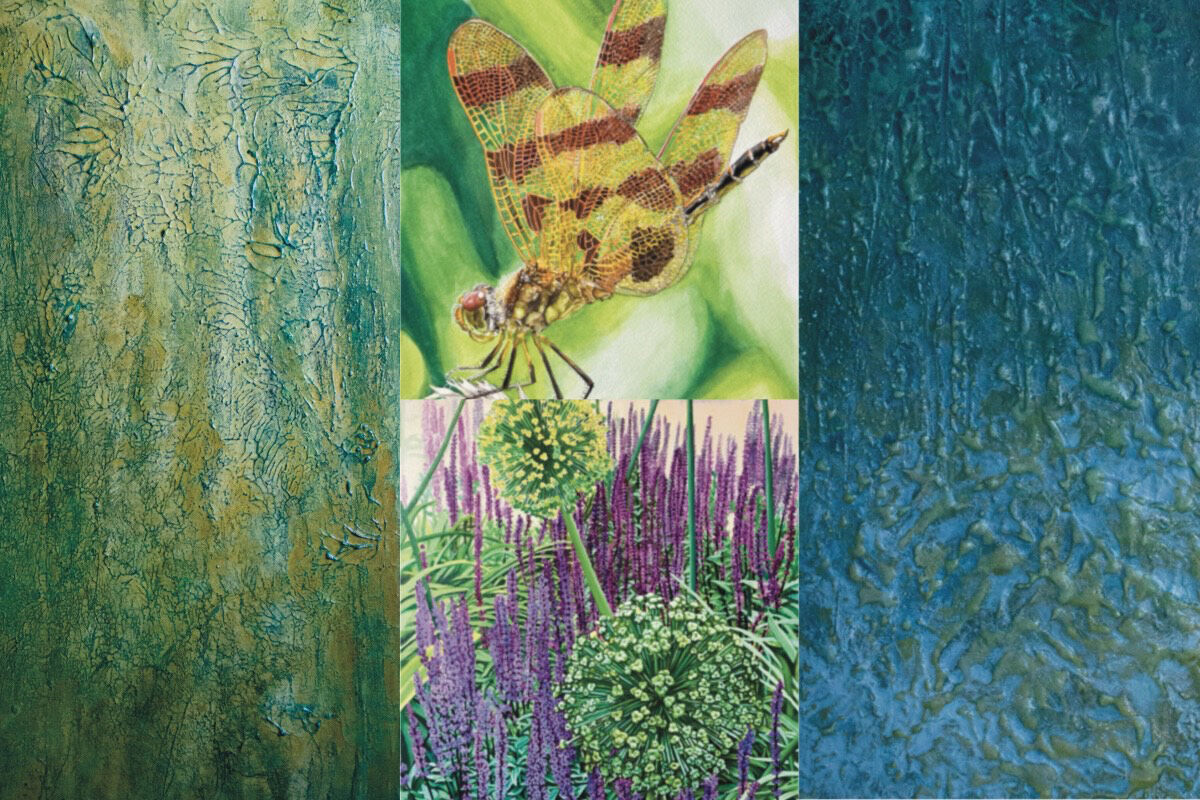
In the “Nature’s Duet — A Fine Art Exhibit” at Tulpehaking Nature Center in Hamilton, artists Laura Beard and Abigail Ella Johnson offer artwork that expresses their own deep connections to the natural world, from different but complementary vantage points. Both share a desire to draw viewers of their art into stronger connections with the natural world.
On her website, laurabeardart.com, Beard captures her connection to the natural world, in particular animals and their habitats: “There is nothing that inspires me more than the natural world and the rich complexities of the lives that inhabit it. I strive, with every piece, to convey the uniqueness of the subject and the unflinching beauty of our temporary existence.”
Johnson also describes her “profound appreciation for and interest in the natural world” on her website, artbyaella.com. “I’m driven by a deep desire to understand humanity’s ever-evolving place in nature, and how it shapes our experiences. As a result, I explore various contexts, investigating natural phenomena from personal, historical, scientific, social, and cultural perspectives.”
Beard and Johnson met for the first time at the Ellarslie Open 40 in summer 2023, where they both received awards: Johnson’s “Colony/Collapse” won the Digital Art Award, sponsored by Hunter Research, and Beard’s “Stick in the Mud” won the Watercolor Award in Memory of Robert Sakson. An artist friend of both, Margaret Simpson, invited them to be part of Nature’s Duet.
“It was quite a delightful surprise to see that her art and my art worked together so well,” Beard says. “Her abstracts are really amazing, the colors and textures, and in my opinion capture the essence of the natural world in a way that I have never felt comfortable being able to do.”
A free reception with the artists takes place Sunday, February 4, from 2 to 4 p.m. The show runs through February 28.
For Beard, attending a book talk on Tomie dePaola’s “The Art Lesson” at age six or seven cemented for her the idea of becoming an artist. “He told me that if I wanted to be an artist I needed to practice every day, and I have been sticking to that as faithfully as I can ever since,” she says.
In fact Beard has been drawing since childhood. “I was always one to have a pencil or crayon in my hand — I would doodle everywhere,” she recalls. “Anything that caught my attention, I would start drawing it.”
Home schooled with her five siblings, Beard often took educational nature walks, followed by private study of different habitats and the interaction of people, animals, and plants within varying ecosystems. As a child she remembers building “food huts” of twigs and leaves whose acorns she hoped would feed local animals.
As an adult artist, Beard conveys the beauty of animals with a goal of inspiring viewers to find out more about both them as well as the organizations that focus on “conserving what we have and increasing the population of endangered species.”
Quite concerned about the rising temperatures and other environmental perils that put these animals in danger, Beard donates some of the proceeds from her art to animal organizations, for example, the IUCN (International Union for Conservation of Nature) Red List of Threatened Species.
“We may not have all of those animals in the next 10 years,” she says. “I see my work as both an act of awareness and an act of remembrance for these animals.”
Beard’s realistic representations of nature begin with reference photographs—either single photos or photocollages she creates using Procreate software to splice together pieces from different photos. She then projects the image onto paper, stretched canvas, or canvas board and uses a pencil to create a map of her projected artwork.
“It would look very much like what you see in a topographical map; you have rings of different widths and distances establishing where color and shadows go,” she explains. Her choice of media is based on how much time she has to spend on a piece, how bold she wants the colors to be, and where she will be working.
As she works on a piece, Beard likes to think about what motivates the animal to be in a particular environment the moment it was captured on film. “I try to get an emotional bond with the subject I am working with and see how I can bring forth their individuality without dictating any sort of anthropomorphizes.”
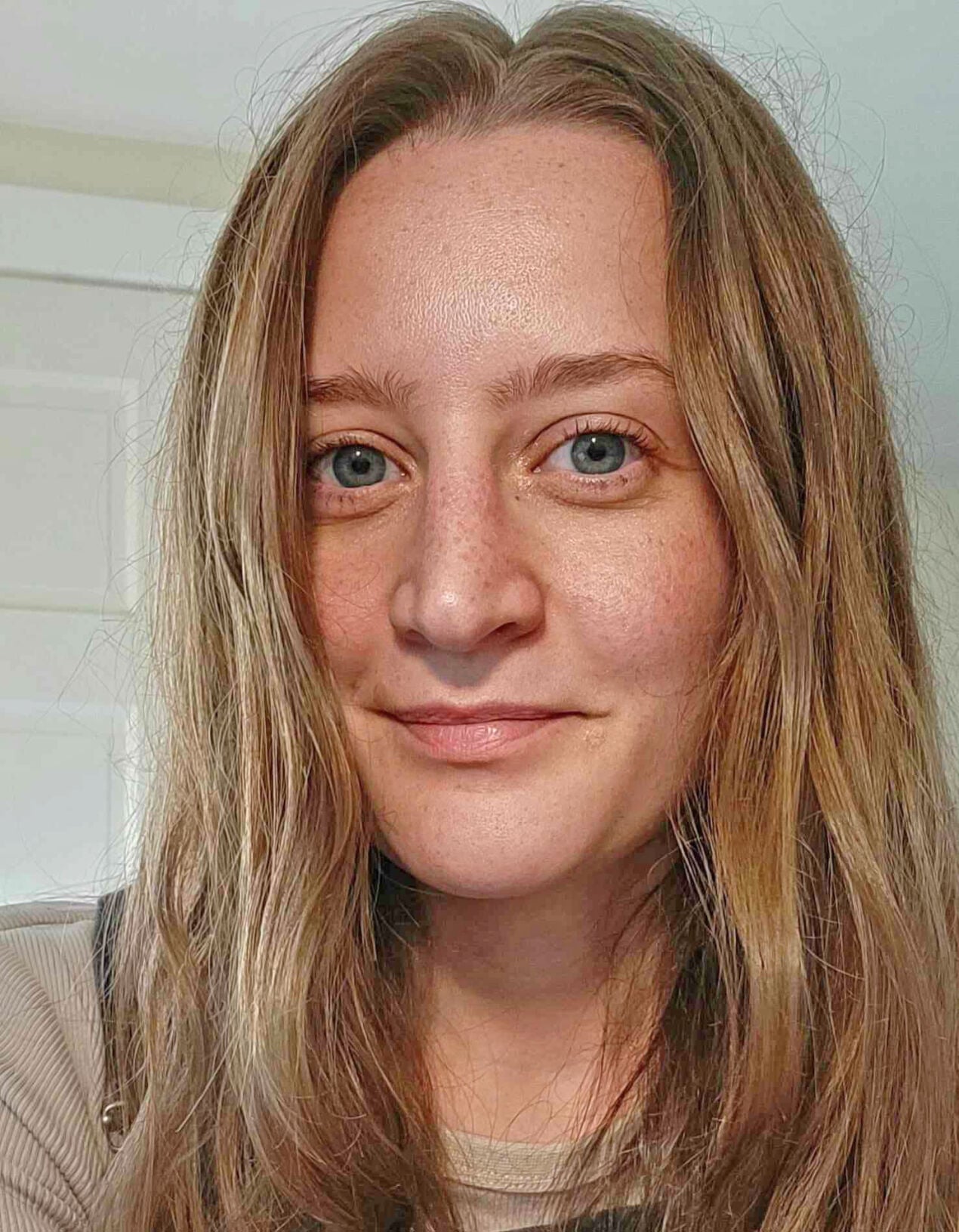
Beard, a Ewing resident, has spent most of her life in Kingston, with her mother, writer and wordsmith Janet Beard; her father, computer programmer Michael Beard; and her five siblings.
Beard’s early art education, largely in painting and drawing in different media, was through the Princeton Arts Council, and later she took art classes through different home schooling groups. By age 14, she entered her first juried show, D&R Greenway’s 2015 “Earth and Fire” exhibit, with a colored pencil drawing of a deer running away from a wildfire.
Beard decided at 18 to start her career as a freelance artist rather than pursue an arts degree in college, due to her concern about the likely debt that would ensue.
In the past Beard has taught art to elementary school children, for the Homeschool Support Network in Lawrenceville, That Pottery Place in West Windsor, and the Sprout U School of the Arts in Trenton. She wanted to give the children “a really firm grounding in art” without making it “so technically focused that it becomes intimidating.”
For this show, Beard mostly chose pieces representative of Central New Jersey animals and environments. “The Fisherman,” is a watercolor based on a photo her mom took near Rosedale Park. “Cool Dip” features a great blue heron standing in a reflective pool, also in Rosedale Park: “a big bird, a big reflection, lots of greens and browns, and some pink.” “Eenie, Meenie, Minie, Mo” is an oil of four squirrels on a fence, with her next-door neighbor’s yard in the background.
“I like to catch moments of playfulness and contemplation, basically trying to give a sense of human thought in the animal world,” Beard says.
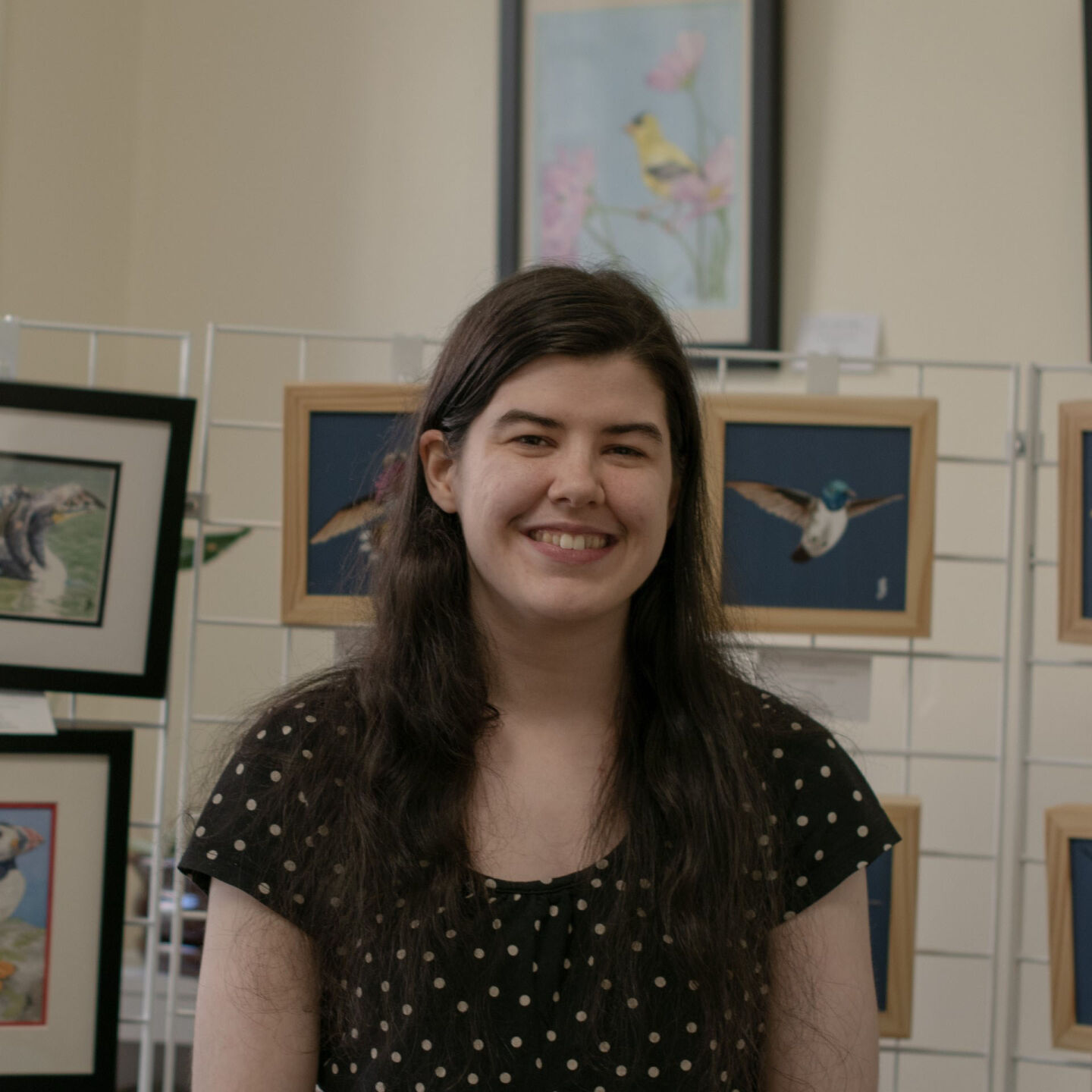
For Princeton artist Abigail Ella Johnson, a drive to seek multiple perspectives has nourished both her art and who she is as an inquiring human being.
In college, her interests varied widely over science and literature, and only toward the end of college did she realize that “completely by accident I had done the entire English major.” Her job as acquisitions editor in the physical sciences at Princeton University Press also draws on a breadth of interests. “Going into scholarly publishing felt like a way to stay engaged in science and the books that I love,” she says.
In her editorial work, Johnson speaks to authors and to scholars teaching interesting courses about books needed in their fields. The main contact for her authors, she also organizes peer reviews and does a bit of developmental editing, especially for the popular science books that in turn feed her art.
Her exposure to so many perspectives from the scientists she works with and the books and articles she reads has made her think a lot about how a person’s approach to a concept reflects the perspective and training they bring to it. In her art she tries to bring together this rainbow of viewpoints.
“If a physicist, botanist, and artist are looking at the same tree, they are going to interact with the tree in a different way,” Johnson says. “The physicist might see it and think about the physics of photosynthesis and light. A botanist might notice a certain type of lichen or moss growing on the tree. An artist might think about what colors of paint would I mix to match color of this leaf or bark.”
“The more ways you can look at something, the more you can understand it,” she says.
In this exhibit she is also using multimedia, by pairing one of her poems with each artwork. Through this double perspective, she explores “a natural phenomenon or a concept in nature [that] generally ties back to how we are connected with nature. I use art as a vehicle to explore different natural phenomena and to learn about them from all different angles.”
The works in this exhibit are all textured abstracts from Johnson’s Planetary series, which started while she was working on a couple of books on exoplanets, planets outside of our solar system. “In a period where astronomers realize there are so many different planets, with different ecosystems, I started thinking about our own planet: there are so many interesting phenomena that happen on the Planet Earth.”
One painting, titled “Forest,” is about the mycorrhizal networks that connect trees in a forest ecosystem via a symbiotic relationship between fungi and trees. Trees will emit warning signals to each other and will share nutrients. “All this is happening silently underfoot,” Johnson says.
The colors in this painting, yellow and green, are meant to evoke sunlight and foliage. The painting’s “spider webby-looking structures,” some prominent and some requiring a close-up view, she says, “are gesturing toward those structures that connect the trees.”
As with Beard, Johnson would like visitors to respond to the piece and possibly take action: “I hope that someone viewing the piece might go home and read an article about the networks.”
The painting titled “When Spring Comes” is a little less scientific. Johnson explains, “It is about that turn-of-the-seasons feeling, when the woods start to wake up and you see buds of green.” The poem that is paired with the painting ruminates on how people become frail as they age, whereas “the opposite thing happens with the forest.” An area without any unnatural disturbance, she says, moves from meadow to young forest to old growth forest. “Each year there is renewal, new growth.”
Johnson grew up in Virginia. Her dad, Phil Johnson, a mechanical engineer, “is a scientist at heart,” with a particular interest in physics. Her mom, Sarabeth Johnson, stayed at home with the kids and also taught yoga. Abigail graduated from the University of Virginia in 2019.
Her interest in science and nature reaches back to her childhood, both via hikes with her father and a summer camp in the middle of the George Washington National Forest that offered science courses in areas like botany and dendrology (the study of trees). “I fell in love with the natural world and all the different ways of engaging with it, one of which was scientific,” she recalls.
As a very young child Johnson remembers mashing up berries to dye fabrics and making pots out of clay she dug from her backyard. But she did not start painting until the pandemic. “Then it spiraled out of control,” she says. “It has become a huge part of my life. Anytime I’m not working or walking my dog, I’m thinking about or actually doing art.”
Although Johnson has had no formal art training, she takes advantage of one of the great perks to her day job — “really great access to a lot of art books.” She reads about great artists and color theory, but adds that “scientific reading also informs my art practice.”
“I feel very lucky to have a career that feeds into my practice; it feels very synergistic.”
Nature’s Duet, Tulpehaking Nature Center, 157 Westcott Avenue, Hamilton. On view through February 28, Wednesdays through Saturdays, 10 a.m. to 4 p.m. Reception with the artists Sunday, February 4, 2 to 4 p.m. Free. For information, email info@abbottmarshlands.org.