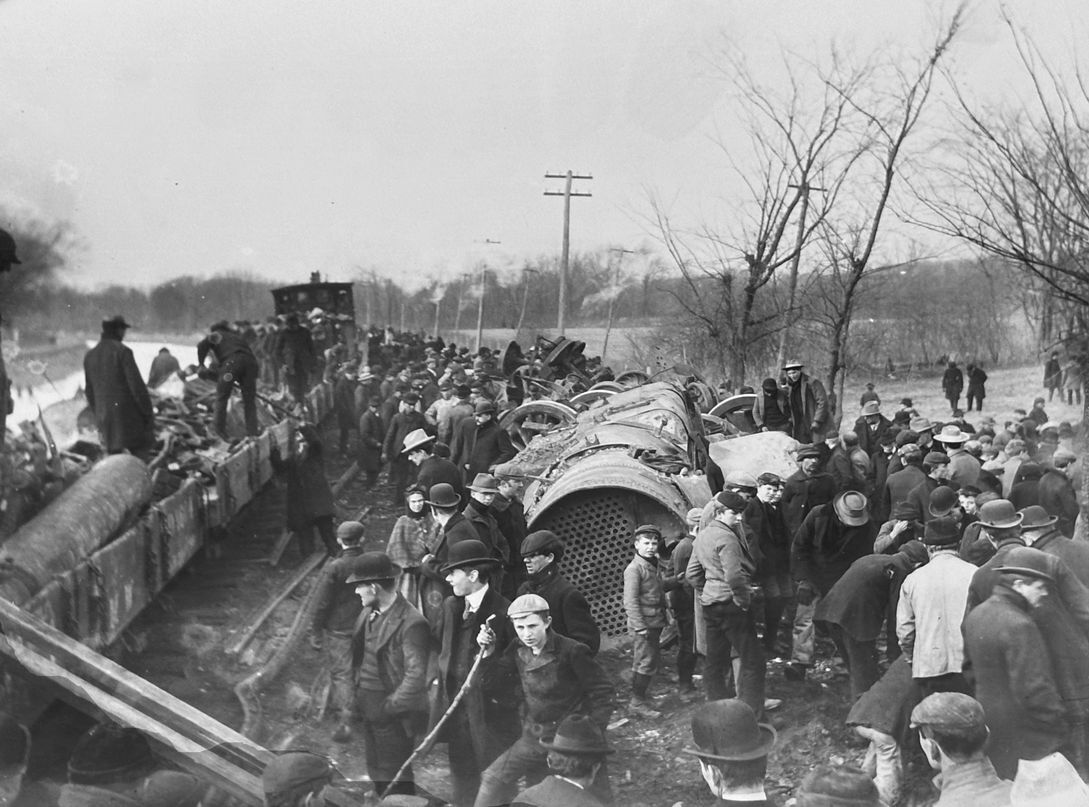
The tale of one New Jersey’s most legendary train accidents makes two stops at Bordentown’s Old City Hall in the form of a new theatrical storytelling presentation developed through the Bordentown Historical Society.
The third installment of the “Harrowing History” series, the presentation led by BHS member Kristi Kantorski arrives 123 years after the train known as the Nellie Bly collided with another train as it passed Bordentown on its way to New York City.
That February 21, 1901, calamity resulted in the deaths of 17 passengers. Others were mangled when cars slipped from the tracks and fire ripped through wooden cars.
It also resulted in a nationally watched investigation that brought changes to the railroad industry.
The Nellie Bly was a Pennsylvania Railroad express connecting New York and Atlantic City.
Traveling at the then-record breaking speed of 60 miles per hour, the express train was named after a newspaper reporter who came to fame for her own record-breaking story — testing the time calculations of French writer Jules Verne’s popular and seemingly fantastic 1872 novel, “Around the World in 80 Days.”
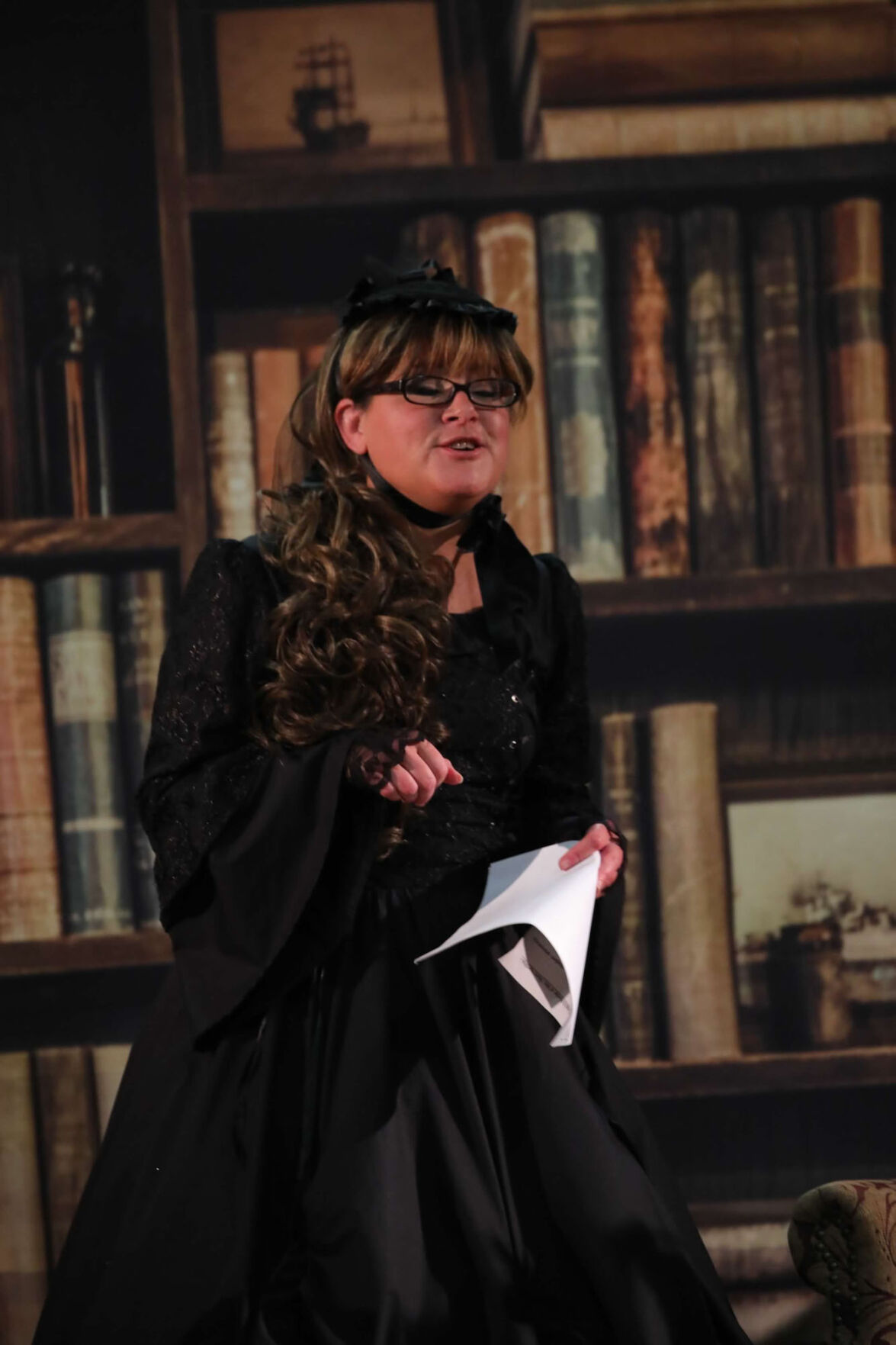
Sharing insights about the creation of the production in which costumed storytellers recreate those who lived and witnessed the accident, Kantorski connects “The Wreck” to her work on the first presentation of “Harrowing History.”
That 2020 event recounting six actual tales of murder, madness, and mystery in Bordentown received a History Recognition Program award from the Burlington County Division of Parks.
“I spent nearly a year spending every weekend in libraries compiling information and building the stories that would be revealed,” Kantorski says. “The result was fascinating stories of betrayal, greed, turn-of-the-century crime and punishment, and even a ghost story or two that had never seen the light of day in many cases.”
She says that it was while looking through files that she discovered the mention of a “horrific train accident” that led to the creation of the current production.
“Around the late 1800s and turn of the century, train accidents were sadly as common as car accidents today. It took more than a ‘fender bender’ to make headlines,” she notes. “So, when I pulled old newspaper records and came across over 100 articles alone, I knew this was more than a simple story and deserved its own spotlight.”
Referring to the other train as a Bordentown local, similar to today’s Riverline, running along the sections of the Delaware and Raritan Canal, she says it and the Nellie Bly “ran head-first into each other, telescoping, causing a chain reaction where both tinders crashed into the passenger cars behind them, and were tossed into the canal some 15 feet below the tracks.”
She then shares some of the details that made the event horrific. “The flames from the engines sparked the coal to ignite, setting the wooden passenger cars aflame. Only the rear cars survived without damage. The suddenness of the crash caused people to be tossed, some through windows, others between the cars, and some were pinned in the burning wreckage. Due to the remoteness of where it occurred, aid was far from instantaneous. Passengers struggled to save one another in the dark, with only the burning cars as light. Burnt and mangled bodies that could be pulled from the wreckage were laid out along the embankment. Seventeen were reported killed with more than 50 injured. There were likely many more.”
Kantorski says the accident made national headlines for months and “initial reporting of survivors and witnesses transformed into accounts of who was to blame. While we no longer have a coroner’s inquest to decide the cause of death in New Jersey, opting for a medical examiner, back then the coroner along with a jury decided where the fault lay.”
And while the coroner’s inquest proceedings were reported in the newspapers, Kantorski notes, “The proceedings revealed that more than a few blunders were made, and poor judgment resulted in loss of life that could have been easily prevented.”
She says those wanting to know where the fault lies will “have to wait for the show to find out all those juicy details.”
While Kantorski demonstrates an expertise in Bordentown history and lives in Bordentown Township, she is originally from Raritan, New Jersey, the daughter of a pharmaceutical quality analyst mother and land surveyor father. She graduated from Stockton University with a degree in graphic design in 2000 and has worked in publishing and as a legal assistant.
She and her husband, fellow BHS member and past president Tim Rollender, moved to Bordentown for work-related reasons in 2015.
Calling her interest in creating theatrical story-telling events an “odd story,” she says, “I have absolutely no experience in any form of theater, be it stage design or anything else. For me, I think it all started with a love of history and reading. I’ve always had a knack for history. Growing up, I was a sponge, soaking up all the information I could. I remember reading a 1000+ page book on the Civil War at the age of 12. Not exactly a fun activity for most 12-year-olds. Not surprising that I would join a historical society as an adult. To say I read a lot, according to my husband, is an understatement.”
As Kantorski says in another CNS interview, her interest in telling harrowing history tales “is a way to broaden people’s understanding of their local history and to reach out to those who might otherwise overlook a historical event offering, seeing it as ‘boring’ or ‘stuffy.’
“We wanted to not only give all the elements of a gripping story, but also tie it to a larger historical picture of the time period. When all these different elements come together, only then do we have a comprehensive historical view, and a really juicy narrative. By presenting the research via a theatrical storyteller performance, we aim to educate the audience in a creative and entertaining way.”
To do so here Kantorski has enlisted the help of four theatrical story tellers who tell the story from four different perspectives: Patricia Kelly, a regional historian and past interpreter at Pennsbury Manor; James Parker, president and CEO of Riverview Studios in Bordentown; Leann Testerman, a medical education coordinator at the Deborah Heart and Lung Center; and Bordentown attorney Chris Campbell.
“As I had four different narratives, I knew I needed four different tellers,” Kantorski says. “This is a dedicated group that has been with us from prior seasons. They’re all volunteers, and they are talented, dedicated, creative, and wonderful people to work with. They’ve inspired me and continue to do so.”
Kantorski and others participating in the project are also volunteers and are operating without a budget. “Most of the set pieces, props, and decor used to create the space for the audience are either owned or created by myself and my husband. What I do not own, I track down through antique stores, flea markets, or various craftsmen.
“The performances’ ticket sales will be split 50/50 between the Old City Hall Cultural Vision Committee and the Bordentown Historical Society. As my husband and I are both directors of the Bordentown Historical Society and volunteers for the OCH Cultural Vision Committee, we are not seeking reimbursement and see this as giving back to the community that supports efforts like these,” she notes.
And while Kantorski acknowledges the attraction of telling “harrowing” tales is in the macabre and scintillating details of such events, she also wants attendees to understand that each tale is an actual story that is “your story” and has a human connection.
“The Wreck,” Old City Hall, 13 Crosswicks Street, Bordentown, Saturdays, February 17 and February 24, at 5 and 8 p.m., tickets are $20 and must be purchased online, no tickets will be sold at the door. For more information, visit thenellieblywreck.com.