Not until the 10 minutes before the end of “Empire Records,” the world premiere musical at Princeton’s McCarter Theatre, does the peace coalesce in any significant way.
Once it does, you wonder where the heart and depth of a sequence that features a mock funeral and personal revelations from core characters was for the rest of the show.
“Empire Records” has a lot of capital to trade on. Though the 1995 film on which it was based was not popular upon its release, it later developed a following that reached cult status. It is the rare child of the ’80s, ’90s, and naughts who does not have affection for the movie, its story, and most importantly, its characters, a motley crew of teens that works behind the counters and cash register of a major record store. (Think Tower Records, but as a one-of-a-kind, stand-alone oasis on a small city’s cultural landscape.)
Those beloved characters come into their individual and collective own in the late passage I cite, but before then, they don’t register as strongly or as compellingly as they do in the movie. It is almost as if book writer Carol Heikkenen, also the scenarist of the 1995 film, and composer Zoe Sarnak, took understanding of the Empire personnel too much for granted. As someone who is familiar with the film, I watched the musical wondering if I would be aware of some character nuances if I wasn’t.
There are scenes that have impact, and a cliched yet entertainingly effective spoof of a has-been rock-and-roll idol, but Heikkenen tells her story too patly for it to be more than a decent tale that passes the time. Broad brush strokes are used to reveal the mise en scene of a record shop while letting the character details that earned the movie its second chance get lost in the size and commotion of it all. The result is being told things you need to be shown.
For instance, one of the record store employees, A.J. (Liam Pearce), an artist who famously tells another juvenile wag he is not going to explain his art, is in love with one of this colleagues, Corey (Lorna Courtney), the studious, college-bound, reasonable one, but is afraid to tell her. To get over his apprehension, he sets a deadline, 1:37 on the clock, to declare his ardor with the magic words, “I love you.”
The trouble is we hear about the dilemma and see A.J.’s angst. He asks advice from everyone, practices saying “I love you” to all and sundry, even customers, and sings an engaging song about his distress and how he figures out the critical time, 1:37, but we never see A.J. look longingly at Corey or even make an awkward attempt to be friendly.
I don’t think Pearce or Courtney is to blame for the disconnect. Director Trip Cullman has to see that it happens, that we see A.J.’s longing in addition to hearing about it. That would enhance Corey’s diffidence and make A.J. more sympathetic rather than a plain unlucky guy.
It’s becoming typical in 21st century movies and plays for characters just to declare something rather than acting it out.
The same shorthand occurs in an important complication to A.J.’s romance with Corey. She is unaware she is the subject of someone’s serious affection. She has a school girl crush on a rock star, Rex Manning (Damon Daunno), on tour at Empire to promote a comeback album, and is bent on acting on it. While A.J. is fawning in private over her, she is figuring out ways to get Manning’s attention.
And she does, but via scenes that work by the numbers and don’t convey the thrill of the hunt or the luster of success. Lorna Courtney makes you aware of the book-smart Corey’s social naïveté, but “Empire Records” doesn’t quite make it believable she would make one move she does, even when taking into account her goo-goo eyed passion for Manning.
Which brings up another complication that is realized, but in a tawdry fashion that was handled so much better in the movie.
The complication is betrayal. Corey has a best friend, Gina (Samantha Williams), who knows about Corey’s lust for the visiting celebrity. Using wiles and more knowhow with men, she achieves what Corey fantasizes might happen to her.
One major difference between Heikkenen’s movie and this musical is how the character of Gina is conceived. In the movie, she is the fast girl in town, known for sleeping around indiscriminately for the fun and recreation of it. In the musical, we see none of that. Gina’s primary complication is her mother pilfering disastrously from a college fund her father, divorced and living with his second family, established for her.
If anything, in the musical, Gina is the raissoneuse, the sensible employee at the store who registers as being as smart as Corey, but without the academic success or credentials.
Her seduction of Manning therefore comes as a surprise. Granted, it is dramatic, but it also comes from nowhere and smacks of spite and betrayal more than just being freer.
I am one who says no movie or show has to be true to its source. Heikkenen is totally entitled to change Gina to a different kind of character, and frankly, Williams is among the stronger performers in Cullman’s cast, but if she’s going to succumb so nonchalantly to Manning, some sense of looseness, advanced maturity, confidence, or lack of self-respect — pick one, add another — must be established. Otherwise, the episode becomes a red herring, something remarkable that comes from the blue and has comic or garish overtone rather than being a poignant comment on who gets what and how she gets it.
“Empire Records” is filled with material. It goes in many directions, and most are interesting, such as why Lucas (Tyler McCall), the hippest of the bunch, absconds with a day’s earnings from Empire instead of getting them to the back or delving more deeply into why Deb (Analise Scarpaci), the likeable rebel of the group, has a conspicuous bandage around her left wrist.
Heikkenen scratches the surface. Until, that is, the quiet but moving intensity of the scene right before the end of the show takes over.
Sarnak’s music is bright and derivative of the period. The sound design at McCarter obliterated any chance to decipher the lyrics of the first songs sung by Courtney and Williams, but someone in charge must have realized that because the sound became less hot for the rest of the show. The numbers are good and give choreographer Ellenore Scott the chance to enliven the production, especially when a truly exciting dancer, Hoke Faser, who quadrupled in bit parts, came into focus.
Trip Cullman was efficient in his direction. He was especially deft in smaller moments when the character did have a chance to reveal themselves. Big ensemble sequences were also competent, but they dwarfed the production, putting flash ahead of story. The flash was fun, but Heikkenen’s story is “Empire Records’” meat, and if the show is to advance towards Broadway, paying more pointed attention to that story will be necessary — even if it means lengthening the show to provide more texture between musical numbers and ensemble scenes.
The cast of “Empire Records” is among its virtues. Samantha Williams made you care about Gina’s plight, the missing funds she was counting on to leave her hometown and pursue an ambitious future, even though that plight seems common in shows depicting teens.
Analise Scarpaci is the galvanizer whose character, Deb, begins to take precedence because she is the most interesting. Scarpaci finds the intelligence and cynical rebel in Deb, who is ahead of her peers in many ways yet needs them to ground her in good old reality.
Tyler McCall has his deadpan down solidly as the arch and mysterious Lucas, a master of arcane but cunning responses. Liam Pearce gives A.J. a sweetness that makes you hope he will have a chance with Corey even if he sabotages that effort with clumsy regularity, The role of Corey, in ways the main character, needs to be built more in the musical, but Lorna Courtney brings attention to that role. She is especially adept at noticing small things but being oblivious to what should affect her most.
Damon Daunno does a fine parody of a proud, egotistical rock star realizing that even if he is clawing his way back to the top, Empire Records is not going to help much. Daunno never complicates Manning’s celebrity with doubt. That’s a good thing. The simplicity works in his and the show’s favor.
Michael Luwoye gives the musical some backbone as Joe, the owner of Empire threatened with takeover by a soulless corporation. He creates variation for Joe, adding to what Heikkenen gives him. Taylor Iman Jones also gives polish and some philosophy to the piece as Max, a former Empire employee now flying high working for a record label. The sophistication and achievement Jones conveys as Max is an eye-opener to the Empire kids.
Eric Wiegand is winning as the rocker wannabe, Mark, always on the brink of starting a band. Sam Poon makes delinquent Warren more palatable than the character from the movie.
David Rockwell’s set recalls the variety and anticipation of going to big record store in days when records were the only way to bring music home. The set proves as flexible as it is nostalgic. Paloma Young, for the most part, nails the kicky fashions of the ’90s, but her dowdy choice for Gina is a curious one. Adam Honore’s lighting at time defines scenes better than Heikkenen’s book does. John Shivers’ sound design worked well once its volume was relaxed.
Empire Records, Berlind Theatre at McCarter Theatre, 91 University Place, Princeton. Through Sunday, October 6 . Showtimes are Wednesday through Saturday, 7:30 p.m., and Thursday, Saturday, and Sunday, 2 p.m. Tickets range from $35 to $98. www.mccarter.org or 609-258-2787.
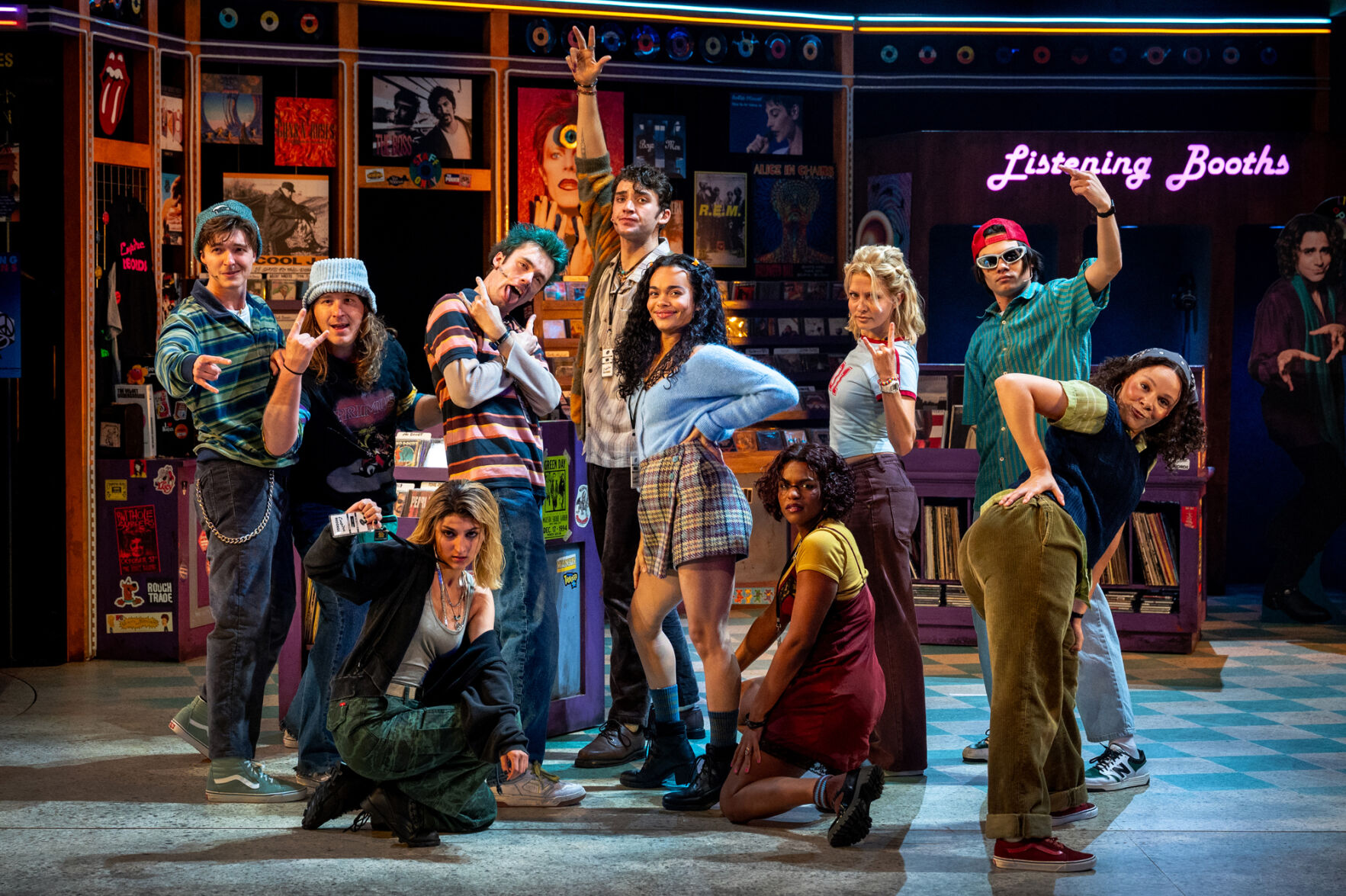
The company of ‘Empire Records the Musical,’ which is on stage at McCarter’s Berlind Theater through Sunday, October 6. Photo by Daniel Rader.,

