Keyboardist, composer and bandleader Larry Fuller is only 59 — not an elder statesman by any means in the world of traditional jazz — but he is one of a very few of at his age who did not “study” jazz in college.
He got a big break, a chance to go on the road with veteran jazz vocalist Ernestine Anderson, when he was in his early 20s. Given he had full-time employment with a friendly bandleader and the chance to travel around the U.S., Canada, and Europe, there was no need for college. Some would say he got his undergraduate and graduate degrees on the road, with prominent people like Anderson, bassist Ray Brown and later on, prominent New Jersey jazz guitarists John Pizzarelli and often his dad, John “Bucky” Pizzarelli. Fuller’s piano playing is steeped in grooves, blues, and even some gospel roots, so in his own way, he is broadening the audience for jazz by playing the kind of music he does, which includes Stevie Wonder, Joni Mitchell and others from the world of pop music, as well as his own originals.
Fuller was raised in Toledo, Ohio, which was close enough to Detroit and Ann Arbor that people enjoyed a lively club and festival scene in the 1970s and ’80s. He has been a resident of Princeton since 2019. His wife, marketing expert Jane Manganaro, is a native who graduated from Princeton High School in 1993.
He performs for his hometown audience in Westminster Choir College’s Hillman Performance Hall in Princeton on Sunday, October 27.
Fuller’s father, Richard, worked for the Libbey Glassworks in Toledo and his mother, Alice, was a housewife.
“My parents were always very supportive of my interest in music,” he said, and he was given nothing but encouragement through his teenage years.
Asked about his upbringing and earliest awareness of jazz and blues, Fuller, raised in the rock ‘n’ roll era, recalled one day, an older brother brought home a slightly used upright piano. Fuller began playing around with it as a 10-year-old. His parents saw his passion and got him lessons. He was off and running with sight reading and boogie-woogie playing.
“When I was in middle school, I had a life-changing experience, a revelation of sorts. I found this mentor, his real name was Floyd Johnson, but they called him Candy, a saxophone player who had worked with a lot of famous groups, Bill Doggett and Clark Terry and the Basie Band. He ended up starting this program in Toledo, the Toledo All City Jazz Ensemble, and he took kids from different public schools and brought them into the group,” Fuller recalled. Throughout his long career, Candy drank no alcohol and preferred peppermint sticks and other candy, thus his nickname.
“Candy started taking me out on some of his local gigs when I was 14 and 15, playing in clubs, country clubs, and restaurants, all these local gigs,” he recalled. His mentor Johnson, who did go to college, had been living in Kansas City, where the Basie band was based for some time, but then began teaching at nearby Oberlin College, home of a prestigious music school.
Of his first big break with Ernestine Anderson, a brilliant blues singer, Fuller said he is pretty sure both Anderson and Jimmy Scott were part of Lionel Hampton’s big band for a number of years together. Scott eventually settled in Newark and East Orange before purchasing a house of his own at 74, back home in Cleveland, while Anderson settled back home near her parents in Seattle.
“I think both Ernestine and Jimmy Scott were with Lionel Hampton’s band as featured vocalists,” he said, “because he featured both a male and female vocalist. Ernestine was living in Seattle, so I moved out to Seattle and I lived there for a long time, as I was accompanying her on piano for many years.”
“I remember we came back for a series of benefit concerts for WBGO-FM [the listener supported jazz station in Newark, then in its infancy], to do shows in New York City. There were concerts on the pier, and we also went to this little club in Montclair, I think it was Trumpets, and I remember Jimmy was so surprised to see Ernestine, he gave her a big, big hug, and kind of lifted her up off the floor a little bit,” Fuller recalled. Later, Ernestine complained that Scott — who was part Native American and used to describe himself as “Heinz 57,” had hurt her ribs a little bit in his excitement at seeing her.
Both singers have since passed on, but their bluesy vocals are in rotation at WBGO-FM, as both were important in developing an audience for the station, in both urban and suburban parts of New Jersey and New York.
“One of Ernestine’s very dear friends was Dorthaan Kirk, and she would bring Ernestine back for these WBGO benefits,” Fuller explained. Thankfully, “Ms. Kirk,” as most called her at WBGO, the widow of hugely influential multi-instrumentalist Rahsaan Roland Kirk, is still among us. She continues to support blues-based traditional jazz, and her [ate cousin from Houston, Albert Collins, was an influence on a young Jimi Hendrix. [This writer worked at WBGO in Newark for a decade during its formative years, until 1995, and helped Collins out when his 200-foot-long guitar cable needed repairing. Collins, a peaceful soul, was famous for getting off the stage and walking around clubs and concert halls.]
After one weekend of working with Anderson at the Bird of Paradise in Ann Arbor, at 23, he joined her on the road full-time and served as her main accompanist for many years. When the economics of the jazz club business didn’t change and it became too expensive to stay on the road as a quartet, the pair would often travel together and use top-shelf drummers and bassists in the respective cities they were visiting, people like Jeff Hamilton and Louis Hayes.
Out in Los Angeles, Fuller worked with Hamilton and Ray Brown for many months.
“When Ray Brown eventually needed a piano player because Geoff Keezer was leaving the group at the end of 1999, I joined Ray in the early part of 2000, and I played with him for another two-and-a-half years until he passed away in July of 2002.”
Brown was an avid golfer, had a house in Hawaii when not on the road, and was married to Ella Fitzgerald for a half dozen years until career pressures on Ella — “The First Lady of Song” — became too much for both of them. One of Brown’s many originals was an instrumental, “Sittin’ in the Sand Trap.”
In 2005, he began a long collaboration with iconic New Jersey jazz guitarist and singer John Pizzarelli, raised in Upper Saddle River and one of two musical sons of the legendary John “Bucky” Pizzarelli. Pizzarelli was raised in Paterson and attended high school with late poet-activist-singer-blues fan Allen Ginsberg. Bucky would often sit in on his son John’s gigs.
“Bucky would often be there to sit in on John’s gigs,” Fuller recalled, “he used to joke with me all the time: ‘I don’t know what John is paying you, but I’ll pay you 20 bucks more each week to come on the road with me!’ Sometimes he’d say that right in front of John!” The elder Pizzarelli was a favorite of the Jersey Jazz Society and a regular at the annual Princeton JazzFeast. He died in April, 2020 at 94.
Fuller has three albums under his own name, and he has accompanied a small who’s-who in traditional jazz over the last three decades. “Easy Walker” with Jeff Hamilton and Ray Brown; a self-titled release, “Larry Fuller,” and his most recent release, 2016’s “Overjoyed,” which includes his take on Stevie Wonder’s hit as well as his original tunes.
At his upcoming Princeton performance, Fuller will be accompanied by bassist Hassan “J.J.” Shakur and drummer George Fludas. Fludas is an alumnus of Diana Krall and Ray Brown Trio, while Shakur has worked with the Duke Ellington Orchestra and the Monty Alexander Trio.
Fuller said an audience unfamiliar with his music, or who think they don’t like traditional jazz, can expect an afternoon of jazz and swing, much of it blues and groove-based music, some pop tunes, and of course, his original compositions.
“I like to think that I play jazz that is accessible to the audiences. I try to play great music but not have it be over the head of the audience. I think a lot of jazz can be that way,” he argued. “I always just try to swing and I know as cliche as it sounds, hopefully people will leave in a better mood than when they came in. There’ll be some blues, some groove music, Great American Songbook standards, some Stevie Wonder tunes, and I do my own [jazzed-up version] of Joni Mitchell’s ‘Both Sides Now.’ It’s all part of my attempts to make this music more accessible to people.”
Now, at nearly 60, does he rue the day he decided, in high school, not to further his musical education at a major university like Oberlin College or Berklee College of Music in Boston or the Manhattan School of Music?
Not at all, he said.
“Back then, around Toledo and Detroit, there were so many gigs to pursue and so much to learn, so many people to learn from, so many older musicians around that had traveling bands, you could learn on the road with all of these people, Betty Carter, Lionel Hampton, Count Basie, Art Blakey and Illinois Jacquet, bands that would travel. You could learn so much on the road with these bands.”
Larry Fuller Trio, Hillman Performance Hall, Westminster Choir College, Walnut Lane, Princeton. Sunday, October 27, 4 p.m. $30. www.larryfuller.com.
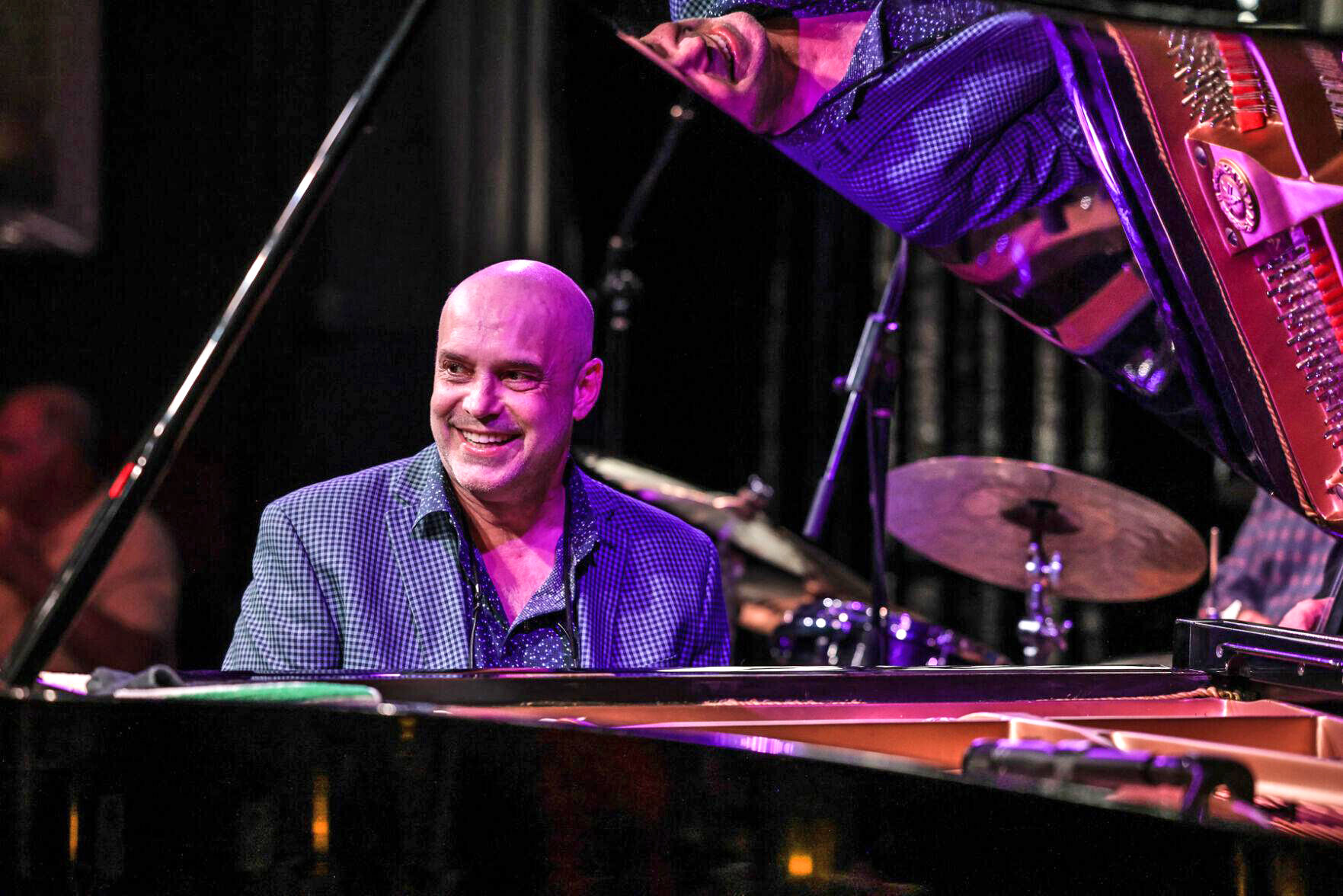
Princeton-based jazz pianist Larry Fuller performs with his trio at Hillman Performance Hall on the Westminster Choir College campus on Sunday, October 27. Photo by Mark Sheldon.,

