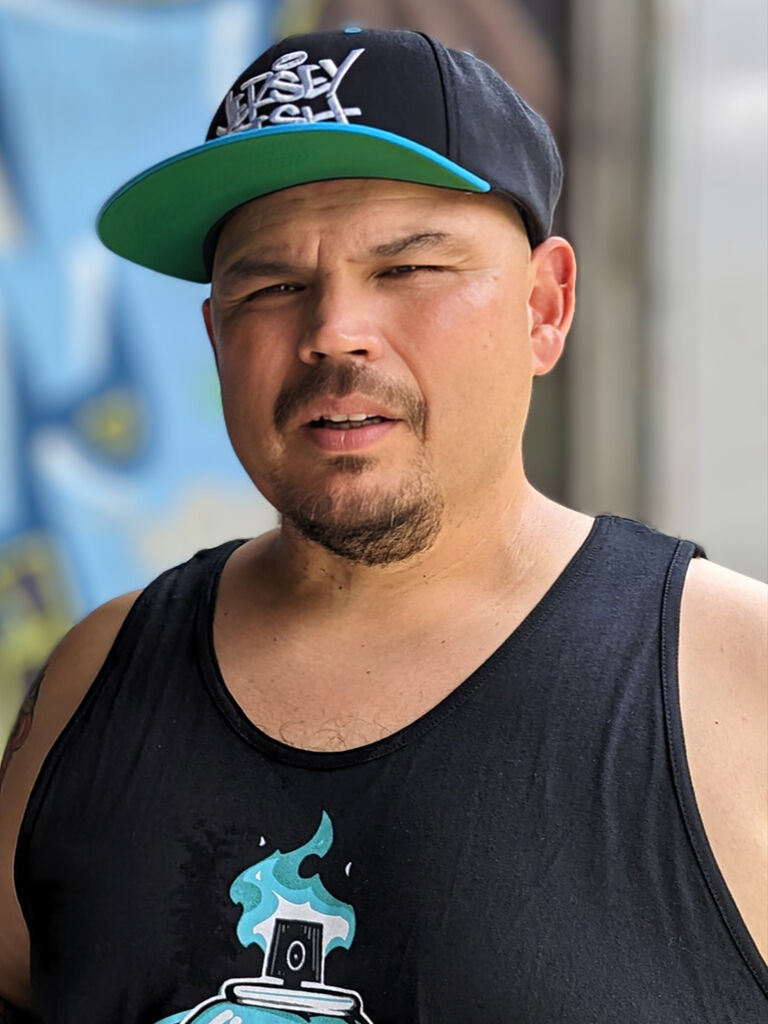
It is a hot day and Trenton-based artist Leon Rainbow is feeling the heat — especially the internal heat connected to preparing for the upcoming August 19 Jersey Fresh Jam.
That’s the annual urban celebration of art, music, and dance he and members of the Vicious Crew art group first put together 18 years ago.
Traditionally held in August, the event hosted by the Trenton-based TerraCycle is touted as New Jersey’s premier hip hop event.
It is also the freshest and hippest art event in the region.
And while not for everyone, it offers a big welcome for the community to connect with street “writers” — aka graffiti artists — and see them in action.
It also offers Rainbow a big task, especially on this hot day at the Terracycle headquarters on New York Avenue where the pressure is on.
“There’s construction,” says the 40-something artist of Native American ancestry standing in one of the several shipping areas of what was once a newspaper distribution site.
He says the temporarily removed doors served as “canvases” for the scores of artists who show up for the one-day of nonstop painting.
“We’re hoping in the first week of August to prime the walls and straighten up the yard,” he says.
He then adds that if that doesn’t happen, they’ll just figure something out.
Rainbow’s “we” translates into the volunteers and regular supporters from the arts community and TerraCycle, the internationally known company the creates commercial products through recycling trash and waste materials.
“DJ Just Ahmad and MC Alberto Rodriquez curate the music and make sure equipment is set up,” says Rainbow about the two known Trenton music masters. “We have Ricky Camilo Ricardo. He takes care of the break dancing aspect.”
“Me and MEK (Dave MEK Klama) curate the walls. Other stuff I work on is getting permits, sponsors, and vendors. (TerraCycle’s) Riley Smith is helping to organize. We all work together and have different artists coming in — from California, D.C., New Jersey, New York, Philadelphia.”
Rainbow says the $5,000 budget comes from a variety of supporters. In addition to the annual commitment from TerraCycle, funds come from I Am Trenton, Capital Health, Princeton Hydro, Adobe Express, and Content Trenton.
“Couldn’t do it without the local support,” says Rainbow, who says the most stressful part of the operations is getting the permits and sponsorship.
“The easiest part is finding artists who want to paint. But that is difficult because we only have so much space — so we have to say no, even though they’re good. We can only have so many people paint.”
Regarding the artist recruiting process, Rainbow says he and MEK keep an eye out while they’re active in their network.
“I like to have people who are active. There are a lot of people who are painting on a regular basis and are pushing the boundaries of what the art is.”
He also likes a sense of new traditions, especially since “graffiti” as it is known today was cultivated in Philadelphia, New York, and the places between.
“We have a few artists who are somewhat historic, and we like to have some of those original artists,” he says, adding another historic reference. “It’s the 50th anniversary of hip hop this year. We always had all the elements the hip hop.”
Taking stock of the current crop of art appearing on streets and walls, Rainbow says, “People are getting better and better. A lot more than a name (the writing of letters), it is a mural. More fine art elements are being added into the mix. Not that it is new, but people are pushing that more.”
However, he adds, “It is like Instagram, the best and worst kind of thing. You have a lot of people doing it, but you have lost some of the regionality of graffiti.
“When I was starting up, you had to seek it out. You had to go down alleys and railways tracks. But now you can see it online in Japan and France. That’s inspiring, but there were a lot of regional styles that were unique to different cities — Philadelphia and Los Angeles. A lot of the styles unique to certain regions have spread out around the world.
“A lot of people don’t know the history of the style. Certain people did things for certain reasons, but now that is lost — lost in translation.”
About the Trenton style, he says, “We have gotten some styles that have come from New York and some from Philadelphia, and we have generated our own style — a hybrid. We have done a lot in our own right.”
Moving to the dollars and cents of the project, Rainbow says, “Since it is a free event, no one gets paid. In the past we had a few headliners, but were able to raise enough money to do that. We have a break dancing competition, but we have to raise funds.”
“In the past years we were able to raise money for paint and stuff like that, but it hasn’t worked out. A lot of funding has been cut recently.”
He says one big difference between producing in Trenton and other cities is that “we are not in a major market. It isn’t like Philadelphia or New York City where national brands — Adidas or Pepsi — are willing to jump on it and possibly sponsor.”
He shrugs off the difficulties and in a year that has seen several regular city events cancelled — including Art All Night and the First Friday Events — he’s moving ahead, but not without some reflection.
“There are times every year, I question (coordinating the festival), but I feel it is important to the arts and culture and the city. There isn’t a lot of hip hop stuff. And a lot people look for it.
Putting the Jam’s effort in context, Rainbow says, “A lot of (Trenton events) may have come off from starting this event. Not that we had anything to do with it, but people saw this type of event and saw that we could do it and others said we could try that. In some ways we laid the groundwork for some of the events.”
And, he adds, it has helped the city become known for quality art and attracts strong artists from different states and countries.
“When I traveled in California and Texas, a lot of people know about it. In a lot of ways this event has put jersey and Trenton on the map. That is something I pride myself on — to have a sense of quality and work with the community.”
Additionally, he says he’s learned some life lessons in the process. One is that consistency and persistence brings results. Another is the reminder to “treat everyone as you want to be treated and create a positive environment. If you create a positive environment, people will treat you positively.”
“And for my art — I’ve definitely grown a lot from what I first started. I met people from all over and learned different styles and grew from the festival.”
Now sitting at a partially umbrella-shaded picnic table in the TerraCycle courtyard jumbled with equipment, materials, and cannisters, an unperturbed Rainbow says, “I would like to expand on (the jam), but I haven’t figured out the right way to do it. We don’t want to charge for the event, so it is very welcoming and everyone can come.”
He looks down at the table and says, “It is tough. But I’ve been doing it for 18 years. Until I find a good reason to stop, I don’t know why I should.”
Jersey Fresh Jam, TerraCycle, New York Avenue, Trenton. Saturday, August 19, noon to 7 p.m. Free. www.jerseyfreshjam.com.
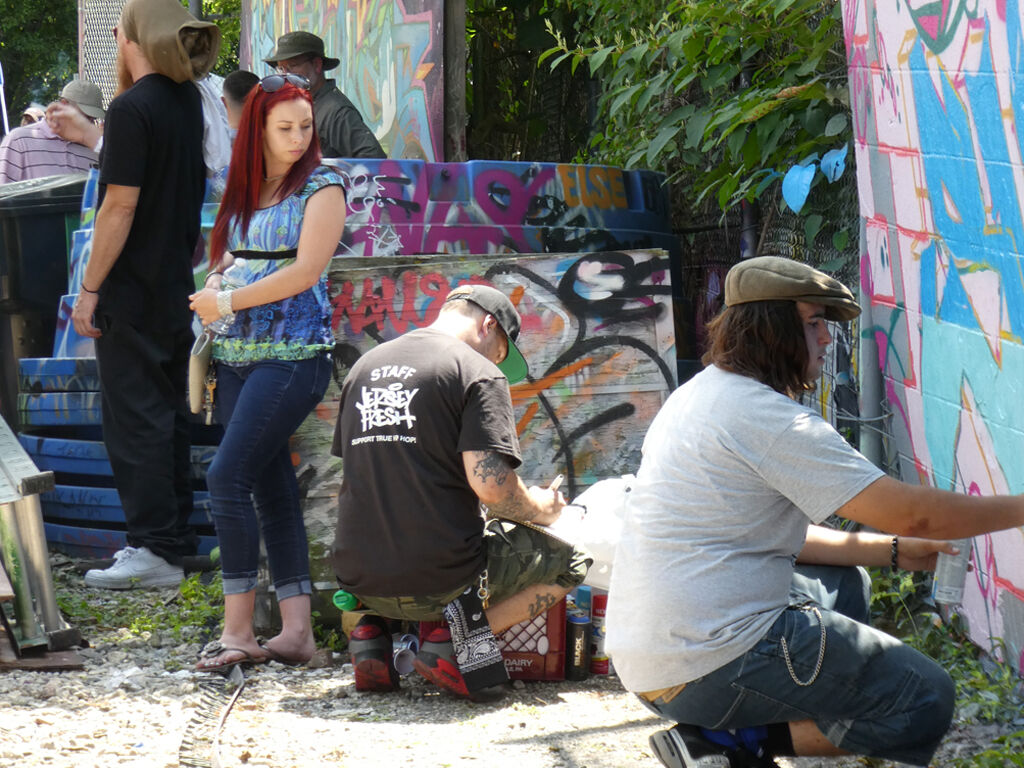
Artists and attendees at a past Jersey Fresh Jam. The annual urban celebration of art, music, and dance returns on Saturday, August 19, at TerraCycle in Trenton.,