For West Windsor resident Ken Jaworowski, the publication of his first novel was the culmination of a long-time goal.
His book, Small Town Sins, was released by Henry Holt and Co. on Aug. 1, and Jaworowski will be speaking at Princeton Public Library on Aug. 20 at 11 a.m.
Jaworowski has worked as a staff editor for the New York Times and contributed to the culture section of the paper for many years.
He has also written plays that have been performed in New York, Scotland and London. Jaworowski’s journalism career began when he was a reporter for Bloomberg News.
Jaworowski has lived in West Windsor since 2007 with his wife, Michele and their two children.
The News has asked Jaworowski to write his thoughts about the publication of Small Town Sins, which appears below. This is followed by a short excerpt from his book.
* * *
The greatest lies are the ones we tell ourselves, and boy, I’ve told myself some doozies.
When I graduated from college I swore that I’d be a best-selling author within three years. Those three years came and went, so I decided that I needed another two or three, or five at most, before I was proclaimed the next Hemingway.
More promises and more letdowns followed until decades had passed, and I changed my tune. The problem wasn’t with my work, I’d rant, usually after my fourth bourbon. The problem was with the literary world, which refused to recognize my talents.
What a crock. It took me a long time to quit deceiving myself and to throw away those lies (along with those early manuscripts). But I did. And now that I’ve finally sold a novel—Small Town Sins—to a major New York publisher, I hereby declare that all that bragging and bitterness has gone out of me. Now, in my 50s, there’s only humility.
Ah, who am I kidding. Let me boast a little. And maybe, dear neighbor, I’ve learned a few lessons that I can pass on to you.
When I first started writing fiction, I spewed forth impenetrable prose that illustrated my grand theories about the human psyche and the philosophical underpinnings of civilization.
For some reason, publishers declined to buy those books. Then I tried a different tack: I chased trends and tried to please everybody. (“Perhaps I’ll rewrite Gone With the Wind, but set it on another planet. With superheroes. And a great white shark.”) The pandering was painfully obvious and equally unsellable.
Then, just as I was about to give up, my daughter entered her junior year at West Windsor-Plainsboro High School North and we began researching colleges.
We drove across Pennsylvania to visit schools, and memories came flooding back from the years I spent at a rural university. On that same trip I read a newspaper story about a city fireman who’d been accused of stealing something while in an apartment building.
I imagined combining that news story with the rural setting: What if a fireman in a tiny town stumbled across a huge stash of money in a burning building and made a snap decision to take it? And what if those ill-gotten riches then threatened to destroy him?
I began kicking around other ideas: What if a nurse in that same town clashed with the fundamentalist parents of a young patient, and secretly went against their wishes for treating their daughter? And what if a third character got thrown into the mix—a recovering addict who uncovered the identity of a serial predator and vowed to stop him?
Those seemed to be good seeds for a thriller, so I decided to intertwine the three stories and tell them in one novel. Yet considering my past failures, how to do it?
Writing only for me was self-indulgent, and writing only for others was selling out. Though it now appears painfully obvious, a compromise seemed to be the best solution: Sure, I’d write what I was driven to write, but I’d keep the reader in the front of my mind, and meet him or her halfway.
Oh, and I’d lay off the bourbon, too.
It worked, wonderfully. I wrote Small Town Sins in about seven months, and my agent sold it almost immediately, to Henry Holt & Co.
My wife and our two children have lived in the Dutch Neck Estates section of West Windsor for 16 years. I think we’ve always been quiet neighbors.
But if one evening last spring you heard four people loudly cheering and laughing and celebrating for hours in that neighborhood, it was probably us.
If it sounds like I’d done nothing but fail in my past writing, that’s not entirely true. I’ve been an editor for The New York Times for years, and I’ve written a few plays that ran Off Off Broadway and in Europe.
But publishing a novel was my ultimate dream, and the book’s early success has been amazing. Among the accolades: a Publisher’s Weekly starred review, a rave from Kirkus Reviews, and an article in Philadelphia Magazine naming “Small Town Sins” as one of the Top 10 books of the summer.
I’ve been waiting three decades for all of this to happen. And though I’m trying to play it cool, I’ll freely admit that I’m nearly jumping out of my skin with joy. If I said otherwise, that would be a lie. And I’m done telling those to myself.
Below in an excerpt from an early section of Ken Jaworowski’s “Small Town Sins.”
I can trace so much of my life back to a summer night when I was seventeen. Everything starts from then and links the years that follow, like one of those connect-the-dots pages you played with as a kid: Begin right here, draw a line to there, then another, then again. Sooner or later, an image emerges.
I’d recently finished my junior year of high school and was kicking around a few ideas on how to get out of Locksburg, a Central Pennsylvania backwater I’d wanted to flee ever since I was old enough to misspell its name. College was a possibility. The marines, a cheaper one. Either would work, as long as it got me away.
I had a nodding acquaintance with my classmates but no real friends among them. That’s not because of bad behavior on my part. The opposite was true: I was the only child of a sweet-spoken, disabled mother and a deacon father who together looked after a struggling church that was too poor to support a full-time priest. When I wasn’t doing schoolwork or house chores, I was at Saint Stanislaus, chipping melted wax from the candleholders or cementing the cracks that the bitter winters brought to the stone walls outside.
One Saturday night I was walking home from the church, head down, hands in pockets, when I turned a corner. LeeLee Roland was bounding down the steps of her house, ten yards away. She was a soon-to-be sophomore who stood out from the other girls at school. Even at fifteen, she was brazenly flirty to most every guy but me. I’d watch her with a side-eye, fascinated but wary, as she bounced along the high school halls.
“Hey, Nate!” she called, employing a nickname I didn’t use. I raised my chin and hid my surprise. We’d never spoken before, and I was a little amazed that she knew who I was.
“You going to the party too?” she asked.
“Nah,” I said, as if I knew which party that was. “Yes, you are. I’m kidnapping you.”
She hooked a hand around my arm, and the breath left my lungs. To feel a girl touch me, even with just a friendly move, nearly froze me. That touch, combined with the warm June breeze, was instantly intoxicating, as if I’d swallowed an entire bottle of altar wine. “Where is it?” I said, tamping down my voice in the hope of sounding somewhat cool.
“Tracy’s house,” LeeLee said. “Willow Street.”
I nodded a few times too many while piecing it together: Tracy Carson lived there, another girl I’d never spoken to. LeeLee and I walked two blocks then turned onto Willow.
“I’m… I’m not really sure I’m invited,” I said, entirely sure
I wasn’t.
“She don’t care. Anyway, too late,” LeeLee said, and turned to walk up the steps of a house. She let go of my arm. I felt both real relief and deep disappointment.
LeeLee courtesy-knocked then pushed the door open. Inside, about fifteen people were circled around the dining room table, playing some kind of drinking game. All were familiar faces. In a town of about five thousand, you saw everyone at one time or another.
“Look who I found,” LeeLee told the group. They seemed indifferent. For that, I was grateful. Anything short of disdain was enough to make me half happy. Like any seventeen-year-old, I was perpetu- ally confused and occasionally anxious, all while acting as confident as I could.
Forty-five minutes later, the number of people had nearly tripled, and the radio, blaring classic rock, had gotten turned up twice as loud. I’d taken a place against a wall, nursing a can of lukewarm Keystone Light and watching the games that no one asked me to join. After finishing my beer, I acted as if the can were full, bringing it to my lips time and again. LeeLee had gone to the kitchen and brought me the beer when we’d arrived. She’d since disappeared upstairs with a pack of other girls.
I debated leaving. No one would notice. I eyed the door.
Any time up until then had been pivotal, of course. What if I had stayed at church a few extra minutes and never saw LeeLee? Or what if I had taken another route home? But when I look back, that moment seems the most decisive, the last real instant when something could have changed. Had I walked out that door then, how many lives would have been different?
Instead, I decided to hang around the party for a little longer. I wandered into the kitchen and took another can from the fridge, hoping no one would notice or yell at me or say I had to pay.
When I went back to my spot at the wall, LeeLee had returned.
“Hey!” she said. “I was wondering where you were.”
I showed her the beer. “Finish it,” she said.
“Why?”
“This place is lame,” she said, not caring who heard. “Let’s get out of here.”
We passed the can back and forth until we emptied it, then left. I imagined that everyone was watching us go. Maybe someone might gossip about me later a delicious notion for a surely no one at school ever thought about.
LeeLee took my hand when we reached the sidewalk. I didn’t know what to make of it and didn’t question her when she led me into a nearby patch of woods, where we sat on a fallen tree trunk. “Gettin’ chilly,” she said, and leaned against me. I put an arm around her.
“You don’t say much,” she said.
I had no response other than a shrug.
“See!” she said, and nudged me.
She smiled.
With no other prelude, we were kissing. I didn’t try to stop her when she unzipped my pants and reached inside. I didn’t have the words. I didn’t know if I wanted her to stop anyway. Within a minute her shorts were down, and she was on top of me. To hold out, I soon moved her below, then slowed. That extended my efforts for at least two minutes until we finished. Then we lay there on the ground.
“That was good,” she whispered after a while. “Yeah,” I said, because I had to say something.
I pined over LeeLee each day that summer, and scanned the streets whenever I was out in Locksburg. When my parents and I went on a three-week church retreat, I called our home number often to check the machine, in case LeeLee had left a message. I debated endlessly about whether to call her, some days convincing myself that she wouldn’t want to talk to me, other days swearing that she was probably waiting for me to make a move. Then in August she knocked on my front door. I couldn’t help smiling when I saw her.
“Hey.”
“Hey. You alone?”
“Small Town Sins” is on sale at all bookstores and online. More information is available at kenjaworowski.com.
Jaworowski will discuss his debut novel at the Princeton Public Library in a “Book Brunch” event on Sunday, August 20, at 11 a.m. Coffee and pastries will be served, and a book signing follows the talk. Free. www.princetonlibrary.org.
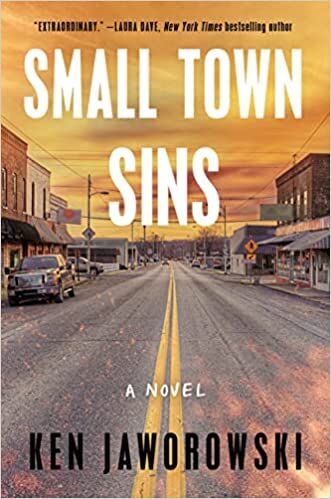
West Windsor resident Ken Jaworowski's book, “Small Town Sins,” was released on Aug. 1, 2023.,