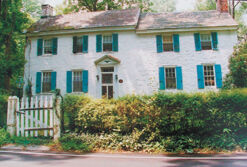
The big farmhouse (later to be known as “Hill’s Hollow”) on Wilburtha Road was the beloved home of many in the DeGrave family. As was often the case in those days, multiple generations of one family shared a household.
Evelyn, the youngest of five children of Gustave and Mary DeGrave, was the author of the reminiscences shared in last month’s column. Born in 1910, she lived in a small bungalow-style home near River and Wilburth roads until her family moved up the street to the larger farmhouse in 1915.
Evelyn’s oldest sibling, Irma, 10 years her senior, also lived in and loved the home, and Irma continued to occupy the house after she married. Early in 1931, little Grace was born, and for five years Grace also lived in her grandfather’s farmhouse. The extended family then moved back to the bungalow (still there) they had outgrown in 1915. For a quarter of a century, until she married Bob Starrett in 1956, Grace lived in Wilburtha, and recalls those years with great fondness and pleasure:
“There were a lot of children my age in Wilburtha, and we had a wonderful time growing up together, and playing together. We each had our own special tree to climb. There were cornfields and meadows below, and we’d play hide and seek and all sorts of games. In the winter, the pond would freeze solid, and we would ice skate there, and the big boys would play ice hockey. We girls had our favorite dolls, and we’d play dolls together.”
“One neighbor boy gave me a pet Banty rooster when I was in third grade. I loved that rooster! He would sit on my finger and crow and crow! I also had a pet hen later—she was great fun!
“We kids loved to wave to the conductors on the Belvidere and Delaware trains, both passenger and freight, that went by on the tracks along the canal (now the D&R towpath). Often in the early 30s during the Depression, men hitching a ride on the trains would come to Grandfather’s door, asking for a place in the barn to spend the night. I also recall making sandwiches for these genuinely nice men, for which they were always so grateful.
“We didn’t have running water in the house—and to this day, I don’t waste water, or anything else for that matter. When you have to hand pump all your water, you learn to use it sparingly. Out in the back we had a privy, and Mother would take care of the chamber pots in the house. I didn’t know any differently and didn’t feel needy in any way.
“All of us children had chores around the house and farm. We also sold tomatoes, fresh corn and vegetables from a farm stand out front on River Road, at Nicholson’s Store in Trenton and sometimes at a farmer’s market near where Thunder Park (Arm & Hammer Park) is today. We also had time to play—Chinese checkers, cards, puppets, rhyming games. We read books, did creative writing, and the family made music around the piano and pump organ.
“There was only one telephone in Wilburtha. It was in our house, because of Grandfather’s quarry business, which was extra income over and above that from Grandfather’s 40+ acre farm. Any messages for Grandfather had to be run up the hill, or to wherever Grandfather was. At that point, well after quarrying in Wilburtha had peaked, much of the business was hauling stone to work sites, or to boats or trains to transport.
“We were very involved in 4-H. We were in the Wilburtha Willing Workers group. We learned sewing and canning, and I did a lot of sewing. I even made my wedding dress and my daughter’s. And my Grandmother taught me my love of plants, which gives me joy to this day.”
Thank you, Grace, for sharing these memories with us, and giving us joy!
Do you have a story to share? Contact Helen at ewingthenandnow@gmail.com
,