A battle between Robbinsville Township and a developer over a 220-acre parcel on Robbinsville-Edinburg Road entered a holding pattern Sept. 27 after Judge Paul Innes ruled against the township and allowed construction on the property to continue.
Innes also granted the developer’s restoration bond, a form of insurance that the township council had twice declined to approve.
“This is a landmark decision,” said David Henry, who manages the property for the developer. “It is extremely rare for a decision to go against a township.”
The proposed site of a 50-home development known as Edinburg Village has been the subject of a game of tug-of-war ever since Mayor Dave Fried announced in April he wanted to raise the township’s open space tax in order to preserve the property.
But the heat turned up in September when the developer started clearing soybean fields and moving dirt on the property. Robbinsville Police responded to the site numerous times last month, ticketing construction workers for guarantee and inspections violations. Construction crews were back at work the morning of Sept. 28, moving dirt this time without fear of punishment. Innes barred Robbinsville from issuing further summonses.
Fried said the township will file to condemn the property as soon as it can, which looks to be Nov. 3. Township council introduced an ordinance to fund purchase of the property Sept. 22. The ordinance must be presented again at the next council meeting. Then, per state law, the township must wait 20 days before filing to condemn.
“It’s disappointing because the residents on Robbinsville-Edinburg Road are going to have to put up with a nuisance over the next 30 days that’s probably unnecessary,” Fried said.
The case is full of history, characters, acts of “civil disobedience” and complex law. Plenty of questions have arisen in the past month. What follows are answers to a few of them:
Who is the developer?
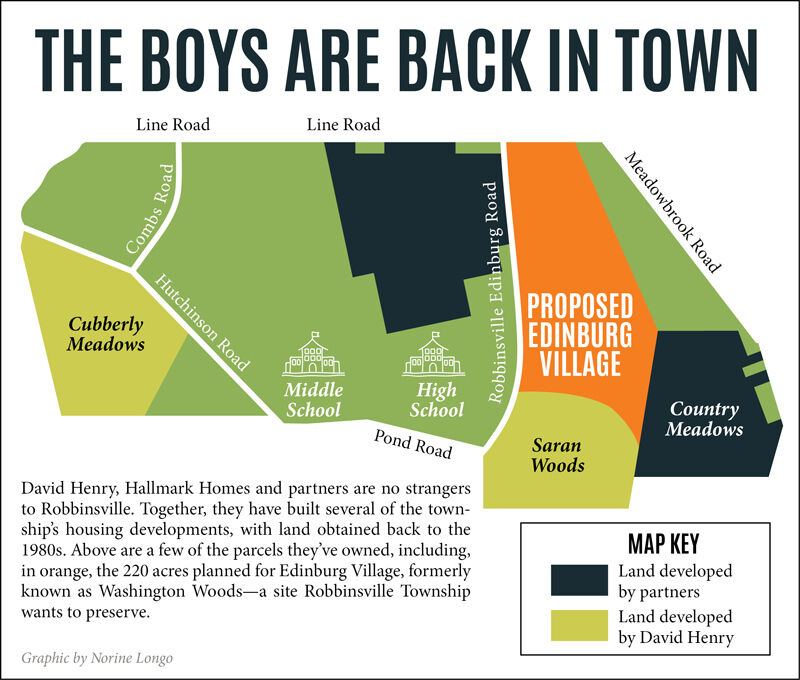
There seems to be some mystery around Edinburg Village’s developer, but David Henry is no stranger to the local development scene. He has been in Robbinsville since 1994—and his employers have been in town much longer.
A Marlboro resident, Henry works out of the sales office at Cubberly Meadows, a 110-unit development off of Hutchinson Road he developed. Cubberly Meadows was his second job in Robbinsville; he came to town 22 years ago to oversee the development of Saran Woods, an 87-unit neighborhood off of Robbinsville-Edinburg Road. Edinburg Village—right next to Saran Woods—would be Henry’s third project in town. It was formerly named Washington Woods.
Henry works for the partners in a company called Hallmark Homes. He started at the business after a friend married one of the partner’s daughters. When that partner died, the family asked Henry to continue managing all the partnerships and all the developments they own.
Partners in Hallmark also have developed Country Meadows off of Meadowbrook Road, and a former partner owned land that became the Estates at Robbinsville, a 19-home development off of Line Road. They have been buying land in Robbinsville for nearly 40 years.
“Some people may try to portray us as big builders,” Henry said. “Yes, we are big…there are about 40 families that are partners here. If you count all the alive people with the kids and the grandkids, it’s probably 120 human beings that will profit from this. It’s not a corporation with shareholders. It’s a partnership. There are plenty of people who will benefit from this, and that’s the face of it.”
Because of the amount of time they have worked together, Henry and the municipal government have developed a relationship. Only recently has it turned contentious. And regardless of the outcome of the fight over Edinburg Village, both parties will need to work together in the future.
Henry anticipates construction on Cubberly Meadows to be finished in spring 2017. At that point, the town will need to approve the development, and release Henry and the partners of their restoration bond—money put forward before development to insure the property in case the construction project falls through and the township needs to restore the land. (Coincidentally, getting a restoration bond had been one of the key skirmishes in the Edinburg Village fight.)
“I don’t want to make enemies, believe me,” Henry said. “I never wanted to have a fight with them. I thought I’m doing well with the township. My record is great. And, suddenly, one day, the whole thing fell apart.”
What is Washington Woods/Edinburg Village? What is being built there?
The current plan has 50 homes—starting price at $1 million—being built on 55 acres. Henry said the developer would dedicate the remaining 165 acres on the property to the township as open space for free.
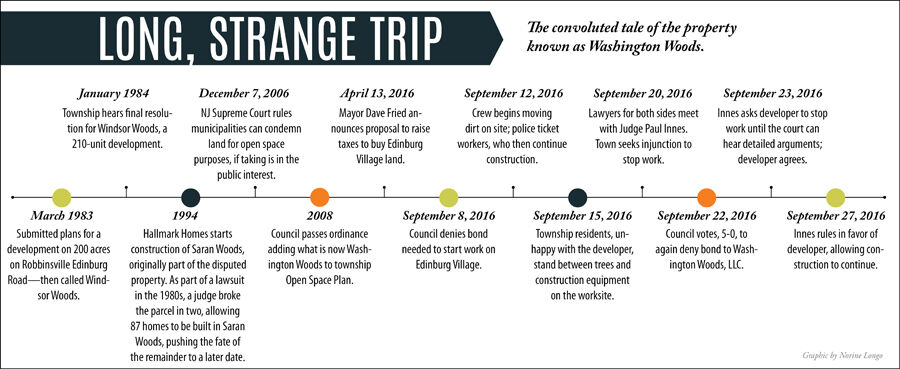
But the property has a long, curious history that predates the current struggle. The developer has owned land on Robbinsville-Edinburg Road since the early 1980s, and first submitted an initial plan for a 210-home, 200-acre development on the parcel in March 1983. Council heard a final resolution for that development in January 1984.
At some point in the 1980s—Henry wasn’t involved and couldn’t produce a record with the exact date—the developer sued the township claiming the municipality backed out of a deal to provide sewer service to Washington Woods. In court, a judge broke the parcel in two, allowing 87 homes—with township-provided sewer—to be built on one part and pushing the fate of the remaining 160 acres to another date. The 87-home development, called Saran Woods, started construction in 1994.
Edinburg Village is the remainder of that land, plus an adjoining 60-acre parcel the developer gained in a deal with a former partner.
The developer received preliminary approval for a 50-home development on the land in 2006. Henry started building Cubberly Meadows at the same time, so he sat on his approval for Edinburg Village, with the intent to start building once construction at Cubberly Meadows wound down.
Why did the town approve the development if it knew it wanted to preserve the land?
In 2008, township council passed an ordinance adding the Washington Woods property to its Open Space Plan—a sort of wish list of undeveloped properties the town may want to preserve. But, Fried said, the township had no plans to stop Edinburg Village. Preserving that property did not become a realistic proposal until after the township failed to stop another development in town.
Developer Sharbell originally proposed its Springside at Robbinsville development on Gordon Road, on a piece of land called the Gordon-Simpson tract, as age-restricted housing. In 2009, the state passed a law allowing developers to convert planned age-restricted units—like those in over-55 communities—into regular housing. Sharbell did so in Springside, and the township was forced to approve a 150-home development in 2014. This development will add children to the school district that school officials did not plan for when it put a school expansion referendum up for public approval in 2012.
“We built the schools with what we thought we were having,” Fried said. “Now, we’re in a very different position, with a tremendous amount of regular residential on Gordon-Simpson that we did not anticipate. We just finished the bonds from the last school expansion, and now we’ve got Gordon-Simpson, which potentially puts us in a threatening situation again.”
So, the township looked for places it could stop further residential development that could add children to the school system. Edinburg Village, with its 50 4-bedroom homes, was the only game in town. On April 13, Fried announced the township’s intention to ask for an increase in its open space tax in order to preserve the 220-acres on Robbinsville-Edinburg Road and also the former site of Miry Run Golf Course.
At the same time, the township continued to work with Henry, especially on a deal signed in 2015 that would provide sewer service to Edinburg Village as long as the developer would give sewer hook-up access to the residents of Buckley Lane.
Even though those in municipal government knew the administration was in the process of trying to stop the development, there was nothing the township could do legally to stop the developers. Henry had obtained his final approval for the development in the last 12 months, and had satisfied all his zoning and permit requirements. Anything the township did to stop or impede the development could be construed as an illegal taking.
“It’s nothing the developer did wrong,” Fried said. “We’re not angry with them. Unfortunately, the law changed with Gordon-Simpson, and that had to change our plans to follow. This developer’s angry because he feels like he didn’t do anything wrong—why is he being punished? I completely understand, but it doesn’t change my circumstances. Preserving it as open space is going to be a lot better for us instead of adding another development.”
What will happen to my taxes?
It depends who you ask, but residents should expect an increase either way.
On the Nov. 8 ballot is a question asking residents if they would approve an increase of 1.5 cents per $100 of assessed home valuation in the township’s open space tax. For the average home in Robbinsville—$368,000—it’d be an increase of $55 per year.
The township takes out bonds to pay for items with large price tags, such as land. Each bond lasts for 15 to 20 years, and is no longer an obligation once paid off. Fried said the township anticipates having some bonds for other parcels come off the township ledger in the next few years, meaning the open space tax could be decreased at that time.
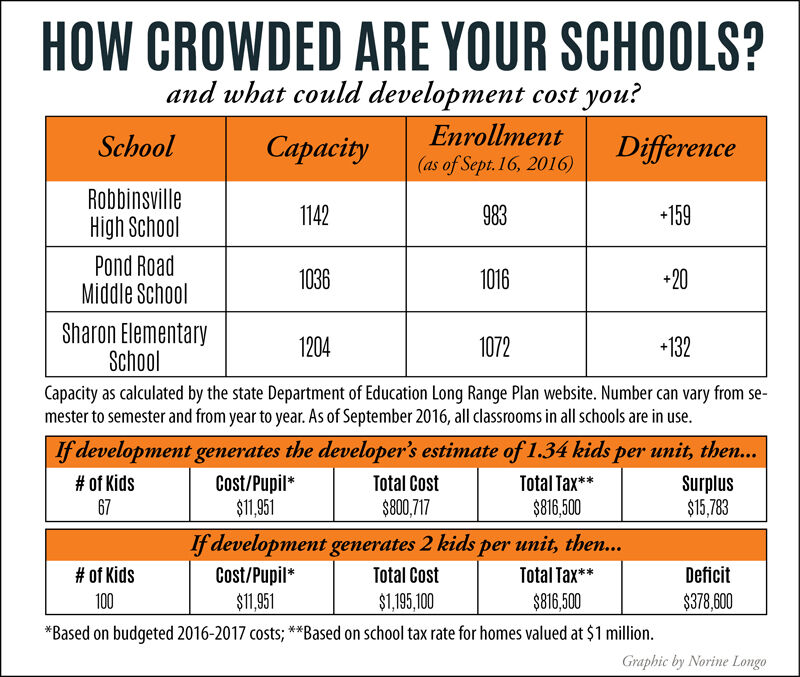
Meanwhile, the costs to educate the kids generated by housing are perpetual—they’ll be there every year as long as there are families in town who have children that need schooling. Fried estimated Edinburg Village could create a $500,000 deficit in the school budget that would have to be filled by increasing taxes. This number does not include any construction costs should the school district require a new school building to meet demands. According to school district numbers, each of the three schools are near capacity, with Pond Road Middle School the fullest. PRMS has room for only 20 more students, based on 2016-17 enrollment numbers.
The developer, on the other hand, has countered that the development would only generate 1.34 children per unit, a total of 67. Based on that estimate and the school district tax for a house assessed at $1 million ($16,330), Edinburg Village would create a surplus. That is, it would pay $15,783 more in school taxes than it would cost to educate its children. However, bump that number up slightly to 1.5 students per house, and the development would create at $79,825 deficit. To reach Fried’s $500,000 deficit number, the neighborhood would have to generate 2.2 children per house.
This whole discussion revolves around the school district and its portion of the tax bill. The neighborhood would also need municipal services, which cost additional money.
For what it is worth, Fried said he expects a flat or decreased budget in 2017. This would mean residents may not see an increase in the municipal portion of their taxes, even if the open space tax hike passes.
Why is the developer working now?
For two reasons: time and principles.
At the same time the state passed the conversion law in 2009, it also approved a law that extended expiration dates on builder’s permits indefinitely. In 2015, the state did not renew the permit law, and the clock started ticking again on the permits.
Henry’s permit from the state Department of Environmental Protection expires Nov. 15. The DEP has required the developer to create a “meandering waterway” where old farmer’s irrigation ditches existed on the property, as well as create 150-foot wetland buffers on each side. The DEP also has asked the developer to create two ponds on the property. Henry needs to show the property is in compliance with those DEP requests before the state will renew his permit.
Henry said he wanted to start construction last spring but couldn’t because he didn’t have the final plans for the Buckley Road/Robbinsville-Edinburg Road sewer project. He needed the infrastructure in place before building could begin, he said.
He placed part of the blame on the township, which he says has purposefully stalled the process during the last year. In late August, frustrated by delays, Henry told the township he was going to start building. He did not have the approval of township engineer Tim McGough nor did he have restoration bond approval from township council. McGough informed him of this.
“We said, ‘Yes, we know, but what you’re doing to us—you and the mayor and the township—is tantamount to illegal taking,’” Henry said. “‘You are withholding all reasonable permits from us. And, therefore, we are going to do civil disobedience. We are going to go, and start work.’”
On Sept. 8, Henry appeared before township council to get approval for Edinburg Village’s restoration bond. Council rejected the request. On Sept. 12, construction crews started clearing the soybean fields anyway. Henry said they had to start work if they had any hope of satisfying the requirements of the DEP permit.
One of the sticking points between the township and developer is if Henry agreed to not start work until after the Nov. 8 referendum. Henry said he made no such promise—to do so would only allow time to run out on his permit.
And if the permit runs out, he feels as if he has essentially handed the land over to the township, ending 35 years of investment on the property.
“The partners are really upset,” Henry said. “This has been in their hands since the 1980s. They really look at it like somebody stealing their property.”
How did the developer work without the restoration bond?
For the same reason the township couldn’t block the development in the first place: There’s only so much the municipality can do legally.
Robbinsville Police responded to the construction site several times in September, writing summonses for guarantee and inspections violations to each of the crew members. Work resumed at the site each time after the police left. The tickets wound up clipped together on Henry’s desk. The tickets and fines were the extent of the township’s power.
On Sept. 20, lawyers for Robbinsville filed for an injunction to stop work at the site. An injunction holds more power since disobeying it would be violating a judge’s orders. Judge Paul Innes heard the case for several days, and on Sept. 23, asked the developer to stop work temporarily so more detailed arguments could be presented. The developer agreed.
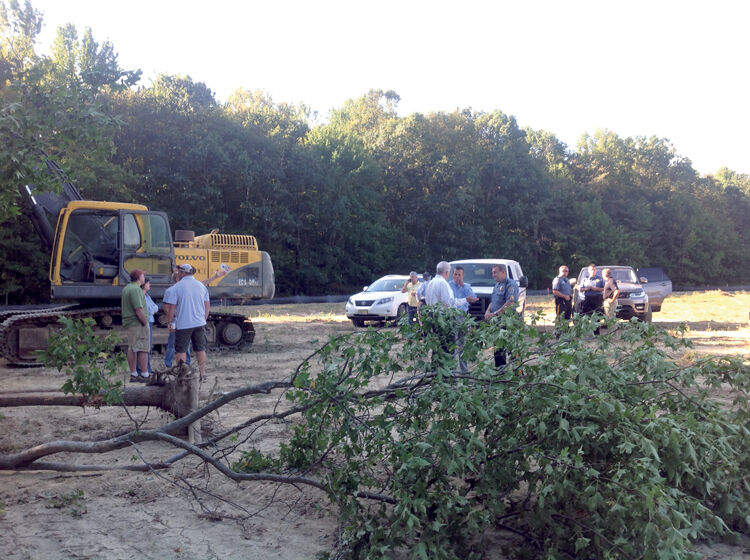
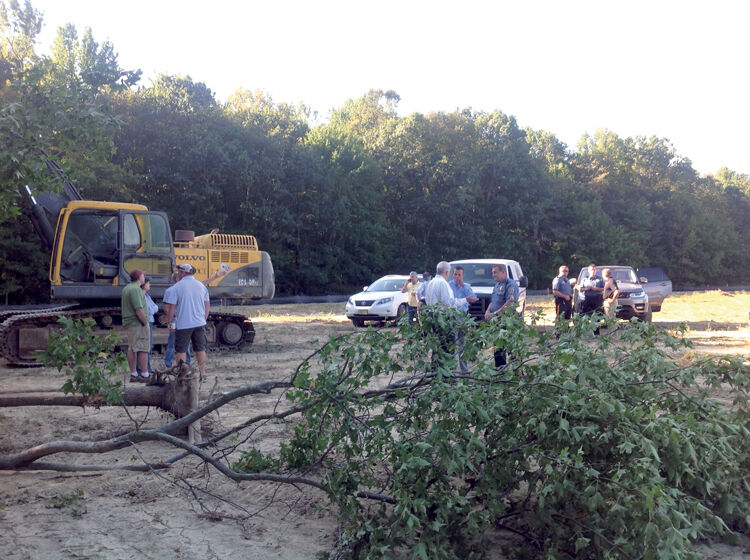
Crews worked illegally most days between Sept. 12 until Sept. 23, clearing soybeans and topsoil, as well as removing trees at the back of the property. The township will need to undo this work if it successfully preserves the land as open space.
How can the township take the land if the developer owns it legally?
In December 2007, the New Jersey Supreme Court decided, in a case between Mount Laurel and a developer called MiPro Homes, that municipal governments have the statutory authority to condemn property for open space, if the condemnation is in the public interest. The case set a precedent that Robbinsville hopes to follow. Helping matters is that the township previously expressed an interest in preserving the Washington Woods property by adding it to its Open Space Plan in 2008.
Normally, a municipality and developer will avoid condemnation by working together to settle on a price—just the threat of condemnation is enough. But not this time.
To start the condemnation process, Robbinsville must file a “Notice of Taking” with the court, which notifies the legal system and the developer of the township’s intentions. With the Notice of Taking, Robbinsville must post 5 percent of the estimated value of the land.
For the next 14 days, the township and the developer can negotiate on price. If the parties do not come to an agreement, the court will decide the price based on the assessment of the land.
Initially, Fried said the township would wait until after the Nov. 8 referendum to start the process of filing for condemnation. But, on Sept. 22, township council introduced a bond ordinance that would give the township funds to purchase the Washington Woods property—the first step in freeing money to buy the land. A township source confirmed that council and the administration both wanted to wait until after the Nov. 8 referendum to introduce the ordinance, but were spurred into action earlier because of the pace of the work occurring at the Edinburg Village site.
As of Sept. 28, the township had not yet filed a notice of taking with the courts. Earlier in the month, Fried bemoaned that condemnation had even entered the conversation.
“You have to be really, really, really careful,” Fried said. “Other than roads, we just don’t do it. We’ve talked about doing it, even [in Foxmoor Shopping Center]. We’ve given Foxmoor lots and lots of time because, to me, when you take someone’s property, you’ve got to think long and hard about whether it’s the right thing to do. Does it really make sense? Is it really in the best interest of the community? It’s a slippery slope. Once you start, where do you stop? I’ve always tried to avoid it, and I would have preferred to avoid it here as well.”
How much would the land cost?
In order to condemn land, a municipality first must obtain an independent assessment of the land and its value. Robbinsville Township’s assessment of Edinburg Village came in at $6-8 million. The developer wants $10-20 million. A source familiar with the case said that $10-20 million is merely a demand; the developer does not have an assessment to back those numbers.
Robbinsville also must have 5 percent of estimated purchase price in hand, which would be $400,000 at a total sale price of $8 million. The township has that money, in part thanks to $2 million pledged by the county government.
Why did the county get involved?
Robbinsville Township contacted the county government on Sept. 13, asking for help preserving the property. Two days later, on Sept. 15, the county announced it intended to provide $2 million to Robbinsville from its Open Space Trust Fund.
County executive Brian Hughes said the county came to a decision so quickly because the Edinburg Village property abuts county-owned open space and contains an important tributary to the Assunpink Creek. Hughes also cited the potential to construct trails and paths on the land that would aid pedestrian and cyclist access to locations like Robbinsville High School.
“We realized the importance of the property immediately,” Hughes said.
Before the county officially commits money, though, it has the land in question surveyed and assessed twice. The county also won’t pay more than fair market value, so Robbinsville won’t receive the full $2 million if, for some reason, the property’s price falls below that amount.
The county money comes from funds generated by a county open space tax, currently at 3 cents per $100 of assessed valuation.
What would Robbinsville do with the land?
The township would attempt to reduce the burden of the bond payments by either selling or renting the land to farmers, Fried said. (The developer currently rents the land to farmers, and receives farm tax assessment on the property.)
There could also be some recreation opportunities. As Hughes alluded to, the Edinburg Village site plan includes a bike path that runs out of the development and behind the houses on Robbinsville-Edinburg Road that would allow off-road, pedestrian access to Robbinsville High School. The township has considered constructing the bike path even if Edinburg Village is not built.
How can residents get involved?
Some Robbinsville residents participated in what they called “civil disobedience” Sept. 14 by standing on the back of the Edinburg Village property and blocking workers from knocking down trees—an act that is technically trespassing since Washington Woods, LLC rightfully owns the land. The most legal way to participate would be to vote on the open space ballot question Tuesday, Nov. 8.
Simplifying, a majority of “yes” votes would provide the township the funds needed to purchase the 220 acres on Robbinsville-Edinburg Road, as well as the site of Miry Run Golf Course. Fried has said, with a “no” result, he would drop the issue and allow Edinburg Village to be built.
Although, with the fighting both in and out of court, the process may have gone too far now for the township to back down.
The bottom line
Township officials like Fried said there are three reasons why this property must be preserved: 1) Mercer County, West Windsor Township and Robbinsville Township all have preserved land around the parcel, and preserving Edinburg Village would tie the open space together. 2) Robbinsville-Edinburg Road can hardly handle the traffic it has now, particularly in the mornings when students drive to Robbinsville High School. Adding 50 homes would add at least 50 cars to that traffic. 3) The increase in open space tax will cost taxpayers less in the long run than having to raise school taxes to pay for the kids generated by those 50 homes.
The developer counters that the township would be overpaying for the land if it enters into condemnation proceedings. Hallmark Homes only plans to build on 55 of the 220 acres, giving the remaining 165 to the township as open space. Those 165 acres would be maintained by the Edinburg Village homeowner’s association, relieving the township of any responsibility or liability. The developer says the option is between receiving 165 acres for free or paying around $10 million for the complete 220-acre parcel.
Henry also has made the case that taking another person’s property—which is what condemnation is essentially—is morally wrong, and he is merely providing a service for people who want to live in a desirable community.
,
development-schools_oct16,