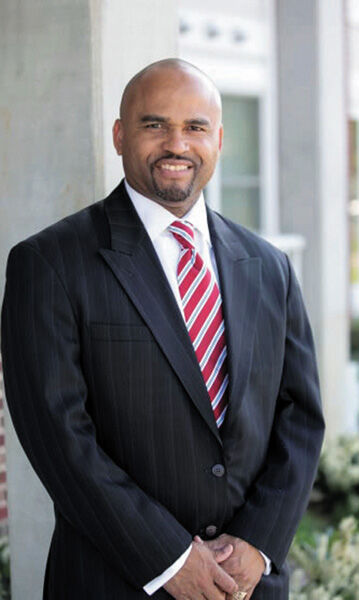
Darrell Armstrong is a man of God who could easily have been a man in Cell Block C. Or dead. Or dead in Cell Block C.
That’s if you believe in statistics, of course. The Rev. Dr. Darrell Armstrong does not. He believes in God, in Jesus and in the human capacity for growth, change and spiritual enrichment through real work.
And he believes in himself, and always has — not an easy thing to do when life deals you some of the cards Armstrong was handed from Day One.
“I’ve always been a person of faith,” he says.
Since 2000, Armstrong, a Ewing resident, has been the pastor of Shiloh Baptist, taking over for the church’s legendary leader of 50-plus years, S. Howard Woodson.
In February, he took on another role when the Baptist World Alliance appointed him to be its chief administrative officer at the United Nations.
The Baptist World Alliance is the largest Baptist body in the world. Armstrong got involved with the BWA in 2013, where he’s volunteered to help get the mission of the organization across the globe.
As the BWA’s chief administrative officer to the U.N., Armstrong works to ensure there is staff in each of the world’s seven BWA offices and to coordinate with U.N. Conference of Non-governmental Organizations, or CoNGO.
Still a volunteer, Armstrong makes sure the BWA’s position is heard when it comes to policy decisions by the U.N., which has representation from every major religion and denomination on the planet. The U.N.’s overarching goals for bettering the world include such words as “gender equality” and “hunger.” What Armstrong helps guide is what the BWA and Baptist churches can do to combat these troubles.
Essentially, there are three levels of policy: federal, state and local/regional. The U.N will make a point to promote, say, environmental awareness and responsibility.
The BWA, Armstrong says, will make a public statement on the matter as a group, then look into “how do we get boots on the ground to deal with that,” he says. “Then, how do we get people to give and help.”
In the Flint, Michigan, water crisis, for example, Shiloh Baptist sent water. From the top, the call towards better environmental responsibility and civil help got down to the basic level of direct water donations for the people of Flint.
Armstrong has come a long way from the days when he was taken away from his drug-addicted mother when he was 5. But then, he looks at it this way: “Growing up doesn’t have to be where you end up.”
Indeed, for if your beginnings were absolutely the harbinger of your end, Darrell Armstrong would have never made it out of Los Angeles as a kid.
“I grew up in South Central L.A. when drugs in urban America flooded the cities,” he says. “My mom, like in so many families, got hooked on crack.”
At the age of 5, one of his mother’s boyfriends in a drug-fuelled frenzy submerged Armstrong’s 2-year-old brother in a tub of scalding water. The state took the boys away, and from 5 until 18, Armstrong lived in the foster/kinship system.
Around age 8, Armstrong landed with his maternal grandfather. By age 12, he had been going to church and decided to accept Christianity and education as his twin-engine ride out of his situation. While he watched his friends and neighbors start Crips and Bloods gangs, saw violence and poverty outside his window, and watched more and more kids from the same background as himself turn to crime and drugs, Armstrong buried his nose in books, intent on getting into public policy guided by the word of God.
At 18, the foster care system turned him loose on adulthood; a well-intentioned act that often has disastrous effects because, as he puts it, “No 18-year-old is an adult in his mind.”
But Armstrong had earned a break that a lot of his fellow young Angelinos wouldn’t get — a scholarship to Stanford University. There he studied public policy, which he intended to make his career in the secular world.
But then he started thinking: What was the point of his being on the most vaunted campus on the West Coast?
“I started asking, ‘Why, God, did you let me survive all that?’” he says.“’What do I do with this responsibility?’ I learned in college that I have to give back.”
Actually, that’s putting it rather mildly. Armstrong’s eyes were not opened to global responsibility in a mere classroom or a bull session with classmates. It happened in South Africa.
In 1990, as part of a school program, Armstrong was part of a group that visited South Africa. It happened to be about three months before Nelson Mandela was released from a 27-year prison sentence. Armstrong met Archbishop Desmond Tutu (the architect of Mandela’s release), saw the country, and drank in the reality of a nation suffering from a most cancerous form of racism as well as the beauty of the possibilities that healing-through-righteous-action afforded.
“I felt God call me to pursue ministry,” he says of the trip. “But I thought I would work on a college campus as a chaplain.”
Armstrong reasoned that while he needed to give something back, especially to the down, the powerless, and the voiceless, he didn’t necessarily need to be back in his old neighborhood in South Central. He figured his work would put him where he needed to be. When he enrolled at the Princeton Theological Seminary (where he earned his master’s in divinity), he found where he needed to be — a dozen miles to the southwest, in Trenton.
Trenton, like Armstrong’s native region of L.A., is a troubled place in the shadow of exceeding wealth and opportunity. Trenton, he soon learned, was the poor and undereducated yang to Princeton’s world-class yin. He knew going into his newly offered pastorship that he could not separate the religious from the secular; the spiritual from the policy.
But he learned how important and how deeply ingrained politics and religion can be, considering who he was following as pastor of Shiloh Baptist. S. Howard Woodson Jr. was no mere church leader, after all.
He was for half a century one of the most important civic and civil rights voices in Mercer County. He was also the first African-American to serve as Speaker of the New Jersey General Assembly, where he worked for fairness in hiring and housing who didn’t see his position as pastor of a church as a vacuum.
The funny part?
“When I got to Trenton, I had no idea who Howard Woodson was,” Armstrong says.
But as he studied his formidable predecessor, Armstrong quickly realized that to lead spiritually in Trenton was to lead politically on issues of basic rights, fair treatment, and equitability. He saw disparities between Princeton and Trenton, the former a haven for intellect and influence in the world, the latter a large, open-air prison for those who don’t know there’s a bigger world out there.
“Whatever is concentrated begets itself,” Armstrong says. “Places of wealth beget wealth and places of poverty beget poverty.” His job, as he saw it, was to integrate his faith into action and change Trenton’s dynamic.
Unsurprisingly, Armstrong is a dogged proponent of family health. Family, as he sees it, is the bedrock of society, and strong families beget strong neighborhoods; beget strong cities; beget a strong world. Accordingly, he is piloting Shiloh through the construction of a $6 million Family Life Center near the church, in the dead center of Trenton’s most crime-filled neighborhoods — because that’s where it’s needed most.
Since coming to New Jersey, Armstrong has earned an educational specialist degree in marriage and family therapy from The College of New Jersey; become a motivational speaker; and was certified as a trainer on issues regarding child sexual assault, infant mental health, responsible fatherhood and family.
He also married Melanie Pinkney Armstrong, a 1993 fraguate of Ewing High School graduate who works as director of civil rights at the state Department of Transportation. The couple has two children.
Armstrong says his newfound global responsibilities with BWA are a complement to his belief in global ministry. He call the whole thing “scary and satisfying.” Scary because you don’t know what to expect; satisfying because he is helping people work together — a stunningly difficult task under the best of conditions — to find common ground. And ultimately, he says, we all have a lot more in common with each other than we think.
“We can find every reason not to work together,” he says. “But inclusivity is much better than exclusivity.”
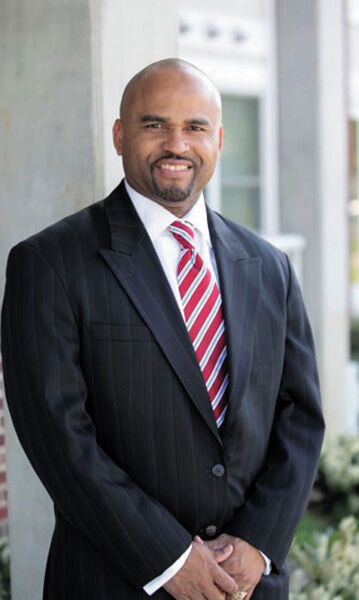
Rev. Darrell Armstrong has served since February as the Baptist World Alliance’s chief administrative officer at the United Nations.,