The 1867 Sanctuary Committee is close to its goal of raising $200,000 to transform the building into an arts and culture center. (Photo by Suzette J. Lucas.)
By Michele Alperin
At a crook on Scotch Road, reminiscent of a country lane, sits what appears to be a brownstone church and steeple, appropriately surrounded on two sides by centuries-old cemeteries. However, the 148-year-old building, now called the 1867 Sanctuary, is no longer a church but is set to open as an arts and culture center for the Ewing community once it receives its certificate of occupancy, projected for November.
Helen Kull — who became chair of the 1867 Sanctuary committee two years ago when David Knights, former board president of Preservation New Jersey and chair of the 1867 Committee, died suddenly and unexpectedly — said that PNJ’s goal is to open as soon as possible as a live building whose events will “let people see what the potential of this can be for the community. It will let people see what an asset, what a treasure this building is, what a resource it is as an arts and cultural venue in Ewing, which Ewing doesn’t have.”
In line with this vision, the name 1867 Sanctuary was selected for the building that formerly served as worship space for the Ewing Presbyterian Church because it implies, “a place set aside for protection,” without a specifically religious connotation, said Kull.
In 2008, when concerns about the building’s structural integrity came to fore and it was threatened with demolition, the First Presbyterian Church of Ewing referred the complex of issues surrounding the building to the Presbytery of New Brunswick for resolution. The Presbytery sought input from Preservation New Jersey (PNJ), an advocacy assistance and education nonprofit organization, which offered to take responsibility to restore and adaptively reuse the building, serving as a model for other preservation efforts in the state; and PNJ signed a 50-year lease with the Presbytery in May 2012.
Kull, who is also secretary of the board of trustees of PNJ, notes that because PNJ could not provide financial support, fundraising has always been part of the overall effort. To open the building’s doors, the committee set a goal of $200,000, of which $120,000 has been raised.
The building, which was declared structurally safe in 2012, needs a certificate of occupancy from the town of Ewing to open. “We can’t schedule events until have that in hand; but we have people interested and ready to go,” said Kull,
To obtain that certificate, they need to clean up, patch holes, scrape walls, remove any hazards, paint and replace the oil furnace in the basement. The $80,000 they expect to raise will also cover improved lighting, but that is not a necessity for opening.
Items on the wish list for the future, which will require additional fundraising, include installing museum molding so that art can be exhibited on the walls and installing bathrooms and a kitchenette in the basement. Once the building is occupied, not only will it generate a stream of income, but its insurance—which has been $17,000 per year because the building is vacant—will go down.
“The one word that sums up this whole effort is community,” Kull said. “The community has supported us from start—the voices of people in the community that said, ‘No, that building has to remain standing,’ or, ‘I will help either with contributing funds, putting out fliers, telling my friends, or offering to do the flooring.’” For more information and to make donations online, visit www.1867sanctuary.org.
The space, which seats 200 to 220, has drawn interest from local arts and music organizations. Some that have contacted the committee include the Capitol Singers, the Stockton Strings, the Newtown Chamber Orchestra and rock and bluegrass bands. The building’s potential as a performance venue is wide, with possibilities ranging from a concert series, choral concerts, cabarets with wine and cheese, sing-along movies, meetings, programs, talks, demos, parties as well as weddings, funerals, ecumenical worship, and vow rededications. Kull would like to invite students from Ewing High School to perform at the opening festivities.
One musician who looks forward to performing at the 1867 Sanctuary is Jonathan Savage, a Ewing resident for about 20 years who has been school board president and vice president. A couple of years ago, after leaving the school board, he decided to focus on his artistic side. The guitar player, singer and composer started a band affiliated with TEMPO, a parents group that supports the band and orchestra at Ewing High School. Interested in doing charity work, the band helped raise money for TEMPO, then performed in other community fundraisers, two of them for the 1867 Sanctuary fund.
“It has never been about the money for me,” Savage said. “I am 55 and enjoy doing it. It’s a great way of helping the community.”
Savage hopes to be involved in the opening event with his current band, Jon Savage and the Classic Rockers, and has high hopes for the sanctuary once it opens.
“Hopefully it will turn into a community-wide and county-wide resource that allows for the development of younger musicians and people like myself who would like to have a steady gig in the community,” he said. He envisions open mic nights that allow people to hone their skills and also dancing and singing, coffee houses, and informal gatherings, as well as ticketed events.
Savage, whose wife serves on the Ewing Arts Commission, said there has been discussion at the municipal level of the potential for arts-based community programs. “There are all sorts of opportunities if we can coalesce them into a facility that has the support of the community,” he said.
For Dale Perry, treasurer of the 1867 Sanctuary Committee of Preservation New Jersey, a lifetime Ewing resident, and member of the First Presbyterian Church of Ewing, the building has always been a big part of his life. “For me it’s a landmark for this township.”
“When they were going to demolish the sanctuary—from a historical perspective, that was something I couldn’t stand,” said Perry, who has a bachelor’s degree in history and is also a member of the National Trust for Historic Preservation. Noting that the former churchwas built with stones brought up in horse and wagon from the quarry in Ewing, Perry said, “When I look at the beautiful cuts on those stones and the architectural beauty, I am amazed.”
Perry sees the rebirth of 1867 Sanctuary as an arts and cultural center as a way to awaken a respect for history by bringing the past into the present. “When listening to a performance, people are suddenly going to have a magnificent feeling about how historic that building is.”
“My hope is that the businesses in the community will really start to support this,” said Perry in reference to the continuing fundraising campaign. He noted that once people start coming to events, both Ewing Township and Mercer County more broadly will benefit from the business it generates. The committee is also reaching out to individual donors in the community.
The committee has held many fundraisers and has received funding from foundations and others, including grants from the 1772 Foundation Grant Program administered by the New Jersey Historic Trust, the Princeton Area Community Foundation, Novo Nordisk and New Jersey Historic Trust Management. Boy Scout Troop #15 and other volunteers removed vines and weeds on and surrounding the exterior.
Bob Kull, a land use planner, member of the 1867 Sanctuary committee, and Helen Kull’s husband, brings his concern about the quality of life in communities to the 1867 Sanctuary project. Since he first came to the area in the late 1970s to work for the state, he said, “I had been curious about this very beautiful building in this context; it rose up from a cemetery in the suburbs, and brownstone is usually in a city.”
He and Helen went there many times when the building was part of the church. “We were very impressed by the sound of the music in there, and the acoustics of people speaking was wonderful,” he said. He was also impressed with the number of strangers who would show up Christmas Eve who, he said, “came there just because it was so beautiful.”
Kull’s experience as a singer and as board president of Hopewell’s Voices Chorale has deepened his appreciation for arts in a community. “Through that I’m exposed not only to how philanthropy works but the importance of arts and cultural organizations in not only being part of a community fabric but to help establish the fabric of a community.”
His professional expertise added to his interest. “Through my experience I saw that historic preservation was really a vital part of sustainability of neighborhoods; it was a lot more efficient and less resource intensive to reuse buildings rather than demolish them. An adaptive reuse study and architectural consultants, along with community participation, suggested that the building be transformed into a community center for arts and culture.”
Participating together in arts and cultural events as well as more spiritual occasions create the communal glue. “People come in to join together to do things that are uplifting,” Bob Kull said. “We’re not islands as individuals, and there is much that we have in common that we can share and celebrate, and I see this place as a place of celebration.”
The building was constructed in 1867 to serve as both a place of worship for the then 160-year-old congregation and a center for the rural farming community, hosting events, meetings, gatherings, socialites’ weddings, and simple funerals. It served as a social center for through to the Second World War
The stained glass windows along the nave, installed in 1967 at the building’s 100th anniversary, detail the history of the Christian church up to the founding of the Ewing Presbyterian Church. Its arched openings over the windows and the doors suggest Romanesque Revival. Other stained glass is original.
“This is something that Ewing has needed for a while; it is exciting to have it panning out and happening,” Helen Kull said about the 1867 Sanctuary. “People wanted to make sure the building was not demolished and that happened, but turning it into a dynamic, vital performance venue will give it life again.”
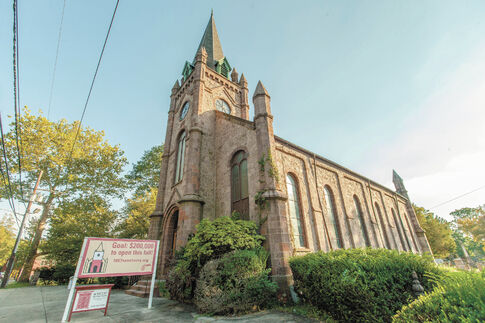
The 1867 Sanctuary on Scotch Road in Ewing.,

