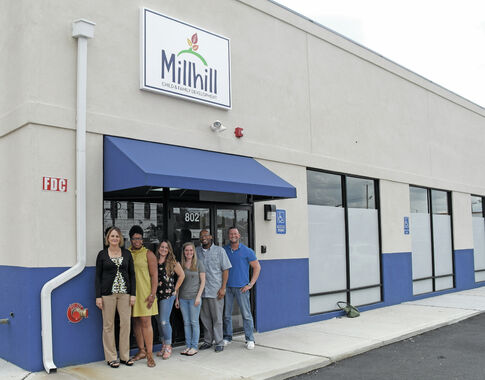
Millhill executive Cynthia Oberkofler, left, billing specialist Tracy Cox, therapists Jennifer Tully and Melissa Pieller, PEERS coordinator Andre Monday, and behavioral health director Jordon Faiman gather at the new facility at 802 Prospect Street.
By Scott Morgan
Depending on how you look at things, kids either have the world in their grasp (and don’t even know it) or they are part of some ominous survival game in which the dangers of drugs, violence, and sexual ignorance lurk behind every blind corner.
Well, both views are kind of right. And at the crossroads of this realm lies Millhill Child & Family Development, a Trenton-based social services organization that points Mercer County youths toward the empyrean by teaching them to point out the perils they and their counterparts will face on the road to get there.
Millhill has been trying to make Trenton and the world at large a better place through education and outreach since 1971, and one of its flagship endeavors is its Trenton PEERS program.
The words behind the acronym say it all — Performing, Educating & Engaging about Responsible Strategies. Andre Monday, the program coordinator, says that PEERS came about through a long trial and error process until the center realized that the best way to reach kids about the dangers of gangs, violence, drugs, bullying, and all manner of trouble, is peer-to-peer education.
The program has been bolstered by the opening in August of a new center at 802 Prospect Street to provide the local community with outpatient counseling and psychiatric services that will enable Millhill to serve 400 children and families each week.
The center, which will host a grand opening on Saturday, October 24, 11 a.m. to 4 p.m., will also provide a dedicated space for the PEERS program.
In a nutshell, the kids involved in PEERS (ages 13-18) visit schools, churches, and pretty much anywhere else that wants them, to perform skits, conduct interactive workshops, and hold Q&A sessions with other kids facing common challenges. PEERS events depict how teens think, feel, react, and make decisions during times of conflict through thought-provoking and age-appropriate performances. At the conclusion of each skit PEERS educators use interactive and educational activities to conduct small group discussions designed to initiate dialogue, explore and expand values and beliefs, and create an exchange of ideas.
It’s part teaching, part acting, and part pointing out the elephants in the room. There is, after all, a lot of common ground among Mercer County’s younger residents regarding the hazards of the world outside, and this, says Monday, is a main reason why the peer-to-peer angle works out so much better than adults going in and giving kids yet another lecture on the dangers of saying yes to the wrong questions.
“The meat of the program is the one-on-one counseling,” says Monday, himself a licensed social worker who holds his MSW from Rutgers University and his bachelor’s in social sciences from Thomas Edison State College. Monday began his career with Millhill in 2001 as a one-on-one teaching assistant, working with special needs children. He soon became an Abbott group teacher at Trenton Head Start.
Known to many of the PEERS kids as “Papa,” Monday oversees the performances and development of educational programs on a day-to-day basis. And as you might guess, these programs are about more than just reaching out to kids in troubled environments. It’s also about helping the kids in the program. PEERS teaches some of the more practical and far-reaching skills to its educators to help them attain their own professional dreams — public speaking, interpersonal communication, and presentation. On top of that, the programs the educators help put together and present cover such topics as financial literacy, conflict resolution, and college preparation, which, of course teaches them things they need to know.
“There are a lot of life skills that we work through with the groups,” Monday says. “You’re not by yourself, you’re with the group.”
So just how well does PEERS help the helpers? Consider Steven Ikegwu, a Rutgers freshman who completed his time with PEERS after he graduated from Ewing High School in 2014. Ikegwu, now 19, has followed in Papa Monday’s footsteps and studied psychology in New Brunswick. Like his role model, Ikegwu wants to help those who need a hand and don’t understand or know the available resources.
The main thing Ikegwu took from his time in PEERS is his new vantage point. “I have a more open-minded perspective in life,” he says. This perspective comes from having crossed the border into the troubled capital city and looking around at the socio-economic system that churns out more tabloid headlines than international ambassadors.
Having come from humble beginnings — Ikegwu’s father is a security guard who works so much that Ikegwu and his three older brothers barely see him and his mother works at home with preschool kids — considers himself fortunate to have gone through PEERS and learned what he has to offer the world and himself. PEERS, he says often, is a family. And because of it he wants to give back.
You could also consider Milan Williams, a 15-year-old at Hamilton High West who joined the program and wants to make the community better. Milan heard of PEERS through an aunt who works in Mill Hill and applied through an interview process that Monday says is thorough but almost always likely to lead to acceptance into the program.
Already, Milan says she is seeing a better world and is becoming more knowledgeable about it. “If people need help,” she says, “what can we do to help?”
Or consider Renata Stankowska, a 16-year-old at Ewing High School who joined PEERS in 2012, as an eighth-grader. In her few years, Renata has seen herself grow into a much more aware, much more open young lady.
“I got to see myself grow as person, from starting off as the youngest and quietest to now not being nearly as nervous presenting,” she says. The most rewarding thing about being in PEERS, she adds, is “seeing myself, as well as the people we talk to, actually get something out of our workshops.”
It is impossible to consider Renata’s involvement in PEERS without considering that of her older sister, Magdalena. The elder Stankowska sister may be PEERS’s flagship graduate. Stankowska is, now enrolled at Princeton University on a full scholarship.
Stankowska came to the United States at age 10, when her parents immigrated from Poland. Her parents set about trying to make a new life, hoping their children make good on the promise of the American dream.
Stankowska got involved in PEERS and the Princeton University Preparatory Program (a program for high-achieving, low-income students) in mid-high school. To her astonishment and no one else’s, she was accepted at Princeton, where she studies sociology.
Renata admits freely that Magda was her inspiration for joining PEERS and remains a lighthouse toward what she wants to be as a person. “In my eyes Magda is perfect,” Renata says. “And if perfection isn’t tough to follow, then I don’t know what is.”
This tough-to-follow act, however, is a natural motivator for Renata. “Please don’t get me wrong I am thrilled to have a role model like her,” she says of her big sister. “She guides me to a lot of opportunities and shows me how they will become pathways to my success, but without my own footprints I won’t get anywhere.”
And isn’t that exactly the kind of thing adults mean when they say kids have the world in their grasp?
Millhill Child and Family Development Center, (609) 989-7333. millhillcenter.org.
,

