Last year, winter pounded Hamilton Township, and the municipal government has the bill to prove it. Public works crews had to clean up after 16 different storms in 2014, at a cost of $1.35-million.
With another winter underway, township officials have their fingers crossed this year will be milder—they’ve budgeted $385,000 for 2015 winter operations.
Just what does the township do with that money? And how can residents help? The following are a few items to know when winter weather comes our way:
Shovel your sidewalk—or pay the price
The Hamilton Post received reports from readers last year that, in some areas, sidewalks went unshoveled for weeks. With cold temperatures hanging around, the snow solidified into ice, the reader said, making the sidewalks dangerous and mostly impassable.
The conditions the reader described should be illegal—it’s right there in township code Section 130-31. The ordinance, in part, says owners or tenants of properties must remove all snow and ice from sidewalks adjoining their properties within 12 daylight hours after winter weather.
If residents fail to follow the law—and the Hamilton Police notice the violation—they would be subject to Section 130-33. This ordinance allows the police department to notify the department of public works about violations, and gives public works the right to clear the sidewalk at the property owner’s expense. Public works bills the township finance department for their work, and the finance department then charges the property owner in the form of a lien on the property.
The responsible party also receives a fine, depending on the type of property and how long the sidewalk has gone uncleared. In general, properties are subject to a $10 fine, with an additional $10 per day for each day of the violation. Owners of multifamily housing developments—such as apartment projects, townhouses or retirement villages—receive a $50 penalty for the first offense, and a $100 fine for each subsequent offense.
Residents are also subject to these penalties if they have been found throwing, placing or depositing snow or ice upon the street. Of course, “found” is the key word. It is up to the township how strictly it enforces its ordinances.
Please don’t park on the street when there’s snow
Unless explicitly marked, it isn’t illegal in Hamilton Township to park on a street during snowfall. But township public works director Dave Carothers said removing vehicles and other items from roadways makes the job easier for first responders—like police, fire and ambulance—and allows crews to plow from curb to curb. It’s a courtesy, not an obligation.
On streets where there is a parking prohibition, residents must keep the road free of parked vehicles until after the snow has ceased and the streets have been plowed sufficiently so that parking will not interfere with the normal flow of traffic. Any unoccupied vehicle in violation could be removed, with the vehicle’s owner paying the costs for the tow and the car’s storage.
There are a lot of roads in Hamilton …
Hamilton residents may be tired of hearing it from township officials, but it’s true—the municipal government has a lot of ground to cover when it snows.
Hamilton Township is responsible for salting and plowing 625 lane miles of roads during winter storm events. By comparison, Robbinsville has approximately 84 miles of roads that are township responsibility.
When it snows, crews plow Hamilton’s main local roads first. Those roads are plowed perpetually until the snow ends. This is done so emergency personnel can safely travel the main roads, according to the township.
Roads in neighborhoods are plowed after snowfall ends. It can take up to 36 hours for all secondary roads in Hamilton Township to be plowed from curb-to-curb.
… and some of them aren’t town responsibility
Some primary roads run though neighborhood areas, and are considered township roads. Other main roads, however, are state or county roads, and are maintained by either the State of New Jersey or by Mercer County. The state or county is responsible for roads like Route 33, Nottingham Way, Quakerbridge Road and Kuser Road.
A complete list of state and county roads in Hamilton is available on the township website.
You can avoid a plowed-in driveway
Snow may be deposited in front of driveways by trucks during plowing. Residents can clear snow from the area of the roadway adjacent to the curb that is left of their driveway when looking at the street from their property. Most of the snow being carried by the plow will drop off in that area before reaching the driveway, preventing a build-up in front of the driveway.
However, it is sometimes necessary to plow roads more than once, and residents, therefore, may have to open up their driveway more than once.
For more information, visit hamiltonnj.com.
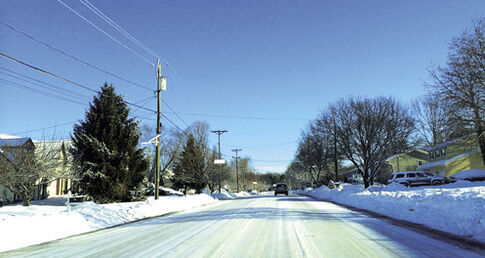
Motorists found a thin layer of snow left on George Dye Road after plows cleared the road last February. The township spent $1.35-million on winter weather operations in 2014. The public works department has a winter weather budget of $385,000 for 2015. (File photo.),

