By Michele Alperin
A house, especially one designed by the owner, is an expression of both lifestyle and values.
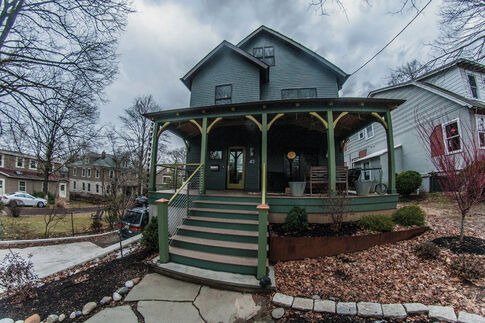
For architect Kirsten Thoft, her home at 45 Linden Lane both makes sense for the way her family lives and also for the way she does architecture.
For her efforts, the house has been awarded Platinum certification by LEED (Leadership in Energy & Environmental Design) for environmentally friendly, green building. It is the first home to receive the award in Princeton.
Her primary concern, though, was not obtaining a LEED certification, but building an energy efficient home.
“That’s what I do and what I care about,” she said, “and it [LEED] is a documentable, rigorous system for measuring whether or not you have achieved an energy efficient building.”
Despite her commitment to green building, though, Thoft is a little cynical about the benefits of making changes at the individual level. “Everybody said every little bit counts — if I’m using less carbon then that makes an impact,” she said. “What I think is that that is a teeny, teeny, tiny impact.”
But she is quick to add that mindset is important and actions affect mindset. “If someone decided they want to use less energy and less resources in general, once they start thinking that way, what I describe as ‘going green,’ it starts to raise everybody’s consciousness, not just as a household, but as a community, as a state, and maybe as a country, and we can do the big stuff that is required to slow or start to reverse climate change — the big overall issue is climate change,” she said.
Thoft said that only a large-scale government commitment to deal with carbon emissions of industrial and commercial facilities will have a real impact on climate change. It is true that 40 percent of our greenhouse gases are produced by the heating and cooling of buildings, she said, but residential is a small part.
“I don’t say that to be discouraging,” she said. “I think that changing your mind about how you look at resources really does make a difference.”
Thoft’s sense of why her customers are looking to improve energy efficiency is not to save money, but because they feel like it’s the right thing to do. “They just realize they shouldn’t be acting any other way, that we need to be treating our resources as though they are scarce, which they are,” Thoft said.
People do realize they can save some money with improved energy efficiency, but that is not the motivating force. Recalling a conversation with a window manufacturer who grew up on the shore about how houses built when he was a child are now being torn down 25 years later, she maintains that a house is a long-term investment and should be viewed as such.
“We should be building for things to be around in 50 or 100 years; over the lifetime of a house, that extra insulation and care about air sealing completely pays for itself and then some,” she said. “People need to think of building a house as the long-term investment it is — not the mass development mindset, where you throw up a house and it gets torn down 10 to 20 years later because it wasn’t built to last more than that.”
Thoft’s commitment to green housing developed under the tutelage of an architecture school professor at the University of Pennsylvania, Donald Prowler, also her advisor, whose major interest was passive solar and energy efficient design. “It was unfashionable at the time; it hadn’t entered the collective conscience. No one talked about going green, and the word ‘sustainability’ didn’t exist,” she said.
Prowler’s good friend, architect and Princeton University graduate Doug Kelbaugh, built one of the first passive solar houses in the United States at 70 Pine Street in Princeton in 1975. The design was the first to use a Trombe wall, a double wall facing south with glass as the outer wall and concrete as the inner. The glass heats the air during the day and it circulates into the house over the top of the wall. A fan pulls the air from the first floor of the house into the bottom of the wall.
At Penn, Thoft’s thesis was on the redesign of a suburban development being built in Newtown, Pennsylvania. Using the same number of housing units, land and lots, she created an alternative design that was more mixed use — and hence energy efficient because people have to drive less — and used prefab housing, which is very energy efficient.
Designwise, Thoft was weighing energy efficiency with what would work for her family and her neighborhood.
The big covered porch on her home was critical. “The essence of in-town living is to sit on the porch and talk to your neighbors — out of the rain,” she said.
Stepping into the house, visitors enter a foyer with a tile floor, hidden lockers for each member of her family, a rack for other people’s coats, and off to the side a half bath, whose walls are lined with strips of wood, from floor to ceiling, that hold her husband’s shell collection. “I care a lot about functionality — you don’t walk in onto a wooden floor, and you need a place to put your coats,” she said. “I’m not so interested in having people feel like they are making a grand entrance as accommodating everyday life.”
Off to the right beyond the entrance is Thoft’s office, which she shares with her husband, a computer scientists who works about half time at home. “I wanted a space that was separate — it has a pocket door — but is in the thick of things,” she said. “I can keep an eye on the kids without being in the middle of the kids.”
Because she has lots of casual parties, she put a 9-foot by 3-foot stainless steel tabletop in the kitchen where people can plop down their potluck offerings. “The kitchen is so often the center of parties — why not acknowledge it?” she said.
The “living room” side of what is one large, airy space, with lots of windows — one thing about an energy efficient house is that during the day, you should not need any indoor lighting — has a nearly 10-foot ceiling, because Thoft allowed the electrical conduits to show, giving the place the industrial feel that she likes.
In the living room, a 60-inch screen is hidden behind a sliding door in wall unit that is built from rafters she salvaged from the building she took down in her backyard and a house on Hodge Road.
Thoft especially likes the staircase, noting that it was very complicated to put together. She wanted the staircase to be exposed steel so she had to draw up the parts and get a steel fabricator to make them. Because she wanted the stair treads to match the oak floors, she had to get a millworker to make them. The railing that lines the stairs is stainless steel cable, but she drew the line at a metal handrail. “I wanted a wood handrail because I like how it feels, as opposed to metal, which is cold,” she said.
Downstairs is what Thoft calls “a second living room” — at least that’s what her kids and even she and her husband use it for. It’s a big draw, given the 120-inch roll-up screen, where the family and friends can project movies and television from a nifty ceiling-mounted projector. “One formal living room does not get used; the idea of two living rooms, equally comfortable and casual, do get used,” she said.
The space could also work someday as a rental apartment, with its mini-kitchen, bathroom, two closets, and a separate entrance that can be locked off from the rest of the house. And she made sure there was plenty of insulation in the ceiling, to block off potential noise from a renter (or her children.)
The bedrooms are all small because, Thoft said, “I’d rather spend the space somewhere else.” But practicalities and personal inclinations are always at the forefront of her decision-making. So, why does she only have a sh ower in the master bath? “I take a bath once a year,” she said, adding that there is a window in a shower because that’s something she loves.
Under the roof is a big, airy space that Thoft uses as a sewing room, complete with a dressmaker’s dummy. Furthermore, this third-floor room does not get overheated in the summer as is it might in a typically underinsulated Princeton home.
“One of the benefits of a LEED house,” she said, “is that you can use all the space — you don’t have to abandon the third floor or the attic in the summer.”
Thoft had to purchase both the lot where her house sits and the one next door, because of a building with two small apartments that stretched across the back of the property, connecting a carriage house on her lot with a 3-bay garage on the lot next door.
When considering how to proceed with the property, she realized right away that since the lot is oriented perfectly south, it was the perfect setup for solar panels.
Given her own LEED accreditation, she figured they should see what kind of LEED certification they could get on the house. But the impetus was energy efficiency more than a race to a particular certification level. A big decision was doing geothermal heating and cooling, which her husband really wanted; it had to be done before any building began because the drilling rig for the required wells was the size of a fire truck, she said.
For the geothermal system, they dug two wells 480 feet deep, 6 inches in diameter. In each well they dropped a double tube/pipe that does a 180-degree turn at the bottom. Concrete is poured in each of the wells, and the tube is filled with a glycol liquid, which Thoft calls “an environmentally friendly antifreeze liquid.”
A pump pushes the liquid through the pipes, and it comes into the house at 55 degrees (ground temperature) year round. The piece of equipment splits the heat, so that in the winter, it extracts 80-degree heat from the liquid and sends 30-degree heat back into the ground. As the liquid travels, it is warmed up again to 55, starting the cycle again.
LEED certification is a green building rating system established in March 2000 by the U.S. Green Building Council, which itself was founded in 1993. It is based on points earned in a number of different categories, which vary based on structure type, but for homes include water efficiency, indoor air quality, energy and atmosphere (carbon pollution), among others. Certifications depend on points accumulated: basic certification: 40-49; silver: 50-59; gold: 60-79; platinum: 80+.
Thoft has a thick notebook where she ta is going into the shell and who knows whether we will have kitchen cabinets.”
She does — they are Ikea cabinets, but with custom doors. Because exterior walls cannot be replaced, she chose to use 2×6’s instead of 2×4’s. To balance the expense of using spray foam insulation in the whole house, she chose to use inexpensive wall tile and light fixtures that are stylish but not expensive.
“It was a constant balancing act — these floors are not inexpensive, because they are wide, but they are oak, one of the cheapest woods you can use,” she said.
When asked about the advantages of a LEED-certified home, Thoft offered a few.
The first was comfort. “There are no drafts, and it holds its temperature amazingly well; you heat and cool it less than other houses because it is well insulated,” she said.
Second, it’s extremely bright. On her sizeable windows, Thoft has no curtains except in her east-facing bedroom, where the summer sun blasts in very early, she said.
Third, there is a sense of doing the right thing. “When I look out at all the other people with smoke coming out of the chimney, burning oil and gas to heat houses, I know I’m not contributing carbon to the atmosphere,” she said.
Finally, in the long run, there are some cost savings.
She calls her house’s style “modern, casual,” with an open floor plan and no crown molding. She likes industrial, she said, noting the exposed electrical conduit on the ceiling of the main-floor living room as well as exposed metal on the stairs. “I like to think it is New Jersey inspired—vernacular New Jersey,” she said. On the other hand, she adds, “the front has a certain Victorian quality because of the front porch and shape of the house—I wanted it to fit into the neighborhood.”
The building process took just over a year, and in April they will have been in the house for two years.
Thoft served on the Princeton environmental commission and on the site plan review advisory board, which were joint bodies of borough and township, but left when the town consolidated, due to her own time constraints. For the same reason, she recently left Princeton Future.
A native of Marblehead, Massachusetts, Thoft said she was destined for architecture from a young age. “I have always, whenever I go into a building, started imagining ways in which it could be improved,” she said. “I see good stuff and bad stuff; and I start working on it in my head.”
Thoft got her undergraduate degree in design in 1986 and her graduate degree in architecture in 1991, both at the University of Pennsylvania. She has worked for Michael Graves and Associates, where her projects included the Denver Public Library and the Library of Congress Exhibit Hall, and for Hillier.
She shares the house with her husband and their three children, Zoe, 16, Ella, 14, and Escher (named after the Dutch graphic artist, M.C. Escher), 11.
At present, she is working on renovations the three-bedroom house next door to her on Linden Lane, built in the 1920s or 1930s. She is also making the garage in the back into a studio and guest space, with a bathroom.
The house next door was for a long time a two-family house, but she is making it back into a single-family house. “I’m trying to do as green a thing as possible within the constraints of the existing building,” she said. She is putting in new efficient heating and cooling, insulation, and water-efficient fixtures, as well as a gas fireplace so that the house will have some heat if the power goes out. She also opened up the floor plan on the first floor and added a master bath and walk-in closet—“the stuff that people like. I’m trying to make the perfect in-town house,” she said.
,

