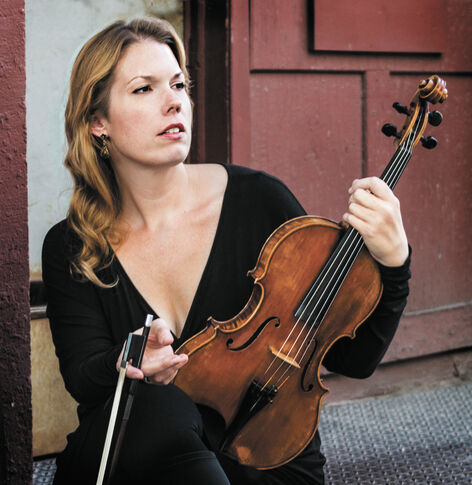
Violist Jessica Meyer performs and speaks at the Princeton Public Library on March 4. The event is a prelude to a March 15 Princeton Symphony Orchestra event, “Soulful Reflections,” at Richardson Auditorium.
Second choice. Use caption from other photo
By Bill Sanservino
Armed with only her instrument and a loop machine — an electronic device mostly used by guitar players, accomplished violist Jessica Meyer turns her live performances into a one-woman stringed orchestra.
Meyer will be the featured speaker and performer at the Princeton Public Library on March 4 as she talks about how people can tap into their own inner creativity. The talk, which starts at 7 p.m. in the Community Room, is part of the Princeton Symphony Orchestra Soundtracks series and is co-sponsored by the library.
The Soundtracks Series explores music and related topics, including background on the music that the PSO performs, concert themes, and what happens behind the scenes at Princeton’s only professional orchestra, the PSO.
Meyer’s presentation is a prelude to the March 15 PSO Classical Concert Series, “Soulful Reflections,” which will feature cellist Zuill Bailey performing Schumann’s Cello Concerto in A Minor and Massenet’s “Meditation” from Thais. The concert is at Richardson Auditorium.
As part of her talk, Meyer will tell the story of her journey from performer to rediscovering a talent for composing that she had in her youth.
“I wrote a lot as a child and I spent hours at the piano just improvising and making stuff up as a way to process my emotional life, especially as a teenager,” Meyer said. “Then I stopped for 20 years, but there was a very clear moment after becoming a parent, after having my son, when I needed a way to emotionally process what I was experiencing.”
Meyer purchased a small piano for her apartment and did some work with a singer-songwriter for a while. “But it wasn’t until I found the loop machine that I really seriously got back into composition,” she said.
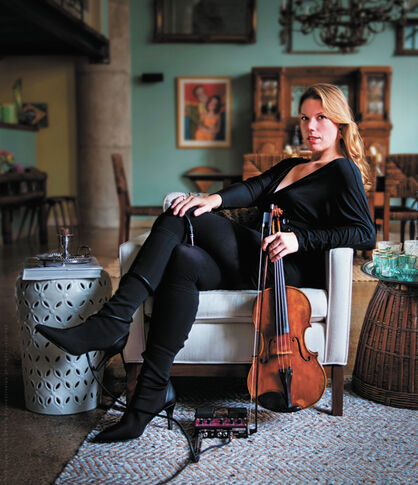
By using an effects pedal by Boss called a Loop Station, Meyer samples segments of her music as she plays, and then uses the machine to play them back in a continuous loop. The pedal allows her to layer the looping segments on top of each other as she performs, blending them to create a one-woman orchestra.
Meyer used the method on her debut album, “Sounds of Being,” which was released in November, and will demonstrate the technique during a 45-minute live performance of music from her CD as part of the library event.
In addition to her solo performances, Meyer is the co-founder of the award-winning and critically acclaimed contemporary music collective counter)induction.
She has also appeared with other new music ensembles in New York City, such as Ear Heart Music, the American Modern Ensemble, the Either/Or Ensemble, and the Argento Chamber Ensemble, as well as ensembles such as the East Coast Chamber Orchestra (ECCO), and Classical Jam.
Last year, her projects on baroque viola included collaborations with the Gotham Chamber Opera at the Metropolitan Museum of Art, and with the Paul Taylor Dance Company.
In October, she returned to the Met for the debut of her new ensemble, “The Pipeline Collective,” where fellow soloists performed music they composed themselves.
As the owner of “Chops Beyond the Practice Room,” Meyer coaches and conducts workshops that help musicians improve networking, communication and entrepreneurial skills to help them advocate for their own careers.
Her workshops have been featured at The Juilliard School, the Curtis Institute of Music, for the TAs of the Philadelphia Orchestra, the Manhattan School of Music, the Longy School of Music, New York University, and the Chamber Music America Conference.
Meyer said that a major inspiration for her work is Reggie Watts, a comedian and musician whose improvised musical sets are created using only his voice, a keyboard and a loop machine. She first saw Watts perform at a club in Brooklyn, where she had gone to see her friend work as a DJ.
“I didn’t know who Reggie Watts was, and he got up there (on stage) with a loop machine, and it was just him standing there turning some knobs and pressing some buttons, basically pulling off the most virtuosic vocal melodies I’ve ever seen,” Meyer said. “He was beatboxing and singing and building up all of these textures and layers and rhythms and just killing it. I remember thinking, ‘I want to do that’.”
The experience made her think about approaching the viola a whole different way.
“I spent many years exploring lots of different colors on my instrument, but not a lot of rhythms,” she said. “Since I’m a closet percussionist, I wanted to try a drum on my instrument and maybe sing a little bit. I thought, ‘that’s my ticket, I just have to go and get one of those things’.”
After telling him she wanted one, Meyer’s husband bought her a loop machine for her birthday and she began the process of experimenting with it.
“That’s how I started writing again,” she said.
One representation of how this all comes together is a song on her album titled “Afflicted Mantra,” where she used the Loop Station to create myriad layers and performs vocals as well.
“That piece really convinced me, not only of the importance of writing as a cathartic process and as a way to distill what’s happening, but also the importance of why I need to keep doing it,” she said.
“Like many musicians, I am prone to obsessive thinking,” Meyer said of the piece. “Sometimes, this can work in one’s favor — relentless fervor supplies endless energy as tasks get done and goals are achieved. By the same token, it can easily be destructive and the root cause of anyone’s pain — mentally, emotionally, and even physically. The text of this piece originated from a series of poems I wrote in 2010 during a particularly rough patch.”
Meyer said that she often turns teachings from yoga to help break her obsessive-compulsive cycles, and “Afflicted Mantra” is a manifestation of many of those concepts.
“What delivers momentary feelings of euphoria or even an intense sense of connectedness in one moment can turn into the very thing that repeatedly allows one to become undone,” she said. “With the loop machine, I am able to create my own harmonium, while the Baroque bow allows me to execute certain harmonics and emote the expressive effects the piece needed.”
,