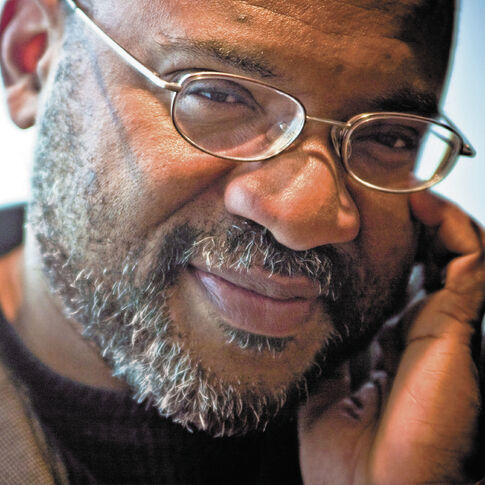
Kwame Dawes is one of 12 poets to be featured at the 2015 Princeton Poetry Festival.
By Bill Sanservino
“I believe poetry is important. It teaches us and trains us,” said Kwame Dawes, the award-winning Ghanaian-born Jamaican poet.
Dawes, who is one of 12 poets to be featured at the Lewis Center’s 2015 Princeton Poetry Festival this month, will read his works and also be part of a panel on “The Place of Poetry.” The festival, which features national and international artists, will take place March 13 and 14 in Richardson Auditorium.
Dawes shared some of his thoughts on poetry in a recorded interview with Knox College posted on YouTube. “There’s a kind of muscular training of the capacity to empathize that poetry gives us,” said Dawes. “I’m unabashed about my feeling that everybody should read poetry. Everybody should attempt to write poetry, because the capacity to empathize, while it might innate, is actually a trained skill.”
One way to strengthen that skill is for people to use their imaginations and try relating the lives of others to their own.
“If somebody says to me, ‘I can’t imagine how you’re feeling, because I feel distant from you,’ whether it’s racially or gender-wise or geographically, my response is ‘Try’,” Dawes said. “The effort is the effort of the imagination. The effort is the effort of trying to imagine what I’m feeling. You support that effort by trying to find as much of what I have been dealing with, bringing that into the pool and then allowing what you have carried in your life to mix into that to arrive at something we call empathy.”
“Look out there. Look at all of that stuff out there. Grab it,” he added. “You think that there’s nothing to write about? Look at everything that’s out there to write about and make it come alive.”
Dawes is the author of 16 books of poetry and numerous books of fiction, non-fiction, criticism and drama. He is the editor of Prairie Schooner and professor of English at the University of Nebraska, and also teaches in the Pacific MFA Writing program.
Dawes won an Emmy Award in 2009 for LiveHopeLove, an interactive website based on the HOPE: Living and Loving with AIDS project in Jamaica. In 2011, Dawes reported on HIV AIDS after the earthquake in Haiti and his poems, blogs, articles and documentary work were a key part of the post-earthquake Haiti reporting by the Pulitzer Center on Crisis Reporting that won the National Press Club Joan Friedenberg Award for Online Journalism.
Despite his activism, Dawes said he doesn’t write his poetry with a social or political agenda in mind.
“I don’t think of it in that way,” said Dawes. “I think that artwork can have that impact, but as an intention, it’s not there (for me). I do not write the poems to change anything. There’s a distinction between what I do to create in the art and what happens to the art after I’ve created it.”
In fact, Dawes said there’s no way to plan the impact of his work. For example, when he writes poems about Haiti, it’s not with the intention of getting people to donate money. “I’m writing for the people who experience what I’m writing about. When they read the poem, I hope they will say to me, ‘That’s it. That’s what I’ve been feeling and I didn’t know how to say it’.”
Organized by Pulitzer Prize-winning poet and Princeton professor Paul Muldoon, the Poetry Festival has grown since it first debuted six years ago.
“The festival started off with a very strong line up — Seamus Heaney and John Ashbery in that first year — so part of the trick has been to try to maintain that standard,” said Muldoon, professor of creative writing in Princeton University’s Lewis Center for the Arts. Muldoon is also director of the Princeton Atelier and chair of the University’s Fund for Irish Studies.
As with the first three festivals, there is a strong international aspect in the selection of poets. This is by design, said the Irish-born Muldoon, to counteract a tendency toward insularity in the United States.
“Princeton is truly an international venue; writers not associated with the university live in the area, and we like the idea of bringing internationally renowned writers into that mix.” Muldoon said. “We’re also committed to giving the wider community the chance to celebrate with us and our students.”
International poets joining Dawes include British poet Paul Farley, Scottish poet Kathleen Jamie, Belarusian poet Valzhyna Mort, Polish poet and translator Tomasz Rózycki and Vietnamese poet Ocean Vuong.
Also featured are seven poets from the United States, including Ellen Bryant Voigt, finalist for both the National Book Award and the National Book Critics Circle Award; Major Jackson, winner of a Whiting Writers’ Award and finalist for the National Book Critics Circle Award; Maureen N. McLane, winner of the National Critics Circle Award in autobiography; as well as Ada Limón, Michael Robbins and Ray Young Bear, a member of the Native American Meskwaki Nation.
Tickets are $15 for each day, free for students and $25 for a two-day Festival Pass. They are available through Princeton University Ticketing at (609) 258-9220, on-line, or at the Frist Campus Center Ticket Office.
,

