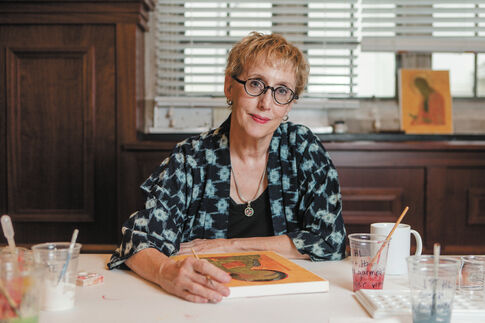
Lawrence resident Maureen McCormick, the iconographer in residence at Trinity Church in Princeton, paints an icon during a workshop in July. (Photo by Suzette J. Lucas.)
By Michele Alperin
Why did Maureen McCormick give up her hotshot job as chief registrar and manager of collection services at the Princeton University Art Museum to become the iconographer in residence at Trinity Church and devote herself to painting icons in the Russian Orthodox style? For love of the art, of course.
McCormick, a Lawrence resident, has been a member of the Princeton church for some 20 years.
A former Roman Catholic, she decided to become a member of the Episcopal church after a friend invited her to a service.
“It is another liturgical tradition, with smells and bells, beautiful music, and beautiful architecture,” she sais. “Beauty is important to me. Like Plato, I think this is how we know God—through beauty.”
McCormick said she was familiar with icons because the museum had hosted an exhibition called “Gates of Mystery: The Art of Holy Russia” in 1990.
“I still was kind of organized religion skeptical,” she said of herself at that time, “but I was intrigued by the fact that whenever I walked through the gallery, there would be Orthodox priests or Orthodox faithful venerating the icons, blessing themselves, and bowing down before them.”
When McCormick’s daughter, Phoebe, now 20, was about two, McCormick heard an announcement during a Sunday service that Vladislav Andrejev of the Prosopon School of Iconology would be teaching a class.
After taking that first workshop, McCormick said, “I was completely blown over; the creation of the icon is itself a form of worship. The actual process is considered a form of prayer and a form of liturgy, and there is all sorts of symbolism you can ponder while you’re ‘writing’ an icon.”
The word “writing,” she said, is a signal that iconographers are not expressing their own creativity, but reenacting a contemplative, prayer tradition, copying existing icons.
The symbols in the icon itself, the materials used, and the process of writing the icon all have meanings.
Once people have learned how to read an icon and make sense of the symbols, the icons became a way for people in a largely illiterate society to learn the Gospel.
Even something as simple as the gesso used to paint the linen-covered wooden board is symbolic—of the divine light coming from within the icon.
“When the light passes through transparent layers of paint, it reflects back and gives the icon its glowing quality,” McCormick said. “That white gesso becomes a symbol of what the Orthodox call ‘the uncreated light of God,’ which refers to light of first day of creation [remember that the creation of the sun and moon did not happen until the fourth day]. Our task as humans is to become transparent vessels of this light.”
Gesso—a mixture of chalk, marble dust, rabbit skin glue, and water—also has a pragmatic side: the chalk makes the gesso able to absorb pigments, and the marble dust creates a hard enough surface to allow for fine detail.
Also symbolic is the gold-leaf halo on the Archangel Michael, the icon first-time students always start with. The halo sits on a backing of a red clay mixture, which is also symbolic. McCormick said.
“When God created Adam out of clay, he created a creature but it did not become a living creature until God breathed into Adam. We talk about humans having both a material and spiritual nature; and this is a symbol of that fusion, of what we could be.”
At the end of the workshop McCormick asked whether the Princeton workshop would continue every year, but the answer was no because the two organizers were moving away, so McCormick volunteered and has been organizing ever sense.
At this year’s workshop at Trinity during the week of July 13, McCormick taught the neophytes while Andrejev worked with the more advanced students.
Each day of the workshop starts in the morning with chanted prayers, then the icon writing begins. Liturgical music is playing, incense burning, candles lit, and, McCormick said, “It’s like stepping back in time.”
For Diane Paulsell of Princeton, writing an icon is a form of spiritual practice, like prayer or silent meditation.
“You could think of the Bible as telling the story of our faith with words, and this is like a sacred image that is also communicating the faith,” she said.
For Nadine Haines of Medford, New Jersey, the process of creating an icon, beginning with the gesso (“the potential for existence”) through the creation story, salvation history, and up to the current time, is a way to build the faith story.
“Through this process you discover your own image of God,” she said.
The early history of icons was mired in controversy, McCormick said. In theological battles over whether one “venerated” or “worshiped” icons, the anti-icon iconoclasts lost out to the pro-icon iconodules at the seventh Ecumenical Council in 787.
McCormick explains the council’s decision: “No, icons are not idols, because of the doctrine of the incarnation: if God chose to take human form, then we can depict Christ’s human nature. We cannot depict his divine nature because that is completely unknown to us, but we can try to symbolize that divine nature with things like gold halos.”
Unfortunately, at the time of the council someone incorrectly mistranslated two Greek words with different meanings (“show honor to” and “worship”) into Latin, both as meaning “worship.” The council itself had clearly distinguished between worshipping God and honoring something holy, like the Bible or cross, McCormick said, but the consequence of the incorrect translation meant that for hundreds of years, in the West, the iconoclasts held the day.
In the 16th Century, Henry VII and his son Edward were iconoclastic to such a degree that they stripped altars and broke stained glass windows. Only in 1984 did the Church of England finally accept the production and veneration of icons, affirming that the extremes of iconoclasm had been due to a mistranslation.
Looking back to her undergraduate years as a fine arts major at SUNY Potsdam, McCormick said she had a crisis of faith in college, due in part to the death of her mother when she was a high school senior but also to being 20 years old, a time when people “disavow anything your family taught you.”
But for her the artwork she created had another dimension. “My yearning for the sublime I tried to satisfy in art,” she said.
Although in some sense icon painting accomplishes the same thing, McCormick said that what she did then was “solipsistic, self-referential artwork.” Yes, it verged on allegory, particularly in a series of personifications she did of the four seasons, but the symbolism she used was entirely her own, not readable by others.
The bottom line, she said, was that “if I was able to express something deeply personal, I could connect with the universal.” But what she created might not be understandable by anyone else.
Both in college, and for the master in fine arts that she earned at Temple University’s Tyler School of Art, she focused on printmaking, but her true love was drawing.
“The kind of drawing I did, was meticulous and process oriented,” she said, recalling a series of stippled drawings she did with “a million dots,” that were denser or less dense as needed.
“I enjoy processes that allow me to become lost in thought, that flow—not big gestural works of art (like Pollack),” she said.
With her master’s degree in hand, she wanted to teach college but ended up as a secretary at the Columbus Museum of Art in Ohio. It was there that she discovered what would turn out to be a great career for her, as art museum registrar.
The registrar is responsible both for knowing where every object is (and at the Princeton Unversity Art Museum that added up to about 70,000 objects) and arranging transportation as the objects came and went.
Describing her role as a cross between a librarian and air-traffic controller, she said, “It suits my personality—I am very organized, and for me it was a really good use of my fastidiousness.”
During her 28 and a half years at the museum, first as assistant registrar and then, when her boss left, registrar, the staff grew to nine fulltimers, and both the collection and the number of exhibitions (from two to maybe two dozen) exploded.
Also during that period she met and married her husband of 26 years, graphic designer Phil Unetic (uneticdesign.com), and they had their daughter Phoebe.
About five or so years ago McCormick felt a call to become a priest and explored this with her own priest, who was very supportive, and the parish committee on the ministry, but ultimately they all decided that she already had a ministry, teaching iconography, and she became Trinity’s resident iconographer, creating a studio in a room that wasn’t being used.
When McCormick left her job in July 2013, she took an 80 percent cut in pay, which she covers in part by working a couple days a week in Philadelphia for a fine arts services company that she used to hire when she was at the museum. She usually teaches two open studio classes a month and sometimes a class during Lent.
Theorizing about why icons have become popular, McCormick said, “The people who come to this are people who are looking for a contemplative experience. We live in such an over-connected, fast-paced, crazy, insane world. You come in, turn off your cell phones; and to paint that line takes every ounce of your concentration.” For the artist in her, writing icons also means working with beautiful materials, through which “there is a reconnection with the created world and how wonderful it is.”
,

