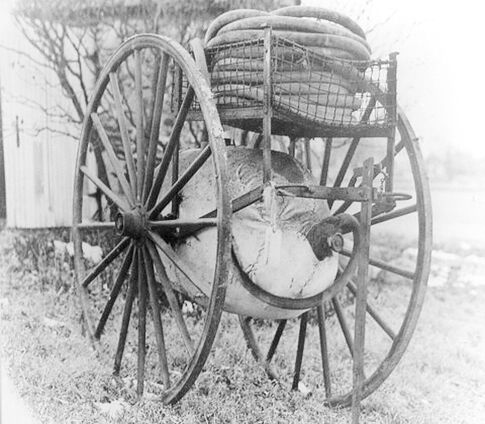
This hand-drawn chemical truck wagon, which was donated to the Lawrenceville Fire Company in 1915 by the Lawrenceville Prep School, was one of the company’s first pieces of fire apparatus.
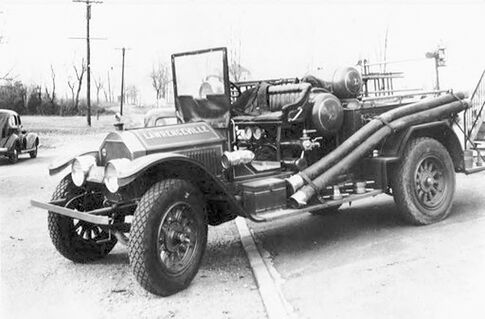
The company’s 1926 American LaFrance pumper, one of its first motorized pieces of firefighting equipment.
By Scott Morgan
By 1915, life in America had gotten a lot faster and a lot more crowded than it was when the century turned. Even in Lawrence.
And even if the township’s size and pace 100 years ago would seem positively pastoral by comparison to today, times were changing in a hurry, and residents realized they needed certain new amenities to modern life, like the ability to fight fires in a growing corner of Mercer County.
Such are the humble beginnings of the Lawrenceville Fire Co., which one century ago got its first piece of firefighting equipment from the then-century-old Lawrenceville School.
A small group of men recognizing the need for fire safety in a town of about 2,000 residents used the school’s equipment — two hand-drawn hose carts, three hand-drawn chemical truck wagons, and one hand- or horse-drawn wooden ladder truck — to carry firefighting powder and whatever water they found pretty much wherever they could get it to douse blazes.
Keep in mind, there were no labyrinths of freshwater pipes in place to feed firefighters back then. Water needed to be collected and carried and it only got there at the top speed guys and horses could get it there.
Fortunately, things move a little more efficiently on the firefighting front these days. And in recognition of its milestone birthday, the Lawrenceville Fire Co. is hosting this year’s Mercer County Fireman’s Association annual parade to kick off Fire Prevention Week on Oct. 3.
According to township manager Richard Krawczun, the route and logistics are still being worked out.
The company took up its familiar residence on Phillips Avenue in 1916, but it had bought the original lot a year earlier for a cool $200.
That was in March. By midsummer, the company held its first drive to raise money to build a fire station. With $3,000, the company went to work on the original building that September.
Lawrenceville Fire moved into its new digs on Phillips Avenue the following January, where it stored the first pieces of equipment it bought — a 1914 Peerless automobile and an 1897 horse-drawn Silsby steam pumper, which the company bought from the Newton, Pennsylvania, Fire Company, though it was still far from in working order when the department’s members held their first meeting on Valentine’s Day.
Members and some guys from Henry Benders Wheelwright Shop rigged the 600 gallons-per-minute pump to the Peerless to make the department’s first complete piece of motorized equipment, but the work took two years.
So though there was a fire department, it was still horses and raw manpower to the rescue until 1918, when an engine finally could pitch in.
The grounds on Phillips Avenue have seen a lot of change since these humble beginnings. These days, the company also owns the lots behind and beside the original plot, and the station itself has seen its share of additions and renovations.
Six, to be exact. These additions allow Lawrenceville Fire to house a host of state-of-the-art vehicles, including Rescue 23, Telesquirt 23, Tower 23, Special Services 23, Brush 23, and Utility 23. The building also houses a five-bay engine room, a radio room, a break room, a workshop, a fully equipped physical fitness room, a 10-bed bunk room, a game room with kitchen, a meeting room, four offices, and a hall with a kitchen.
The fleet of trucks to fight fires grew with the company and the township, as well as the times. That first motorized pumper that took so much labor and two years to make was in service less than 10 years, and retired in 1926, when better equipment was available, said Chief Gary Wasko.
Wasko was born to be a fireman in Lawrenceville, he said. His father, Gary Sr., was an active member of the department for 20 years and once served as deputy chief. These days, the elder Wasko does not fight fires anymore, but he remains a lifetime member.
When he’s not fighting fires or acting as the Lawrenceville Fire chief, the younger Wasko is a detective for the Mercer County Prosecutor’s Office. He graduated from Lawrence High in 1993 and got his bachelor’s at the University of New Haven, where he went to school with his good friend and Lawrenceville Fire president (and past chief) Raymond Nagy.
Wasko joined the department as a member of the first aid squad and has watched the company grow into the well-equipped public safety entity it is today.
That status, of course, took a whole century to build. In 1950, the department bought its first ladder truck.
By 1968, the company finally had the ability to carry a lot of water with it, when it purchased a 300-gallon-capacity tower wagon designed to fight brush fires. And even though the township is pretty suburban these days, “brush fires still break out every now and then,” Wasko said.
Lawrenceville Fire continued to build and update its inventory in the 70s with the purchase of two twin pumpers a 100-foot aerial ladder truck. Both trucks have since been replaced.
At the end of the 80s, Lawrenceville Fire had a substation behind Quakerbridge Mall that housed a 65-foot ladder truck. That station has since closed (“Took too much manpower,” Wasko said) and the department’s operations are now fully consolidated on Phillips Avenue.
The full tally of vehicles at Lawrence Fire’s fingertips today is four trucks, three command vehicles, one trailer for special operations and technology, and one rescue boat, Wasko said. The department got the boat six years ago and it has proven valuable already.
“That boat has made its money,” Wasko said. “Last year we had a pretty complicated recue. A dump truck hit a car and pushed it into the lake on Route 1.”
The boat’s also been called upon by other departments for missing person searches and other water rescues, he said.
If there’s been any significant change, it’s been in technology, Wasko said. Today’s upgraded, computerized command system is a far cry better than life in the Dark Ages pre-internet.
Today’s system allows firefighters and department officers to find hydrants and track responses to calls through mobile technology so that everyone knows what they’ll face before they get there.
The response tracking and mobile announcements of calls are huge advantages, Wasko said. “We all have full-time jobs, we’re not at the station house every minute.”
As for the department’s mission, well, that hasn’t changed much from its original one, which is to serve the township and keep it as safe as possible. “The only way the mission has changed,” Wasko said, “is that around 1995, the three fire companies took over motor vehicle extractions from the first aid squads.”
That change allowed medics to attend fully to the patient, rather than having to deal with pieces of metal and machinery at a scene, Wasko said. “It allows the EMTs to maintain 100 percent care.”
It also doesn’t seem likely that the department’s mission would change any time soon, either. Nor would some in the township want it to.
“The fire department has certainly been important to us,” Krawczun said. “If I were to be alive in 100 years, I would hope to see it still supported by the volunteers and the community.”
,