Charlie Thomforde, the historical horticulturist who tends the Trent House garden, is quick to tell you that gardens and kitchens have stories to tell. And two upcoming events that celebrate the 75th anniversary of the establishment of the 1719 William Trent House Museum – the building completed in 1719 and located at 15 Market Street in Trenton – are designed to keep the past talking.
On Saturday, October 4, the Trent House Association hosts an archaeological dig for a kitchen torn down during 19th and 20th century renovations. And on Saturday, October 18, Trenton mayor Eric E. Jackson and his wife, Deniece Johnson-Jackson, are the honorary chairs for a gala to raise funds for public education programs.
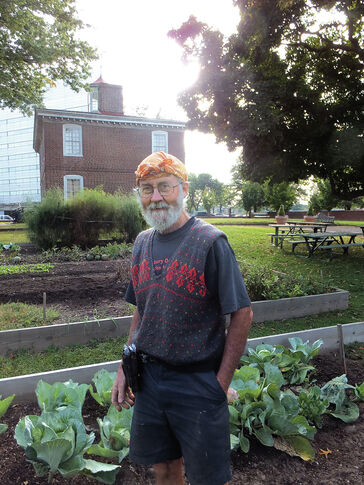
“In America we value the new — but the unfortunate byproduct is that many people have a casual contempt for the past. New is good, old is bad. So we lose touch with how things used to be. A place like Trent House may allow people to reconnect,” says Thomforde as he works in the garden of plants used for medicine, hygiene, and flavorings.
The current garden, says Thomforde, is the result of planning and hands-on work from Trent House educator Kathy McFadden and docent Walter Ritter around 2003. More recently, Mercer County Community College students planted vegetables.
This season, the garden produced over 50 types of vegetables and herbs. And while there is familiar produce — lettuce, potatoes, squash, and carrot — there is the unfamiliar: Good King Henry, similar to spinach but milder; tansy, a plant that is used for flavoring or for medicinal purposes, especially digestive track problems; and elecampane, also known as wild sunflower, used for skin problems for horses, said to be a remedy for asthma and coughs for humans, and – in early American folklore – said to protect one from witches.
Thomforde says the garden and the historic registry landmark house serves the community as a place where children and adults can learn about 18th century living as well as the city’s roots.
Recently appointed Trent House Association trustee, Ali Wilson, an executive with Zurich Insurance, agrees and says that he would like to see more school children visit the property and learn about the city’s history. “The Trent House tells us a lot about Trenton, the good, the bad, and otherwise,” says Wilson, an African-American who grew up in Trenton and lives here today with his wife and three daughters. Wilson, who earned a Jurus Doctor degree from Washington & Lee University School of Law in Virginia, and a bachelor’s degree from Middlebury College in Vermont, joined the THA this spring.
Acknowledging that Trent owned and even traded slaves, Wilson sees the property as a place where people can come together and talk about the roles that people of diverse backgrounds played in shaping the city. “There could be some people living in Trenton who are descendents of slaves and not even know it. We can celebrate the fact that men and women who were brought to New Jersey contributed to the growth of the city as well as individual households like the Trent House. Their descendents are still here today and thriving. Maybe the Trent House could be a place to open dialog,“ Wilson says.
Trent had emigrated from Scotland to Philadelphia in about 1693 and became a successful merchant and prospered from trade with Great Britain. In 1714 he acquired 800 acres of land in New Jersey and began to build his grand home (Trent’s house) overlooking the Delaware, finishing it in 1719. In 1720, he laid out a settlement, which he incorporated and named Trent-Towne (later shorted to Trenton). In addition to his business success, Trent also did well in politics, becoming a member of the state assembly and a resident chief justice.
After his death on Christmas Day, 1724, the house was sold and would be home for several owners and tenants over time, including Governor Lewis Morris for whom the kitchen — the main focus of the dig — was built in the mid 1740s.
The last private owner was Edward A. Stokes who donated the house to the city of Trenton with the stipulations that the house would be restored to its original early 18th century appearance and that it be used as a library, art gallery, or museum.
Thomforde, who lives in Yardley, Pennsylvania, with his family, came to the Trent House with several years of experience starting from his childhood. During his early years, he lived on a farm with his parents in Chester County. Later, his father, a farmer, was employed by the United Nation’s Food and Agricultural Organization in Rome, where Thomforde lived and attended middle and high school. He later earned degrees in biology and horticulture from Swarthmore College and the University of Delaware and became the historic horticulturist at Pennsbury Manor in Morrisville. He now volunteers for the Trent House, works as an adjunct instructor at Mercer County Community College, and gives lectures throughout Mercer and Bucks counties.
Busy tending the garden, working with other volunteers, and talking about battles with squirrels, Thomforde may be curious about the stories that may be unearthed during the dig, but he’s more interested in treasures of a different kind: the beets, kale, radishes, and other plants that connect to the roots of the Trenton.
The 1719 William Trent House Museum, 15 Market Street, House and Garden tours, Wednesday through Sunday, 12:30 to 4 pm and by appointment for school and group tours. Admission $4 – $5.
The Dig Opening, Saturday, October 4, 11-3 p.m. free. For more information, call 609- 989-3027 or visit williamtrenthouse.org. The Trent House Association’s 75th Anniversary Party, Saturday, October 18, 4 to 7 p.m. Tickets are $60 per person and need to be purchased in advance by calling 609- 989-0087 or williamtrenthouse.org.
,

