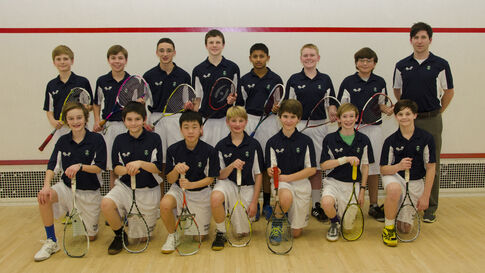
The 2014 Princeton Academy squash team includes (back row) Alexander Schade of Hopewell, Andrew Tokarski (Princeton), Nicholas McLean (Princeton), Robert Vogel (Yardley, Pa.), Raghav Pemireddy (Somerset), Stefan Reutter (Princeton), McKenna Palmer (Skillman), coach Matt Trowbridge and (front row) John Paul Jeanes (Princeton), Chase Pratt (Hopewell), Christian Bae (Pennington), Alexander Kurowski (Skillman), Alec Papanicolaou (Skillman), Henry Howe (Princeton) and Conrad Ketting (Princeton).
Three years ago, Matt Trowbridge wanted to elevate his Princeton Academy of the Sacred Heart squash club to the next level: he and his players spent their Saturday mornings honing their skills at The Lawrenceville School’s courts, but that wasn’t enough.
So Princeton Academy established squash as an official school sport in the winter of 2010, and the elevation continued all the way up to this season, when the team completed an undefeated regular season and finished fourth out of 16 teams at the National Middle School Squash Championships in New Haven, Conn., its best finish ever.
“It was a great feeling to know that we were the best team this season,” sixth grader and Pennington resident Christian Bay said.
Squash is a racquet sport played by two or four players. Matches are contested in four-walled courts, and the ball, which “squashes” when it’s hit with the racquets, is small, hollow, and made of rubber. The higher the skill of the players, the squashier and therefore slower the ball that is used. It’s similar to other games, such as racquetball, and played with stringed racquets not unlike tennis rackets, although there are differences.
The boys, ranging in age from sixth to eighth grade, had few local opponents during their first two seasons and had to seek competition in Philadelphia. Since then, though, Princeton Day School started a team. The Great Road neighbors square off twice a season, and the Academy also faces Princeton Junior Squash and some Pennsylvania teams.
“The first year, it was sort of touch and go,” Trowbridge said. “We had a lot of support from our athletic director, and the headmaster was really interested in it as a full sport. I played squash in high school and a little bit in college. I knew that it was possible. We had to make long afternoon trips in the first couple of years.”
More local matches allowed the team to get more playing time in. Several of the athletes also compete in tournaments and play with clubs like Lawrenceville and Princeton Junior Squash outside of school, and Trowbridge, a Princeton native and resident, said that has had a major impact on the team’s collective ability.
“The fact that they have put more time in on their own and are more serious about it in the time that we’re able to offer them four nights a week, we’re really blessed to be able to do that,” he said. “They take it seriously, and we’ve got results. The proof is in the pudding. We were able to win some close matches as a result of that.”
Three eighth graders—Henry Howe of Princeton, Bobby Vogel of Yardley, Pa. and Nicholas McLean of Lawrence—have been with the team since its first year, and Trowbridge said they make up a core group that is key to the squad’s continued growth.
“If you had told me four years ago that I would witness a challenge match like the one between Bobby and Henry in January … it looked like a high school-level match,” he said. “It was awesome. It was the type of match that was no longer coaching youth squash. I was just witnessing a great match.”
Howe and Vogel both had no squash experience before joining the team, while McLean had played recreationally for a few years. At number three, Bay is the youngest player in the team’s top five.
As the team’s number one, Howe was always tasked with facing the opposing team’s top players, some of whom were nationally ranked and the majority of whom have played the sport “since birth,” Trowbridge said.
Howe said it was easy to get intimidated, but setting small goals before matches helped him focus without worrying about the end result.
“I’ll say that I want to get three points off this guy if he’s really good, or win a game,” Howe said. “Just setting small goals helps in the long run, but it’s definitely hard once you’re getting demolished.”
Trowbridge said while squash is largely an individual sport, there is a definite team aspect that he saw resonate throughout his squad, especially during tough games.
“The team element has been really helpful just in terms of not getting bummed out,” he said. “You might get smushed, but then we have the team result to focus on.”
McLean agreed. “If you win, it’s going to do no good if your teammates don’t win,” he said. “No one’s going to remember if you won. People are going to remember the match itself. The only thing you can do after you win or lose is just root for your teammates.”
Alex Schade, a sixth grade student from Hopewell, sees comparisons between squash and other scholastic sports.
“We made it into a team sport,” he said. “We were all chanting at each other, hugging them when they won, pats on the back if they lost. It’s kind of like cross country. You’re basically running against yourself, but you’re running with your team.”
The team’s unity is even more present at Nationals, where Vogel said it is vital.
“At a normal game, everyone just shows up and they see each other at the game and then they leave afterwards,” he said. “When we went to New Haven, it was different because we were with each other all the time, so it helped strengthen the team bond, and it also helped you get a sense of each other. That really helped the team. It helped you stay focused on the games better, because you were always with your teammates even though you’re not playing with each other on the court.”
McLean said he couldn’t keep his mind off of the court in that environment.
“Even when you’re not playing squash, when you go out to dinner, when you have breaks, you never stop thinking about it,” he said. “You can never kind of get away and let your mind go blank. It seems like you always have another match coming up. Even when you’re done, you’re never really done.”
All that thought paid off. It was up to McLean to win his game in the last match of the season to preserve the undefeated record. He took it down to the wire and won.
“Nicholas always had us on edge because he likes to take all of his matches to five games,” Trowbridge said. “He doesn’t seem like he does, but he really does [like the suspense].”
Once he won, though, the squad took a collective breath and celebrated.
“It was one word: unbeatable,” Schade said. “Our chant at the last game was ‘go for gold,’ and we did go for gold.”
,

