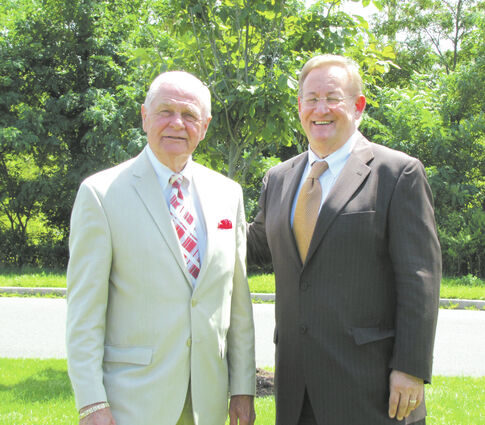
Former Ewing mayors Jack Ball, left, and Wendall Pribila.
Interview by Joe Emanski and Bill Sanservino
The first edition of the Ewing Observer, published in September 2003, featured a Q&A with then-Mayor Wendell Pribila. On the occasion of its 10th anniversary, the Observer sat down with both Pribila and former Mayor Jack Ball for an informal Q&A session, of which this story is an edited transcript.
The pair has kept busy after leaving office. Pribila, 63, currently runs two businesses: a financial advisory firm called Wealth Management Partners, and a medical diabetes diagnostic company located in Indianapolis, called Intervention Diagnostics. Pribila became mayor in 2000 after Al Bridges, the township’s first directly elected mayor, resigned during his second term due to personal issues. Pribila served through 2006, when he opted not to run for reelection.
Ball, 70, a former Trenton public school teacher, served as mayor fr0m 2007-2011. He and his wife, Marcia, have managed the Trenton Farmer’s Market for 34 years.
The former mayors stopped by the Observer office to discuss what they’ve been up to in recent years, talk about what its like to be the mayor, and generally reminisce about the past.
Ewing Observer: Jack, the Trenton Farmers Market has changed a lot over the years, but at the same time it feels like it hasn’t changed at all.
JB: I think we have a great diversity of products to offer to people, including a number of Amish dealers, who have attracted a great number of people to the market.
EO: About the Amish. How did that come about? Do you go out and recruit them, or did they contact you?
JB: It all started with Cartlidge’s Meats. There was a fellow named Jim Cartlidge, and Jim was there for many years running the meat stand. He actually managed to get the first Amish dealer there to purchase his business.
After his business was purchased by the Amish, the father-in-law of the fellow came in and took over the chicken department in the east wing of the market. That was the second Amish dealer.And then, the fellow that owned the meat stand decided to buy the peanut shop next door to him, so he now has two spots. And his uncle decided to come our way and open the bakery. It was like a domino Amish effect. (laughs)
Two other people who are not Amish — they’re Mennonite — run the Amish Country Store and Curly Jake’s Soft Pretzels. They’re both new to the market this year. We’ve had some people retire, and those that retired were great and those that have come in are equally great. So we’re really fortunate.
That’s basically how I’ve been keeping busy. I still am involved in the township. With respect to the Ewing Talent Show, we’re starting on our 10th year. In fact, this past Sunday (Aug. 11) I had a cookout at my house for all of the people that are members of the talent show committee. They don’t get paid, so I wanted to treat them. I wanted to thank them for all they do to help me with the show.
EO: Wendell, after you were no longer mayor you took a pretty big step back from political life.
WP: Politically, I’ve retired. Recently, I’ve had some inquiries about whether I’d be interested in coming back, mostly on a county or another level, but I said no.
I’ve got two businesses, and I volunteer my time. I’m on the board of directors at St. Francis (Medical Center). I share my time with Catholic Charities and to a lesser degree with the (American) Cancer Society and a few other small entities. I just don’t have the time for politics. Plus, I spend a lot of time with my six grandchildren.
I stay in contact with the current mayor and the current business administrator and some of the county folks. Believe it or not, I have as many close friends on the other side of the aisle as I have that are Democrats. Sen. (Peter) Inverso is a dear friend of mine. I’ve had dinner with the mayor of Hamilton several times — Mayor (Kelly) Yaede.
EO: Tell us about the hours the mayor puts in.
WP: When I was mayor I was there, even though I had a full time job elsewhere, (I was there) from 6 a.m. until 10 a.m., and then I was back at 3 p.m. until whatever time I had to be. They can say what they want, it’s a not a part-time job, it really isn’t.
JB: Yes. It’s part-time pay for full-time work.
WP: Someone like the current mayor (Bert Steinmann), who is retired, probably has an easier time with time management than we did. But for me, I was fortunate to have a partner who took care of the financial advisory end of the business. Ultimately, though, three jobs were one too many.
EO: Do you remember back to those first days of being mayor, what that was like?
WP: The biggest asset I had was a man called Fred Walters (the township’s long-time business administrator). One of the reasons I was in there at 6 a.m. was because Fred was there. I was in Fred’s office just trying to absorb everything that he was doing. I was his puppy. Where he was, I was.
Al (Bridges) had basically walked away from the job. Eventually, I branched out, but there was a period of time at the beginning where there was a large learning curve.
EO: Did you feel that the situation, with Bridges resigning, made the job more difficult?
WP: At the time that I took over, nobody knew what was going on with Al. He said he was retiring to spend more time at The College of New Jersey, where he was a vice president. It was only a short time after that that some of his issues began to surface.
As far as Al was concerned, I don’t know what he did or did not do (as mayor). If I came to work for you guys, I would try to absorb everything that you do and how I would be fitting into what you do. That’s basically what I did when I became mayor. I was on council a couple of years before, but that’s not nearly anything close to being what a mayor is.
EO: Jack, you were not on council when Al stepped down.
JB: No. I served with Al from 1990 to 1993, and that was under the old (township committee) form of government. I was mayor in ’92 and ’93, and Al was a committeeman then. At that time, the mayor ran the meetings, like the council president does now.
Al Bridges, and all the Democrats that I worked with at the time, got along really well. Blacey Cammarata was the chairman of the Democratic party at the time, and even Blacey and I got along really well. Some of my Republican counterparts were not really happy with me because I got along so well with Blacey.
Anyway, that’s when Al and I served. He was always a gentleman. The nicest guy you could talk to. Well spoken. Just a super nice person. He would give his all for the people of Ewing, without any doubt.
EO: Tell us about the experience of being a public figure.
WP: Unlike Jack, being a teacher—where you’re starting from a young [age] in front of an audience—it was frightening. I went to a number of people that worked with public speakers, and they assisted me. We would sit and rehearse a speech, and they would tell me about inflection and where I should be raising my hands or shouldn’t. But after the first few times, it wasn’t bad.
The first annual meeting I had after becoming mayor — it was at the college — I mean, I was scared as all get out. But after the speech and the questions, it was like, “Hey, this isn’t so bad.”
One of the places I actually miss not being mayor is going to St. John’s Baptist Church. And also Shiloh, down in Trenton. You’d go there and they would escort you to the front pew. The first time, you’re sitting there and praying—I can’t sing and I have no rhythm, so I just sat there— but then they turned to me and said, “And now we’re going to have a few words from the mayor.” And I was like, “Really?”
So after that, I, mean, came prepared. I would go there once a month or once every six weeks, and I would always have something in my pocket to speak about.
Now, I’m a Catholic, and I don’t think I’ve ever heard a Catholic priest talk about politics from the pulpit. But (at St. John’s), that was part of their Sunday worship. They’ll get up, especially around election time, and they will advocate. There was a person there, (Republican) Jerry Ball. He was an elder in the church. And the minister would say, “That’s who you want to vote for,” and he’d point at me. I felt bad for Jerry. I was like, “What’s going on?”
JB: I also spoke at St. John’s, and Rev. Jackson and I did get to be friends and it was always fun to go there. I’d be sitting in the audience and Rev. (Vincent H.) Jackson would be standing at his pulpit and he’d go, “Brother Ball! Come on up here!”
I’d go up, and I’d be like, “I’m getting an opportunity to speak from the reverend’s pulpit.” It was really a great feeling, and an exciting time. I just enjoyed talking to the people.
Wendell mentioned my friend Jerry Ball. Well Jerry taught me a prayer — I don’t know if I can still remember it now — but nonetheless, I had it down pat at that time, and I’d end whatever I had to say with that prayer, and I think people really liked that. I guess I got through to the people that way that they saw that I was kind of a human being and was even reaching out to pray the way that they do.
EO: Did you perform any weddings?
WP: I performed over 100 weddings.
JB: I did, and one night I decided to just sit down and count them up, because we kept a receipt for each wedding ceremony that we did. I counted, I believe, 195 or 197, somewhere in that range, in the four years. And when I was mayor in ’92 and ’93, there was another 100. So I was averaging about 50 weddings a year. That’s one a week. Including civil unions too — in this last stretch — not in the first two years.
It was one of the nicest things that we had to do as mayor. It was one of the more fun things that you got to do. Everybody was happy, everybody was smiling. Nobody was worrying about any kind of politics. You were just doing a wedding ceremony and people were happy, and happy to be there, and very complimentary and friendly.
EO: The people of Ewing can be passionate about issues they believe in. What is it like trying to keep them happy?
JB: I would give out my cell phone number. I put it in your paper, I put it in the Times, the Trentonian, I’d do it on TV with WZBN. I’d give it out wherever I spoke, I’d end my speech with, “Here’s my cell, call me.” I spent hundreds of hours a week on that cell phone — the town paid for that, that was one of the things they did pay for— and I felt, (because of that) there was no way I could ever lose an election. But I lost.
Every month I would have a mayors meeting at town hall. Everybody was invited. It would be in the paper for people to come and air their concerns or bring their issues. and we did that pretty much all my four years.
WP: You try to understand what the issue is. Sometimes they just want to vent. But if it’s a legitimate, and even if it’s not legitimate, you try to take are of the matter as best you can.
EO: Wendell, you didn’t go to council meetings at mayor, but Jack did, which was controversial at times.
JB: It was very controversial, especially when I first started, because the council was made up of four Democrats and one Republican, and I am a Republican. And we had gotten into a little bit of a match where I would raise my hand to speak. I wasn’t really asking to sit up with them; I was still in the audience.
But they wouldn’t let me speak. One night, I just got a little upset and threatened to take them all to court and sue them. I have a perfect right to speak, not only as the mayor but (also) as a resident of the town. So shortly after that, it was arranged for me to sit right with the council and to have an opportunity to be there.
There were some people in the audience — I’m not going to mention names — but they would attend all the meetings, and they would take it upon themselves to beat me up at every meeting. One of them would say to me, “Jack, you come to every meeting, you come here to get beat up?” I said, “Well, I guess I do.” But I’m not afraid to take it, and I did.
There was one time I remember where a woman, she went off. She was screaming at me for seven or eight minutes, and I’m not exaggerating. I mean screaming at the top of her lungs.
EO: What was it about?
JB: Everything that I’m doing wrong.
WP: Did it matter?
JB: I mean, really. And I just sat there and I took it. Joe Murphy was running the meeting at that time, he was acting president of the council, so when she finished, I just turned to Joe, and I said, “Mr. President, would you allow a resident to speak to you like that?” If he really wanted to, he could have stopped that woman from badgering me.
WP: But our Ewing residents are very passionate, and as Jack has said, whether it’s Democrats attacking him or Republicans attacking me — they are there for their own agenda, plus sometimes the party’s agenda.
JB: You’ve been at those meetings where you were screamed at. I remember Fisher Middle School where they were screaming at you.
WP: (needling) You were one of the ones screaming.
JB: I didn’t scream at you — I just said, “Mr. Mayor, are you having a rough day?” (laughs)
WP: But the point of the matter was, that’s the way it’s been. And I applaud you for extending yourself, Jack, but I still believe council meetings are for council meetings, not for anybody to beat you up.
JB: I understand. But I was only there to try to help them.
EO: Tell us about the people who were there to support you.
WP: People complain about government employees, (but) I found that the vast majority of Ewing employees were great. You find the exceptional one who’s always looking to work the system, but I bet if you looked in your little universe you’d probably find one or two of those (as well). By and large I felt the employees were phenomenal. [Jack and I] came and went; they were (always) there. And if you could prove you were there to help them, they were very supportive.
JB: When I became mayor, I had the opportunity to hire my own administrator. My administrator was good, Dave Thompson. Dave had his little idiosyncrasies but he was very passionate about the job and always did what he thought was best for the town.
I will be forever grateful to Michael Hartsough. Michael was our township attorney. Mike was just a person that really took a great interest in the job. As the attorney he actually worked on the items that had to do with the township so when he spoke at a council meeting, Mike knew every inch of what he was talking about.
And Don Cox was also and still is a great friend. He’s pretty much how I got started in politics, which goes way back to 1980, I guess. His wife and I worked together at the City of Trenton, we were both math teachers. I said to her, Vi, I’d really like to get involved with the township, run for the school board. Well, that night, by seven o’clock her husband was knocking at my door, Don Cox. He had all the papers, all the forms. So that I could get started. And we’ve been friends ever since.
EO: Why did you become involved in local politics?
JB: I think it’s the love of your community. For me, the nicest thing was the opportunity to work with a lot of different people in the town and to hopefully try and make a little bit of a difference, to make your town the best it could possibly be. For me, starting what we called the Concerts in the Park which I did for the four years I was mayor, that was a fun thing. It was great to see the seniors come out, and even some of the young parents with their children, just enjoy that music. It’s not a big deal but it’s still making your town a little bit more fun.
WP: Everything that Jack said is very truthful. I was raised in a coal regions of Pennsylvania, raised in a Polish —
JB: Don’t start talking about that kielbasa now. (laughs)
WP: No, but I make it!
JB: I know you do. We’re both Polish, you know.
EO: Wendell, where did you grow up?
WP: Summit Hill. The Polish nuns taught me to go out and volunteer. My father (Wendell), who was a coal miner and an amputee, was out running the Little Leagues as a handicapped person. When I came down here, I ran the Little Leagues for 11 years, Babe Ruth for five or six years. This was just the natural progression. It’s an opportunity to help individuals, but an opportunity also to help the community.
I’m proud of the economic development that we started. The first hotel (Courtyard by Marriott). The Home Depot (on Olden Avenue), the redevelopment of ShopRite. A whole host of other economic development that we started. Atchley Farms, we got approved for 775,000 square feet of A1 commercial, we’ve got about 60 percent of that done now. That was helping people, helping the community.
EO: Jack, you were born in Trenton?
JB: I was born in the City of Trenton. Home Avenue. At age 11, we moved to Hamilton. At age 21, when I got married, we moved to Ewing. We’ve been in the same house going on 49 years. Been married 48 as of this past June. Married in ’65, and I had to pay a fortune to have that home built — $17,800. Paid $500 extra for a fireplace, and $1,000 extra for a garage. And that included the land, $17,800. My taxes and mortgage were $118 a month. I was teaching in a Catholic school and making I think $4,200 a year.
But we talked about the community, and I would like to also offer congratulations for the Ewing Observer for their 10 years now of serving the community, letting Ewing people know what’s taking place in our town. We talked about good additions to the town, that’s a great addition to the town.
WP: I would like to concur, and also add that you are an informational community newspaper, not a controversial newspaper, and I don’t need to qualify why I said that. You came at the right time, and kudos to what you’ve done. With this model, you’ve been a success around the county.
EO: Thank you to you both for talking with us. It has been a pleasure catching up with you.
,

